
You know the look.
The flatness in their eyes. The way they avoid your gaze when they say, “I’m fine.” The quiet tension in their body when you ask if they’re really okay.
You’ve seen this before—maybe more than once.
And even though your son or daughter is technically an adult now, you still feel every twist in your gut when something isn’t right.
You’re not overreacting.
You’re not being controlling.
You’re a parent whose child is hurting again. And whether they’re 17 or 27, watching them spiral is one of the hardest things a parent can endure.
If your young adult child is using again—or hasn’t found stable recovery after treatment—a partial hospitalization program (PHP) might be the support you both need. Not just for them. For you, too.
Places like Greater Boston Addiction Centers offer PHP services in Boston and nearby cities like Needham that are built to meet families where they are—mid-crisis, emotionally depleted, and unsure where to turn.
It’s Not About Blame—It’s About Support That Works
Maybe your child already went through a detox or rehab program. Maybe they’ve white-knuckled it for months only to slide back again. Or maybe they’ve never really admitted how deep the problem goes.
You’re doing everything you can.
But love alone doesn’t detox a brain. And being there, while essential, isn’t the same as getting help.
PHP offers structured, daily support for young adults struggling with addiction or co-occurring mental health issues—especially those who need more than outpatient therapy but aren’t ready (or willing) to enter inpatient care again.
What Is a Partial Hospitalization Program?
A partial hospitalization program is an intensive, short-term treatment option for people who need focused care but don’t require overnight supervision.
In most PHPs, your child would:
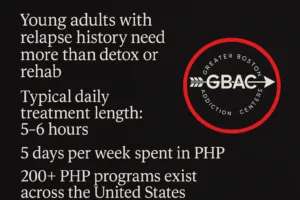
- Attend treatment 5–6 hours a day, 5 days a week
- Return home or to a sober living environment each evening
- Participate in group therapy, individual therapy, and psychoeducation
- Receive clinical support for both addiction and mental health conditions
Unlike inpatient care, PHPs give young adults a chance to stay tethered to their everyday lives—while doing the deep emotional and behavioral work recovery demands.
And unlike outpatient therapy alone, PHP provides real momentum and accountability.
Why PHP Is Especially Effective for Young Adults
Young adulthood is often a confusing emotional landscape. There’s pressure to be independent, functional, and socially connected—but developmentally, the brain is still maturing until around age 25.
This means that your child:
- May intellectually understand consequences, but still act impulsively
- May want to change, but feel emotionally overwhelmed
- May reject your help, while also craving your presence
A PHP meets them at this intersection of resistance and readiness. It offers enough structure to interrupt destructive patterns—without demanding full disconnection from the world they’re trying to live in.
And when the program is trauma-informed, age-relevant, and led by clinicians who get this developmental window? It works.
What PHP Looks Like Day-to-Day
At Greater Boston Addiction Centers, the PHP model includes:
- Morning check-ins and mindfulness practices
- Group therapy sessions (topics may include relapse triggers, emotional regulation, self-worth, trauma)
- Individual therapy sessions (usually once or twice weekly)
- Life skills development (boundaries, communication, stress management)
- Medication management if needed
- Family therapy or parent consultations (when appropriate)
The goal is not just symptom relief—it’s helping your child reconnect to themselves, their goals, and their values.
For many families, PHP becomes a crucial “reset point” when things are starting to unravel again—but haven’t hit rock bottom.
How PHP Supports Parents (Without Blame)
It’s common for parents to feel like they’re walking on a tightrope. You want to help—but not enable. Be available—but not smother. Set boundaries—but still show up.
That’s why the best PHPs include family support—not to lecture you, but to help you heal and recalibrate too.
You’ll gain:
- Language to talk to your child without escalating conflict
- Support in understanding addiction as a brain-based disorder
- Tools to rebuild trust and protect your own emotional health
- Space to grieve, breathe, and process your own experience
Because here’s the truth:
When your child enters PHP, you enter recovery too—from fear, guilt, helplessness, and hypervigilance.
Who Is PHP For? (And Who It’s Not For)
PHP may be the right fit if your adult child:
- Is using substances again after a prior treatment
- Hasn’t found stability through outpatient therapy alone
- Has co-occurring anxiety, depression, or trauma symptoms
- Still lives at home (or with support) and can attend daytime sessions
- Is overwhelmed, resistant, or emotionally erratic—but not in immediate danger to themselves or others
It may not be the right fit if:
- They are experiencing active psychosis or suicidal intent
- They need medical detox first
- Their living environment is unsafe or triggers relapse
In those cases, inpatient care or crisis stabilization may come first—followed by PHP once things have stabilized.
Common Questions From Parents (Answered Gently)
Will my child actually show up for PHP?
If they’re resistant, a warm handoff or pre-admission consultation can help. Many programs, including GBAC, offer pre-enrollment support to ease the transition. It’s a big step—but it often feels more doable than inpatient care.
What if my child says they don’t need “that much” help?
That’s common. PHP is often more acceptable to young adults because it doesn’t require them to leave their life behind—just to pause, recalibrate, and engage. You can frame it as an intensive check-in, not a punishment.
What if I’m more willing to get help than they are?
You can’t force change—but you can model it. Attend your own therapy. Consult with the PHP team. Let them see you’re investing in your own healing, too. Sometimes, your calm is the bridge they need.
Will this actually work if they’ve already relapsed?
Relapse is a detour—not a failure. PHP helps unpack why relapse happened, what support was missing, and how to rebuild without shame. The goal isn’t perfection. It’s momentum.
What happens after PHP ends?
Most programs recommend a step-down plan—often to an Intensive Outpatient Program (IOP), sober living, or regular therapy. PHP is a launchpad, not the finish line.
You Are Not Alone—Even When It Feels Like It
If you’re still reading, chances are you’re carrying something heavy:
Guilt. Hope. Exhaustion.
The ache of loving someone whose life is drifting.
Just know this:
- You are allowed to be tired and still be a good parent.
- You are allowed to need help—even if your child isn’t ready to ask for it yet.
- You are allowed to take the first step, even if they’re afraid.
Because your love is fierce. And your hope is not foolish.
Ready to take action that feels right for both of you?
Call (877) 920-6583 to learn more about our partial hospitalization program services in Boston, MA. Help is here—for them and for you.