

The diagnosis made everything make sense.
And at the same time, it made everything feel fragile.
If you’ve just been diagnosed and someone is already talking about medication, you might feel cornered. That tightness in your chest? That fear of losing yourself? We see it often.
At Greater Boston Addiction Centers, we’ve walked alongside many newly diagnosed individuals who weren’t ready to say yes to medication—but were willing to say yes to cbt.
This is one of those stories.
The Diagnosis Was A Relief—And A Shock
When she first came in, she wasn’t resistant to help. She was overwhelmed.
Months of racing thoughts. Sleepless nights. Waves of panic that came out of nowhere. Self-criticism so sharp it felt like truth.
When the clinician said “anxiety disorder,” she cried.
Not because it was devastating—but because it finally had a name.
But the next sentence shifted everything:
“We should talk about medication.”
Her body stiffened.
“What If Medication Changes Me?”
She didn’t argue. She didn’t storm out. She just got quiet.
Later, she admitted what she was really afraid of:
- What if I feel numb?
- What if I lose my creativity?
- What if I don’t recognize myself?
- What if I can’t stop once I start?
These weren’t dramatic fears. They were identity fears.
When you’re newly diagnosed, you’re already trying to reconcile who you thought you were with what you’ve been experiencing. Adding medication into that mix can feel like surrendering control.
So instead of pushing, we slowed down.
And we talked about CBT.
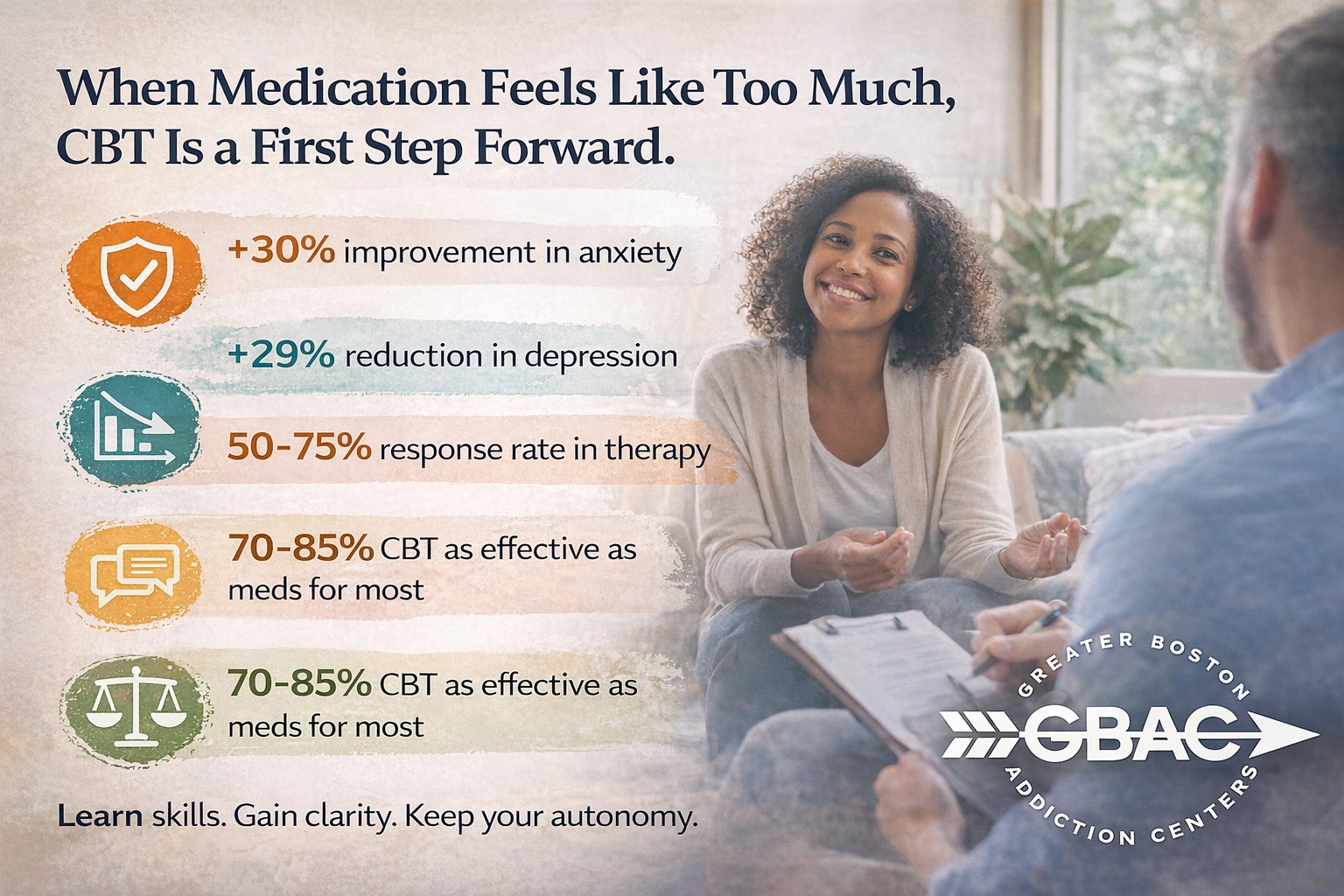
Why CBT Felt Like A Safe First Step
CBT didn’t promise to “fix” her.
It promised to help her understand her mind.
That difference mattered.
In CBT, we explore how thoughts, emotions, and behaviors connect. We examine automatic beliefs. We challenge distortions. We build skills.
No one takes anything away from you.
You learn to work with what’s already there.
For many newly diagnosed individuals—including those coming from communities like Dorchester, Massachusetts—that sense of agency is powerful. Therapy becomes a place of exploration, not erasure.
And for individuals seeking support near Dedham, Massachusetts, CBT offers a structured, evidence-based path forward without immediate pressure to medicate.
Saying yes to CBT often feels like saying yes to yourself—not surrendering to a system.
The First Time She Challenged A Thought
The shift wasn’t dramatic.
It happened on a random Tuesday.
Her mind told her, “If you speak up in class, you’ll embarrass yourself.”
Normally, she would have avoided raising her hand. Avoidance had been her coping strategy for years.
In CBT, she learned to write down the automatic thought. Label it.
Catastrophizing.
Then ask:
- Has this happened every time before?
- What’s another possible outcome?
- What would I say to a friend in this situation?
She still felt anxious.
But she spoke anyway.
Nothing catastrophic happened.
That experience didn’t cure her anxiety. It introduced doubt into the certainty of her fear.
And doubt is powerful when fear has been absolute.
CBT Helped Her Separate Identity From Symptoms
One of the most painful parts of being newly diagnosed is the identity confusion.
Am I anxious?
Or do I have anxiety?
Am I broken?
Or am I struggling?
CBT helps create distance between a person and their symptoms.
Instead of “I am a failure,” it becomes, “I’m having a thought that I’m a failure.”
That linguistic shift sounds small. It’s not.
It creates space.
Space between self and symptom.
Space between fear and fact.
And in that space, healing begins.
When Therapy Became Deeper Than Coping
At first, CBT was about immediate relief—reducing panic attacks, managing rumination, interrupting spirals.
Over time, it became something else.
We started exploring:
- Where did these beliefs originate?
- When did self-criticism become the default voice?
- What happens when you don’t immediately obey anxiety?
CBT isn’t just about challenging thoughts. It’s about practicing new behaviors. Exposure. Emotional tolerance. Boundary-setting.
She began to notice she wasn’t just managing anxiety. She was building confidence.
That’s different.
The Medication Conversation Revisited
Months into CBT, something shifted.
Not her diagnosis. Not the suggestion of medication.
Her confidence.
When her psychiatrist revisited the option of medication, she didn’t feel cornered. She felt informed.
She understood her patterns. She knew her triggers. She had skills.
The conversation became collaborative instead of frightening.
In some cases, CBT alone provides significant improvement. In others, therapy and medication together create the most stability.
The key is choice.
CBT gave her the grounding to make that choice from clarity—not panic.
When Higher Levels Of Care Are Needed
For some newly diagnosed individuals, symptoms escalate beyond what outpatient therapy alone can manage.
If safety becomes a concern, or if symptoms severely impair functioning, CBT can be integrated into more immersive treatment plans, including support in Residential settings.
That doesn’t mean you failed. It means you need containment while you stabilize.
But not everyone needs that.
Sometimes the first brave step is simply sitting in a therapy room and saying, “I’m scared.”
What Saying Yes To CBT Really Means
It means you’re willing to look at your thoughts instead of being ruled by them.
It means you want tools before prescriptions.
It means you want understanding before intervention.
CBT is structured, yes. Evidence-based, yes.
But more than that—it’s human.
You and your therapist sit together and gently question the stories your mind tells.
Over time, those stories lose their authority.
Frequently Asked Questions
Is It Okay To Try CBT Before Medication?
Yes. For many individuals, starting with therapy is appropriate—especially if symptoms are moderate and safety is not at risk. Treatment plans should be collaborative and individualized.
Does CBT Work For Anxiety And Depression?
CBT is one of the most researched and effective therapies for anxiety, depression, and related conditions. It focuses on identifying and restructuring harmful thought patterns while building coping skills.
What If Therapy Isn’t Enough?
If symptoms persist or intensify, additional interventions—including medication or higher levels of care—can be explored. Choosing CBT first does not close other doors.
Will CBT Change My Personality?
No. CBT helps you challenge distorted thinking and develop healthier coping strategies. It does not alter your identity or suppress your emotional range.
How Long Does CBT Take To Show Results?
Some individuals notice small improvements within weeks. Deeper change typically occurs over several months of consistent engagement.
Can I Combine CBT With Medication Later?
Absolutely. Many individuals begin with therapy and later choose to incorporate medication once they feel more informed and comfortable.
If you’re newly diagnosed and scared of medication, you’re not irrational. You’re human.
You’re trying to protect your identity. Your creativity. Your sense of self.
Saying yes to CBT doesn’t mean saying no to everything else forever.
It means starting where you feel safe.
And sometimes, that first yes—to understanding your thoughts instead of fearing them—is what opens the door to lasting stability.
Call (877)920-6583 to learn more about our Cognitive Behavioral Therapy in Boston, Massachusetts.
