

You might be reading this with your heart in your throat. Maybe someone just said the word “addiction” out loud for the first time—maybe it was you. Maybe you sat across from a doctor who gently introduced the idea of Medication-Assisted Treatment (MAT), and now you’re home, scrolling, unsure what to feel.
Let me start here: being scared doesn’t make you weak. Wanting more information doesn’t mean you’re resisting recovery. And if part of you wants to get better but another part is terrified of what that might look like—you’re human.
As a clinician, I’ve had this conversation more times than I can count. I’ve watched people wrestle with the idea of taking medication for substance use—worried they’d lose something essential about themselves. I’ve also seen what happens when fear doesn’t get the final word: people who felt unsure take a small step, find a little relief, and eventually start to feel like themselves again.
This is your guide—not to pressure you, but to walk beside you as you explore what’s possible.
You’re Not Alone in This Uncertainty
The first time you hear the phrase “Medication-Assisted Treatment,” it might land with mixed feelings: confusion, relief, skepticism, fear. Some people imagine methadone clinics or side effects they’ve heard horror stories about. Others think MAT means giving up or “taking the easy way out.”
But that’s not what modern MAT looks like.
At Greater Boston Addiction Centers, we understand that every person’s recovery is personal. If you’re newly diagnosed and uncertain about medication, that doesn’t mean you’re in denial—it means you care about what comes next. That awareness is a powerful starting point.
What Is Medication-Assisted Treatment Really?
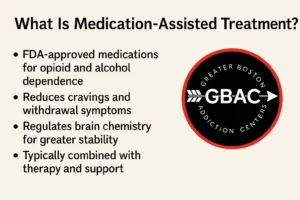
Let’s get clear on definitions. MAT is a clinical approach to treating substance use disorders, particularly opioid and alcohol dependence, using FDA-approved medications alongside therapy and psychosocial support. It’s not a “pill fix.” It’s a support system—for your body, your brain, and your emotional stability.
When someone uses substances regularly, the brain’s chemical balance is disrupted. Cravings, withdrawal symptoms, and emotional volatility can make it feel impossible to stop using—no matter how much you want to. MAT helps by regulating that chemistry.
Here’s what that can look like:
- Reduced cravings so you can focus on living
- Fewer withdrawal symptoms, meaning less physical distress
- Stabilized mood, sleep, and cognition so you can function at home and at work
Think of it as stabilizing the ground beneath your feet. Once you’re not constantly bracing for impact, it’s easier to move forward.
MAT Doesn’t Take Away Who You Are
A fear I hear often is this: “Will this change me?”
That fear is real. Especially if you’re someone who connects their identity to creativity, connection, performance, or even chaos. If substances have been part of how you cope or express emotion, it makes sense to feel unsure about changing that.
But what I’ve seen time and time again is that MAT doesn’t make you less yourself—it helps you reconnect to the parts you thought you lost.
You don’t become someone else. You become someone more present. More grounded. More able to feel things without being overwhelmed. The medication isn’t the end—it’s the beginning of being able to build something that lasts.
Fear of Medication Is Common—and Valid
If you’ve been scared to start MAT, you’re not the only one. I’ve sat across from teachers, engineers, parents, college students, and creatives—all struggling with the same fear: “What if this makes things worse?”
It won’t.
At Greater Boston Addiction Centers, we start slow. We assess your specific situation, your substance use history, your health needs, and your goals. You’ll be involved in every decision. You’ll never be forced into a plan that doesn’t make sense for you.
And you can stop at any time. MAT is not a life sentence. It’s a tool—one you get to hold, use, adjust, and let go of when the time is right.
The Unknown Feels Bigger Than It Is
When we talk about starting MAT, we’re not asking you to leap off a cliff. We’re inviting you to take one small step into safety.
That might mean:
- Showing up for a first consult with a provider
- Asking questions about medications and side effects
- Trying a low dose and seeing how your body feels
- Checking in weekly to adjust and recalibrate
Each step makes the next one feel more doable. And before you know it, you’re no longer walking alone.
If you’re looking for Medication-Assisted Treatment in Newton or nearby areas like Waltham, our team can help you start gently—with no pressure, and a lot of compassion.
Everyone’s Path Through MAT Is Different
Some people stay on MAT for a few months. Others for a year or more. Some combine it with therapy, peer support, or outpatient groups. Some keep their treatment entirely private. Others talk openly about it to reduce stigma.
What matters is that your path is yours. There’s no one right way to recover. What matters is that you feel supported, safe, and seen.
Expanded FAQs: Answering the Hard Questions Gently
Will I have to be on medication forever?
No. Medication-Assisted Treatment is flexible. Some people use it for a few months, others for longer. The goal is always to create stability—then, if and when you’re ready, taper safely. You’ll never be stuck in a plan you don’t agree with.
What if I feel weird or numb on the meds?
It’s okay to notice those feelings. Some adjustments might be needed at the start. Your provider will work closely with you to ensure you’re not overmedicated or feeling flat. Most clients report feeling more like themselves as cravings and anxiety decrease.
Is MAT just replacing one addiction with another?
No. That’s a common myth. The medications used in MAT (like buprenorphine or naltrexone) do not produce a high when used as prescribed. They’re medically monitored, designed to reduce harm, and restore function—not create dependence.
Will people judge me?
They might—but your health matters more than their misunderstanding. More importantly, the tide is turning. More families, employers, and providers recognize MAT as legitimate, evidence-based care. You’re not alone, and you’re not doing anything wrong.
Can I keep working or parenting while on MAT?
Absolutely. That’s one of its main strengths. MAT is often provided in an outpatient setting so you can stay engaged with your life while you heal. Many clients report better focus, better sleep, and improved relationships once treatment begins.
What if I try and it doesn’t work?
That doesn’t mean you failed. It just means we try something else. Healing isn’t linear—it’s responsive. Our team is here to adjust, reassess, and support you through every stage.
What I Tell Every First-Time MAT Client
You don’t have to feel 100% ready. You just need to be willing. That quiet willingness—no matter how small—is what opens the door.
And when you walk through it, even slowly, we’ll be there. You’ll meet providers who listen. Staff who see the whole you—not just your diagnosis. You’ll get options. Honesty. Permission to feel however you feel.
And maybe—for the first time in a long time—you’ll feel like healing is actually possible.
It Starts with a Conversation
You don’t have to commit to everything today. You don’t have to know the whole road. Just take the next small step. Ask a question. Schedule a call. Breathe.
We’ll meet you where you are—with clarity, kindness, and care that honors your pace.
Want to talk to someone who gets it?
Call (877) 920-6583 or visit our Medication-Assisted Treatment services in Boston, MA. We’re ready when you are—no rush, no pressure, just support.
