

You stopped showing up.
Maybe you meant to call. Maybe you didn’t. Maybe one missed group turned into three, and then it just felt easier to disappear.
If you stepped away from our intensive outpatient program — or any intensive outpatient program — we want you to hear this clearly:
You are allowed to come back.
You are not blacklisted.
You are not “that client.”
And you are not beyond help.
This isn’t a door that locks behind you.
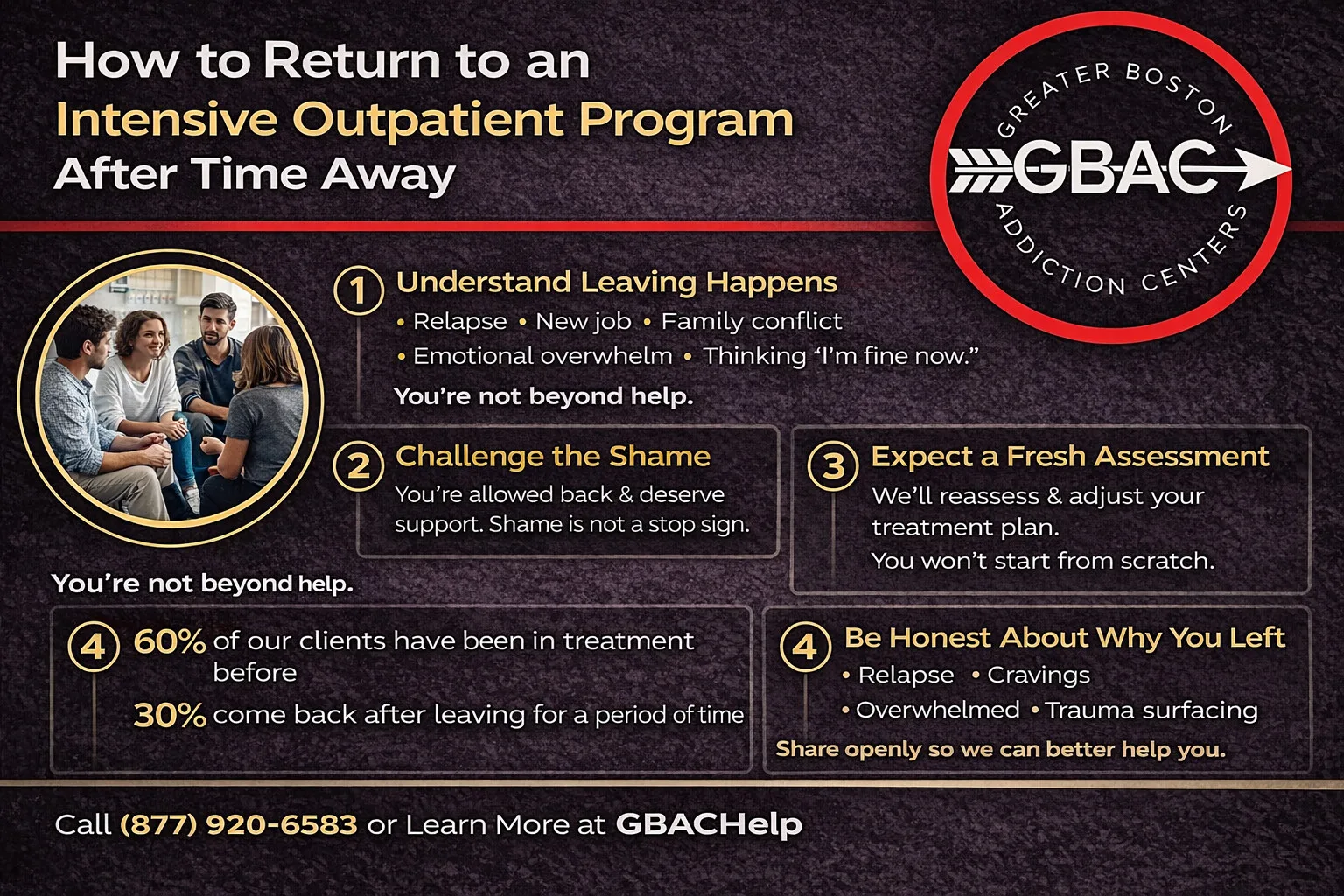
1. First, Understand This: Leaving Happens More Than You Think
People step away from treatment for all kinds of reasons:
- A relapse that brought shame
- A new job that shifted your schedule
- Family pressure
- Emotional overwhelm
- Fear of going deeper in therapy
- Thinking, “I’m fine now — I don’t need this.”
None of those make you hopeless.
An intensive outpatient program is designed to support real life — and real life can get messy. When it does, some people drift.
Drifting is human. Coming back is strength.
One former client told us:
“I didn’t leave because I didn’t care. I left because I cared too much and I was scared I’d fail.”
– IOP Client
If that resonates, you’re not alone.
2. Challenge the Shame Before It Stops You
The biggest barrier to returning isn’t logistics.
It’s shame.
Shame says:
- “They won’t take me seriously.”
- “I already messed this up.”
- “I’m embarrassing.”
- “They probably talk about me.”
Let’s gently correct that.
When someone returns to an intensive outpatient program, we don’t see failure. We see someone who is still fighting.
We understand relapse.
We understand avoidance.
We understand fear.
What matters is not how you left. What matters is that you’re considering coming back.
And that tells us something important about you.
3. Reach Out — Even If You Don’t Have the Words
You don’t need a polished explanation.
You don’t need to justify yourself.
A simple message works:
“Hi. I was in IOP a few months ago. I’d like to talk about coming back.”
That’s it.
We won’t respond with policy language. We won’t interrogate you. We’ll focus on where you are right now.
If calling feels overwhelming, start with a form submission or email. Sometimes the first step back is the hardest. After that, momentum builds.
4. Expect a Fresh Assessment — Not a Restart From Scratch
When you return to an intensive outpatient program, we’ll likely schedule a reassessment.
That’s not punishment. It’s clarity.
We need to understand:
- Have your symptoms changed?
- Have you been using again?
- Are there new stressors?
- Is your risk level different?
- Do you need more support right now?
Sometimes, people who step away realize they need a higher level of care temporarily. In those cases, we may recommend beginning with support in Residential to stabilize before transitioning back into outpatient.
That’s not “going backward.”
It’s strengthening your foundation.
And if outpatient is still appropriate, we’ll adjust your treatment plan to reflect what you’ve learned since you left.
You are not starting over. You are building on experience.
5. Be Honest About Why You Left
We can’t help with what we don’t know.
Did group feel intimidating?
Was trauma work surfacing too much too fast?
Did cravings increase?
Did you relapse and panic?
Did you feel disconnected?
There’s no wrong answer.
The more honest you are, the more tailored your return can be.
Sometimes small changes make a big difference:
- Different group time
- Smaller group setting
- More individual sessions
- Medication adjustments
- Clearer structure around accountability
You deserve a plan that fits you — not one you feel pressured to endure.
6. Start Where You Are — Not Where You Think You “Should” Be
One of the most dangerous thoughts is:
“I need to be fully committed before I go back.”
No, you don’t.
You just need to be willing.
Motivation often follows action — not the other way around.
If you’re unsure, anxious, or even slightly resistant, that’s okay. Many people return to an intensive outpatient program feeling conflicted.
You don’t have to be 100% ready to sit in the chair again.
You just have to show up once.
7. Understand What an Intensive Outpatient Program Really Offers
When you’ve been away for a while, it’s easy to forget what IOP actually gives you.
An intensive outpatient program provides:
- Structured therapy multiple days per week
- Accountability without overnight stays
- Peer support from people who understand
- Relapse prevention planning
- Coping skill development
- Ongoing clinical oversight
- Space to process real-life stress as it happens
Unlike residential treatment, you remain connected to your daily life — work, family, responsibilities — while receiving consistent support.
That balance matters.
Especially if you’ve tried to “white-knuckle” it alone since leaving.
8. Remember: Relapse Doesn’t Disqualify You
If you relapsed after leaving, you might feel like that closes the door.
It doesn’t.
Relapse is information.
It tells us something wasn’t stable yet.
That information helps us refine your care plan.
You are not disqualified from treatment because symptoms returned. In fact, that’s often when support is most needed.
Recovery isn’t linear. It curves. It dips. It surprises you.
Coming back is not proof you failed. It’s proof you’re still trying.
And that matters more than you think.
9. You Won’t Be the Only One Who’s Returned
This may feel uniquely embarrassing to you.
It’s not.
Many of our current clients are on their second — or third — engagement with treatment.
Some left after a month.
Some ghosted mid-week.
Some relapsed quietly and came back months later.
They’re not treated differently. They’re welcomed.
Because treatment isn’t about perfection. It’s about persistence.
And sometimes persistence looks like walking back through a door you once walked away from.
Frequently Asked Questions About Returning to an Intensive Outpatient Program
Can I return to the same intensive outpatient program after dropping out?
In most cases, yes.
Programs understand that treatment engagement can fluctuate. You’ll likely need a reassessment to ensure the level of care is still appropriate, but returning is common and encouraged.
Will I have to start the entire program over?
Not necessarily.
Your treatment plan will be reviewed and possibly adjusted, but prior progress doesn’t disappear. Skills you learned, therapy work you completed, and insights you gained still count.
Recovery builds — even through pauses.
What if I relapsed after leaving?
You can still come back.
Relapse is treated as clinical information, not moral failure. The goal is to understand what contributed to it and strengthen your support moving forward.
What if I’m embarrassed to see the same group again?
This is a very real concern.
Some clients choose to rejoin the same group; others transition into a new group if available. We can discuss what feels safest and most productive for you.
Your comfort matters.
How soon can I restart treatment?
It depends on availability and clinical assessment, but many clients can re-engage quickly — especially if they were recently enrolled.
The best first step is reaching out to discuss options.
What if I think I need more support than IOP now?
That’s okay.
If your needs have changed, we may recommend a higher level of care temporarily — such as residential treatment — before stepping back into outpatient services.
The goal isn’t to place you somewhere restrictive. It’s to match you with what will help you stabilize.
What if I leave again?
This is an honest fear.
Recovery is not about proving you’ll never struggle again. It’s about continuing to seek support when you do.
We would rather you return multiple times than disappear permanently.
If You’re Thinking About Coming Back
You don’t have to draft an apology email.
You don’t have to explain everything perfectly.
You don’t have to feel fully ready.
If you’re even considering returning to an intensive outpatient program, that’s a sign something inside you still wants steadiness.
And that part of you deserves support.
Call (877)920-6583 or visit to learn more about our intensive outpatient program services in Boston.
We’re not here to judge how you left.
We’re here to help you move forward — from exactly where you are.
