

You got sober. You stayed sober. You followed the steps, did the work, maybe even helped others along the way.
But now you’re tired. Not “I need a nap” tired—emotionally worn down. Life feels like rinse and repeat. You’re sober, but not really connected. Not to joy. Not to meaning. Sometimes not even to yourself.
This is what nobody tells you: long-term sobriety can start to feel like a treadmill. You’re moving, but going nowhere. You’ve got milestones under your belt but feel strangely hollow. You’re grateful—but also restless, numb, or disconnected. And that’s the kind of emotional friction that no chip or slogan can fix.
What you might need isn’t another meeting or a motivational quote—it might be a reset at a deeper level. A place to unplug from the noise, confront what’s been quietly draining you, and get real about what recovery looks like now. That’s where our partial hospitalization program comes in.
When You’re Doing “Everything Right”—And Still Feel Off
Here’s the catch about being the strong one, the long-term alum, the person everyone thinks has it figured out: people stop checking in on you. The assumption is, “They’re good.” But you know better. You know what it feels like to stare at a life you built in recovery and wonder, “Why don’t I feel connected to any of this?”
That feeling isn’t failure. It’s feedback.
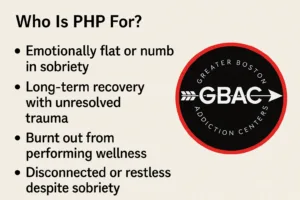
What you’re experiencing is common—especially among people who stayed sober through trauma, burnout, or performance. You survived. You stabilized. But you haven’t yet thrived. And the emotional weight of carrying all that alone is exhausting.
PHP is designed for this exact moment—not to “fix” you, but to wake you back up.
Partial Hospitalization for Alumni Isn’t Backtracking
Let’s dismantle the biggest myth first: enrolling in a partial hospitalization program (PHP) doesn’t mean you’ve failed. It doesn’t mean you’re at risk of relapse. It doesn’t mean you’re broken.
What it does mean is that you’re self-aware enough to know that something inside you isn’t working the way it used to.
PHP at Greater Boston Addiction Centers isn’t just for first-timers or people in crisis. It’s also for alumni who feel emotionally flat, spiritually stalled, or stuck in cycles of numbness. This isn’t rehab 101. It’s deep work for people who’ve done the basics and are ready for what’s next.
We don’t start you over. We meet you where you are—with tools that reflect the complexity of long-term recovery.
What PHP Looks Like for Alumni (and Why It’s Different)
Our partial hospitalization program in Boston isn’t about hand-holding. It’s structured, clinical, and rooted in growth—not survival.
As an alum, your needs are different. You don’t need to learn what a trigger is—you need space to unpack why old patterns still show up in new ways. You don’t need a list of coping skills—you need help applying them when life feels uninspired or directionless.
What we offer:
- 5 days/week of intensive therapy, groups, and clinical care
- Programming focused on depth work—grief, identity shifts, post-acute emotional numbing
- Individualized care plans that speak to long-term sobriety, not early stabilization
- A break from routine that’s still connected to your real life
If you’re looking for a partial hospitalization program in Wellesley or even nearby West Roxbury, this program is built for people who know the language of recovery but need help reconnecting with its meaning.
You Don’t Have to “Crash” to Deserve a Reset
This isn’t about relapse prevention. It’s about re-alignment.
You don’t need to spiral to deserve care. You don’t need to hide your burnout because “others have it worse.” In fact, it’s the high-functioning, emotionally detached folks who often carry the most invisible weight—and wait the longest to ask for help.
But here’s what I see: the ones who do reach out? They don’t just survive recovery—they deepen it.
PHP can help you:
- Reconnect with your own emotional experience
- Address grief, anger, or guilt that never got processed
- Explore your identity outside of “the sober one”
- Set boundaries that match who you are now—not who you were in early recovery
This Is About More Than “Staying Sober”
If the goal was just abstinence, you already won. But you’re here because you want something more. Not just days without substances, but days with substance. And that takes new tools, new space, and sometimes… a new level of honesty.
Here’s what no one brags about in recovery rooms: sometimes, sobriety becomes your new mask. The performance. The routine. The identity. But underneath? You’re still lonely. Still disconnected. Still exhausted from performing okay-ness.
PHP gives you a place to take off the mask. Not forever. Just long enough to remember what you look like underneath it.
FAQ: Partial Hospitalization for Long-Term Alumni
Is PHP only for people at risk of relapse?
Not at all. Our PHP is built for a wide range of needs—including emotional burnout, depression, disconnection, unresolved trauma, and growth plateaus. Alumni who’ve stayed sober for years can still benefit deeply.
Will I lose my job if I enter PHP?
Not necessarily. Many employers support structured outpatient care under FMLA or short-term medical leave. Our team can help you navigate those conversations confidentially.
Isn’t this “too much” if I’m not using?
That’s a common belief—but emotional stagnation is a serious issue. You deserve care before things fall apart. Preventative mental health support is just as valid as crisis care.
What if I’ve already been through IOP or PHP before?
Great. That means you know how to show up—and now, you’re bringing a deeper layer of insight. Alumni often get more out of structured care the second time, because they’re clearer on what they actually need.
How is PHP different from therapy or meetings?
PHP offers a focused, immersive experience. Unlike weekly therapy or peer-led meetings, you get daily clinical support, group process, medical check-ins, and peer accountability—all in a short-term container designed for transformation, not just maintenance.
Do I have to be on medication to enroll?
Not at all. While psychiatric support is available, participation in PHP does not require medication. It’s tailored to your needs, not a one-size-fits-all model.
Final Thoughts: If You’re Feeling Numb, It’s Time to Listen
You didn’t come this far to feel this flat. And you don’t have to settle for a version of recovery that feels like autopilot.
You’re not a beginner. You’re not in crisis. You’re simply ready for more—and that’s one of the most courageous places you can be.
The truth is: you don’t need permission to seek deeper healing. You already know something’s off. Now you get to do something about it.
Time for a real reset?
Call (877) 920-6583 or visit our Partial Hospitalization Program in Boston, MA. You’ve stayed sober. Now let’s help you feel alive again.
