Not Ready for Rehab? A Partial Hospitalization Program Might Be the Level of Care You’ve Been Quietly Searching For
Clinically Reviewed by Dr. Kate Smith
There’s a quiet space between recognizing you need help and being ready to walk into a rehab facility. It’s not a place of denial. It’s a place of caution. You’re not sure yet if your struggles are serious enough to warrant treatment—or if they’re “just a phase.” You’ve searched. You’ve read. You’ve maybe even filled out an intake form and closed the tab before clicking submit.
You’re not avoiding the truth. You’re just not sure how to act on it yet. You’re not ready for something that feels like disappearing. But you are ready for something.
That “something” might be a partial hospitalization program.
At Greater Boston Addiction Centers, we meet people in that exact middle space every single day. Our partial hospitalization program (PHP) offers a path forward that doesn’t require an overnight stay, full-time separation from your life, or an all-or-nothing declaration. It gives you structure, support, and real tools for recovery—without demanding you call yourself anything you’re not ready to.
Here’s what you should know.
What Is a Partial Hospitalization Program?
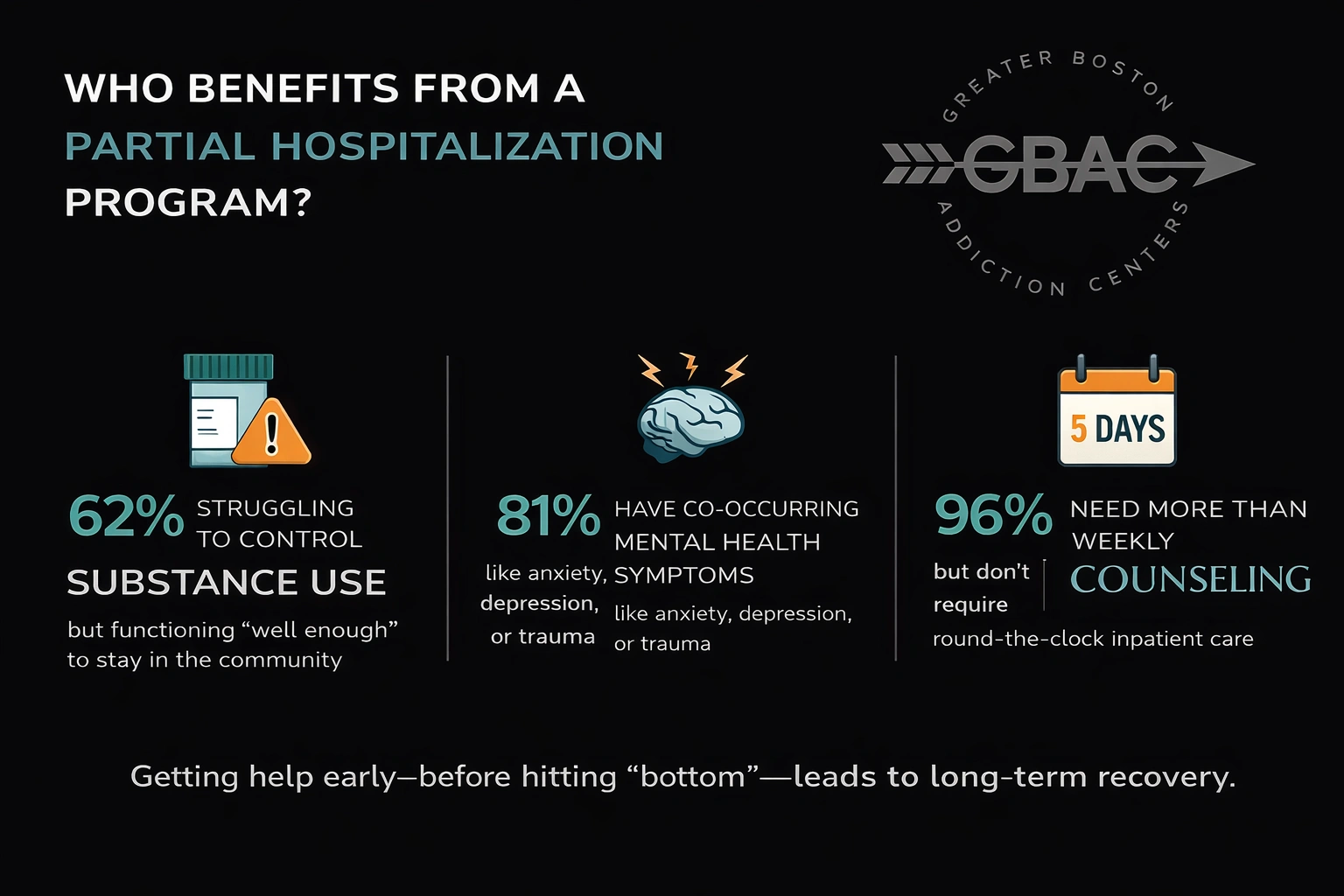
A partial hospitalization program, or PHP, is a level of care that sits between inpatient rehab and standard outpatient therapy. It’s designed for people who need more than just a weekly counseling session—but who aren’t ready for, or don’t need, round-the-clock supervision in a residential facility.
In a PHP, you attend structured programming during the day, typically five days a week, for several hours a day. You receive intensive clinical care including group therapy, individual counseling, psychiatric support, and life-skills training. But at the end of the day, you go home.
This level of care works especially well for first-time treatment seekers who are:
- Struggling to control their substance use but functioning “well enough” to stay out of crisis
- Managing co-occurring mental health symptoms like anxiety, depression, or trauma
- Not in need of detox or 24-hour medical monitoring
- Nervous about committing to residential care or explaining a full rehab stay to work or family
If you’re reading this and thinking, “That sounds like where I’m at,” you’re not alone. This is often the beginning of something better.
What PHP Looks Like at Greater Boston Addiction Centers
Our PHP is rooted in compassion, flexibility, and real-world support. We know how hard it can be to walk into treatment when your life hasn’t completely fallen apart—but your inner world feels like it’s unraveling.
Here’s what your days in PHP might look like:
You arrive at our Boston facility in the morning, greeted by a care team who knows your name. You start the day with a short check-in—what you’re bringing into the space today, how you slept, what you’re struggling with.
From there, you move through the day with a mix of group therapy, psychoeducation, and individual counseling. You might explore:
- What triggers your cravings or anxiety
- How to rebuild trust in relationships
- Why setting boundaries feels impossible
- What’s underneath your fear of failing, or getting better
You’ll have breaks to eat, breathe, and reflect. And you’ll end the day with a sense of direction. A plan. A thread of hope you can hold onto until tomorrow.
You don’t have to figure out your whole life in a week. But you will leave each day with more insight and more support than you came in with.
Why PHP Might Be the Right First Step
The word “rehab” can carry so much weight. It’s easy to picture a facility far from home, with rules, roommates, and a 30-day minimum stay. For some people, that’s exactly what they need. But it’s not the only option.
PHP allows you to:
- Receive high-quality treatment without checking out of your life completely
- Try out structured sobriety or mental health support in a lower-pressure environment
- Test your coping skills in real time as you return home each night
- Keep existing connections to family, work, or community while still prioritizing recovery
Maybe you’re not ready to commit to forever. That’s okay. PHP gives you room to try. To learn. To build trust in yourself—without needing to have it all figured out first.
Who PHP Is Designed For
PHP isn’t just for people who are newly sober or fresh out of a crisis. It’s for people who feel stuck in patterns they can’t quite break on their own. People who feel like they’re surviving, but not thriving. People who keep saying, “I’m fine,” while quietly Googling phrases like “what does high-functioning alcoholism look like?” or “how do I know if I need help?”
It’s also a strong option if:
- You’ve tried outpatient therapy and feel like it’s not moving the needle
- Your substance use has escalated, but you’re not physically dependent
- You’re using substances to manage mental health symptoms you haven’t fully addressed
- You’re afraid of being labeled, judged, or pushed into a system you don’t trust
If you’re looking for a partial hospitalization program in Newton, or exploring partial hospitalization program options in Needham, we’re here to talk through what’s possible. Quietly. Privately. Kindly.
What Happens After PHP?
PHP isn’t the end—it’s the foundation. After you complete PHP, you’ll likely move into a less intensive level of care like:
- Intensive Outpatient Programming (IOP), with fewer hours per week
- Standard outpatient therapy
- Group support or sober community programming
- Psychiatric medication management, if needed
The transition is thoughtful, gradual, and personalized. You’ll never be left to figure it out alone. We walk with you through every phase, adjusting the plan based on how you’re doing—not just how long you’ve been here.
What If You’re Still Not Sure You’re “Bad Enough” to Deserve Help?
This is the most common concern we hear from first-timers. And it makes sense. The world has trained us to believe that only people who “hit bottom” qualify for care. But the truth is, waiting for a bottom can be deadly. More often than not, the people who succeed in long-term recovery are the ones who get help before they’re falling apart.
If you’re reading this and still managing your life on the surface—but your inner world is fraying—it’s time. You don’t have to fall apart to justify asking for help.
And PHP doesn’t require you to call yourself anything you’re not ready to. You just have to be open to something different.
FAQs: Partial Hospitalization Program for First-Time Treatment Seekers
Do I have to be sober to start PHP?
No. Many people enter PHP while still using. If you need detox before you begin, we’ll help coordinate that. Otherwise, we’ll meet you where you are and help you stabilize safely.
Will I lose my job if I take time off for PHP?
Many employers offer medical leave or flexible work options under FMLA. We can provide documentation and support to help you navigate this conversation confidentially.
How long does PHP last?
The average stay is 2 to 4 weeks, but some clients stay longer based on clinical need. We assess your progress regularly and collaborate with you to decide when to step down.
Is this covered by insurance?
Most major insurance providers cover partial hospitalization programs. Our admissions team can verify your benefits and explain coverage before you commit to anything.
What’s the difference between PHP and IOP?
PHP is more intensive—typically 5 days a week, several hours per day. IOP is often 3–4 days a week with fewer hours. Many clients begin in PHP and transition to IOP as they stabilize.
Can I attend PHP while living at home?
Yes. That’s one of the key benefits. You return home each night, allowing you to practice new coping skills in your real-life environment, with daily support to process what comes up.
You’re Not Too Early. You’re Right on Time.
There’s a kind of strength in asking for help before everything breaks. It means you still believe in the possibility of something better. It means you still care.
Maybe you’re not ready for rehab. That’s okay. But you might be ready for this.
Call (877) 920-6583 to learn more about our partial hospitalization program services in Boston, MA. You don’t have to fall apart to start healing. You just have to start. We’ll meet you where you are.

Live Sober
Live Connected
Greater Boston Addiction Centers
Rehab Blog