

Some people collapse under the weight. Others carry it well—on the outside. If you’re holding it together at work, managing the bills, showing up for your people… but still waking up tired in your bones, you might be the kind of person this blog is for.
Because high-functioning doesn’t mean okay. And CBT—short for Cognitive Behavioral Therapy—might be a way to feel human again, without throwing your life into chaos.
The Hidden Weight of High-Functioning Pain
You’re not falling apart. That’s the problem.
People come to you. You handle things. You get it done, no matter how much is burning in the background. And that becomes your identity: The one who’s fine. The one who never complains. The one who doesn’t need help.
But here’s what we know as clinicians: that role gets heavy. And over time, it costs you more than you realize.
Maybe you can’t sleep. Maybe you’re using alcohol, Adderall, or just raw grit to keep going. Maybe nothing feels particularly wrong—but nothing feels right either.
CBT is a way to stop performing wellness and start practicing it—for real.
Why Asking for Help Feels Like Losing Control
When your whole life runs on control, asking for help feels like setting it all on fire.
People who avoid therapy aren’t always in denial. Many are hyper-aware. But acknowledging that awareness out loud? That’s vulnerable. And vulnerability, for a high-functioner, can feel like weakness. Or even danger.
CBT was designed to meet people in the space between logic and emotion. You don’t have to pour your heart out. You don’t have to “relive trauma.” You don’t even have to call yourself struggling. You just need a place where your thoughts can be examined—and challenged—without judgment.
Because if you’re exhausted but still showing up… you’re not broken. You’re just running a system that’s maxed out.
What CBT Actually Does (And Doesn’t Do)
Let’s bust a myth: CBT is not pop-psychology self-talk or toxic positivity. It’s not about “thinking happy thoughts” or ignoring your pain.
CBT is evidence-based, structured, and incredibly practical.
Here’s what it does:
- Helps you identify recurring thought patterns (like catastrophizing, all-or-nothing thinking, or perfectionism)
- Shows how those thoughts shape your emotional responses and behaviors
- Offers step-by-step skills to reframe and respond differently
Here’s what it doesn’t do:
- Force you to talk about things before you’re ready
- Require you to unpack your entire childhood
- Expect you to change everything overnight
It’s therapy for people who like clarity, logic, and movement—not endless emotional excavation.
CBT for Alcohol, Anxiety, and Quiet Burnout
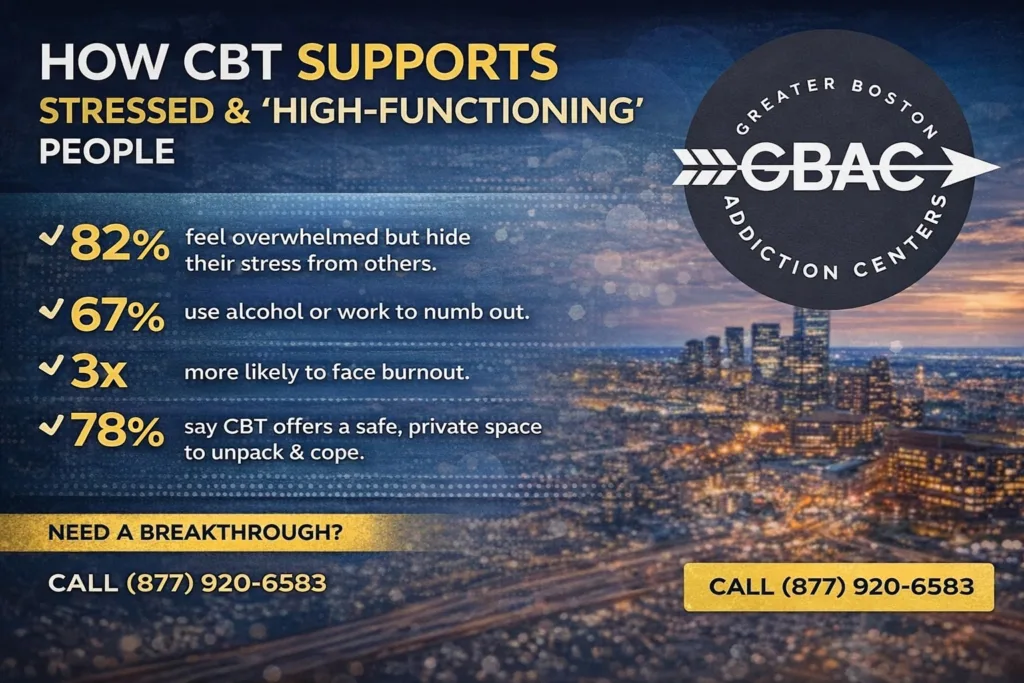
Many high-functioning individuals are silently managing more than they admit. That includes:
- High-functioning alcohol use (drinking to “take the edge off,” not to blackout)
- Workaholism or perfectionism that leaves no space for rest
- Chronic anxiety masked by productivity
- Private panic or spirals that no one sees
CBT can help rewire the internal dialogue that drives these behaviors. Not by blaming you—but by giving you language, tools, and choices.
One client said, “CBT didn’t make me a different person. It made me a version of myself that I actually liked being.”
That’s the point.
What a CBT Session Looks Like
Forget the chaise lounge and open-ended questions. CBT sessions are structured but flexible. Here’s a glimpse:
- You bring in a current problem: something that triggered stress, shame, or overwhelm
- Your therapist helps you unpack the thought process behind that reaction
- Together, you identify distorted thinking patterns and explore alternative interpretations
- You leave with a specific skill or practice—not just insight, but something actionable
It’s collaborative, forward-focused, and grounded in respect. Especially for people who don’t want therapy to feel like a freefall.
You Can Be Strong and Still Need a Reset
Here’s something we wish more high-functioning clients heard:
Needing support doesn’t erase your strength. In fact, it requires it.
The people who’ve held everything together for years—the ones who’ve hidden their anxiety in humor, their loneliness in productivity, their stress in substance use—they don’t need to hit bottom. They just need someone to say: You can put some of this down.
CBT doesn’t fix you. It helps you see what’s not yours to carry anymore.
Therapy That Respects Your Privacy and Pace
At Greater Boston Addiction Centers, we’ve worked with hundreds of people who felt like therapy “wasn’t for them.” People who weren’t in crisis—but were cracking quietly. People who hated asking for help but were brave enough to start somewhere.
Whether you’re dealing with alcohol use that’s gone from casual to concerning, anxiety that won’t shut off, or emotional fatigue that sleep can’t fix—CBT may help.
And no, you don’t have to tell your whole life story in week one. We meet you where you are.
You Don’t Have to Call It Rock Bottom
There’s no ceremony for starting therapy. No dramatic event required.
CBT works whether you’re falling apart… or just tired of holding it all in. In fact, it might be the perfect starting point because it meets you in logic, structure, and small steps—the very strengths you’ve built your life on.
You don’t need to call it a crisis. You can just call it time.
FAQ: CBT for High-Functioning People Who Hate Asking for Help
Do I have to talk about my childhood in CBT?
Not unless it’s relevant to what you want to change. CBT focuses on present-day thoughts and behaviors. It’s about what’s happening now—and what can shift.
Is CBT only for people with a diagnosis?
Not at all. Many high-functioning people use CBT to address stress, perfectionism, overthinking, substance use, or emotional flatness—before it becomes a crisis.
How fast does CBT work?
Many clients notice shifts in the first few sessions. CBT is designed to be efficient and skill-building. That said, lasting change takes time—and the pace is always set collaboratively.
Can CBT help if I don’t feel “bad enough” for therapy?
Yes. In fact, that’s one of CBT’s strengths. You don’t have to wait until everything falls apart to benefit. If you’re tired of running at 110% just to feel “okay,” CBT is a valid place to start.
Will CBT push me to change things I’m not ready to change?
No. CBT is a collaborative process. You won’t be forced into any decision or disclosure. The work happens at your pace, with your goals in mind.
Ready When You Are—Not When You Break
You don’t need to hit bottom. You don’t have to call it a crisis. You just have to be willing to look honestly at the systems you’ve built—and ask if they’re still working for you.
CBT offers a structured, respectful, and private way to begin that work. No pressure. No collapse. Just a shift. For those in or around Boston, Dedham, Waltham, or West Roxbury, MA, GBAC provides accessible, community-based programs rooted in empathy, structure, and real recovery.
Call (877)920-6583 or visit to learn more about our CBT services in Boston, MA.
