

Relapse doesn’t mean your child is broken. It doesn’t mean you failed. It means this is hard. It means they need more support—not more shame.
If your young adult son or daughter has relapsed, you’re likely overwhelmed by fear and confusion. You may be asking, “What do we do now? What will actually help this time?”
For many families, the answer isn’t starting over—it’s stepping differently. That’s why clinicians often recommend a partial hospitalization program (PHP) after relapse. Not because it’s softer than inpatient, but because it offers structure and flexibility. It meets your child where they are—without forcing a full reset.
At Greater Boston Addiction Centers, we work with families like yours every day. Families who want to believe that healing is still possible—even when they’re holding heartbreak in both hands.
Here’s why a PHP is often the next best step after relapse.
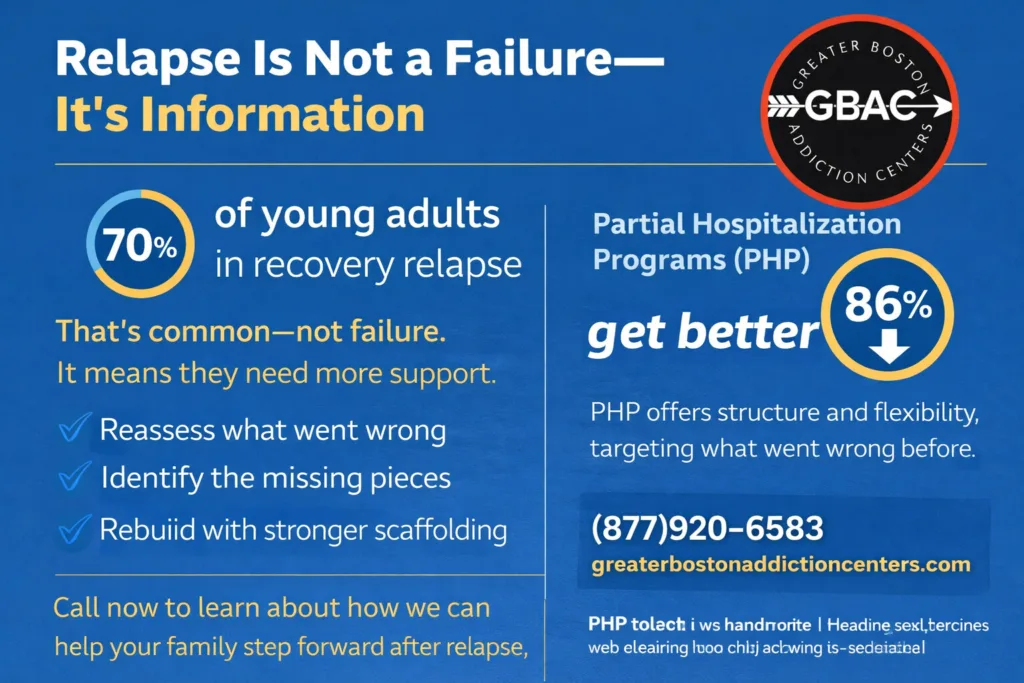
Relapse Is Not a Failure—It’s Information
We say this gently but clearly: relapse isn’t proof that treatment didn’t work. It’s proof that something in the plan wasn’t strong enough yet.
Relapse is common in recovery, especially among young adults who are still developing emotional regulation, identity, and autonomy. That doesn’t excuse it—but it does help us respond with strategy instead of panic.
A partial hospitalization program allows us to:
- Reassess what went wrong
- Identify the missing pieces
- Rebuild with stronger scaffolding
It’s not about “starting over.” It’s about re-aligning the treatment to meet where your child actually is—not where we hoped they’d be.
PHP Balances Structure With Dignity
After relapse, many young adults resist returning to residential treatment. They don’t want to “go backward.” They don’t want to feel locked away. They want to feel like they still have agency—even if they’re struggling.
PHP offers that balance.
It typically runs five days a week during daytime hours, giving your child:
- Daily group and individual therapy
- Psychiatric support and medication management
- Real-world skill building
- Routine and accountability
And then, each night, they return home—or to a sober living environment—with enough independence to keep building self-trust.
For parents in places like Dedham, Massachusetts, this often feels like a life-saver: intensive support without the disruption of full-time inpatient care.
Why PHP Is Clinically Different After Relapse
When someone relapses, the surface behavior (drinking, using, avoidance) often hides deeper fractures. In PHP, we dig into those—not with blame, but with curiosity.
We focus on:
- What internal beliefs made relapse feel like the only option?
- What social or emotional triggers were underestimated?
- What was missing from their coping toolkit?
This level of daily engagement allows our clinicians to notice patterns faster, intervene earlier, and adjust the treatment plan in real time. It’s active care—not reactive crisis management.
Relapse Recovery Is Also Family Recovery
As a parent, relapse hits hard. Especially when it’s not the first time.
You may feel:
- Angry but heartbroken
- Hopeful but afraid to hope
- Guilty for not catching it sooner
- Confused by how they “seemed okay”
All of that is real.
In PHP, we often work with families to rebuild trust—not just between parent and child, but inside the parent’s own heart. We support you, too.
Our team helps guide communication, establish boundaries, and offer education that empowers rather than blames. Because recovery doesn’t happen in isolation—and neither should parenting someone in pain.
What PHP Includes at Greater Boston Addiction Centers
Our PHP isn’t just “more therapy.” It’s a full-day program built around evidence-based care, emotional safety, and next-step momentum.
It includes:
- Trauma-informed individual therapy
- Process and psychoeducational groups
- Relapse prevention curriculum
- Medication and psychiatric oversight
- Family communication support
It also connects clients with aftercare planning early in the process—because relapse recovery isn’t just about surviving this phase. It’s about preparing for what’s next with intention.
For some, that means stepping down to outpatient therapy. For others, it may include longer-term treatment options in residential.
What Parents Like You Ask Most
Is PHP enough if my child has relapsed more than once?
Often, yes. Many of our PHP clients have relapsed multiple times. What matters most is not how many times it’s happened, but what’s been missing from previous care. PHP offers a new layer of clinical intensity—and fresh strategies.
What if my child is resistant or doesn’t want to go?
That’s common. Relapse often comes with shame and defensiveness. We approach those moments with compassion, not control. Our admissions team is trained in motivational interviewing and can often help open a door gently—even when things feel stuck.
Can they work or attend college classes during PHP?
PHP is a daytime commitment, so most clients need to pause work or school temporarily. That said, it’s a short-term investment for long-term capacity. We also help with documentation for medical leave or academic accommodations.
How long does PHP last?
Typically 2–6 weeks, depending on clinical progress and readiness for step-down care. Every client’s timeline is customized, and we reassess weekly to ensure care remains aligned with their needs.
What if I need support as the parent?
You do—and you deserve it. We offer family support sessions and referrals to therapists or parent groups who specialize in addiction-related grief and resilience. You don’t have to carry this alone.
A Parent’s Courage Changes the Story
We’ve seen parents walk into our center with tears still on their cheeks and a quiet desperation in their voices: “This can’t be happening again.”
And we’ve watched those same parents weeks later, sitting in a family session, hearing their child say things like:
- “I’m starting to believe I can do this.”
- “I don’t want to go back to that place.”
- “Thank you for not giving up on me.”
The in-between is hard. But the hope? It’s real.
One family from Needham, Massachusetts recently shared:
“PHP helped our daughter feel like she was healing—not just being punished for relapsing. It helped us feel like a team again, not enemies.”
That’s what this care is built for: healing the rupture and rebuilding the connection.
Call (877)920-6583 to learn more about our partial hospitalization program in Near Boston, Massachusetts. You’re not out of options. You’re allowed to begin again—even now. Let’s do it together.
