

I didn’t plan to relapse.
Most people don’t. I had 93 days clean—nearly to the day. I’d stopped counting. Started smiling again. People were proud of me, and for a minute, I was too. Then came a night I thought I could handle. One drink became five. One “slip” became three days of shame.
Walking back through the doors of treatment felt like crawling through glass. I was ready to be judged. What I wasn’t ready for was kindness.
The team at the partial hospitalization program at Greater Boston Addiction Centers didn’t scold me. They didn’t talk to me like I was starting from zero. They met me where I was—with truth, structure, and a kind of honesty that didn’t require shame to work.
Shame Was Already Doing the Talking
You don’t have to tell someone who relapsed that they messed up. Trust me—we already know.
The first few days back, I avoided eye contact. I kept quiet in group. Not because I didn’t care, but because the voice in my head was screaming: “You blew it. You had 90 days. You’re a fraud.”
But I’ll never forget what one of the group leaders said during check-in:
“You’re not starting over. You’re starting again. That’s different. And you’re not the only one.”
That one line snapped something inside me. It reminded me that relapse isn’t rare—it’s a human thing. And more importantly, it doesn’t erase everything you’ve learned.
PHP Gave Me Structure Without Locking Me Down
I’d done inpatient before. I knew the drill. But this time, I didn’t need to be cut off from the world—I needed to be supported in it.
The partial hospitalization program (PHP) was the sweet spot. I spent the day immersed in treatment—group therapy, one-on-ones, skill-building workshops. But I still went home at night. That balance helped me reconnect with my recovery in the real world.
Each day had rhythm:
- Morning check-in, where I could be honest without being pitied
- Clinical groups that called me in, not out
- Space to breathe, reflect, and feel without spiraling
PHP felt like a reset button I didn’t know I was allowed to press.
I Was Met With Honesty, Not Harshness
Let me be clear: the staff didn’t baby me. They were real. Honest. They challenged me on my rationalizations—but they never humiliated me.
There’s a huge difference between someone saying, “You need to take this seriously” and someone saying, “You’ve messed everything up again.” At GBAC, I got the former. Over and over.
They helped me understand that the why behind my relapse mattered more than the shame I brought with it. And they helped me work through it—without trying to scare me straight.
The Power of Seeing Others Like Me
Relapse isolates you. It whispers, “You’re the only one who couldn’t hold it together.”
But PHP showed me I wasn’t some outlier. I met others who had been where I was—people who came back after a slip, who were still fighting, still showing up.
That community didn’t feel like punishment. It felt like coming home.
“Relapse doesn’t mean you’re done. It means you’re still learning,” one of the alumni in group told me.
– Outpatient Client, 2023
That line stuck with me. It shifted how I saw my recovery—from a fragile streak I couldn’t mess up, to a path I could stay on, even when I stumbled.
PHP Let Me Rebuild Without Pretending
You can’t lie your way through a partial hospitalization program. Not for long. But the beauty of it? You don’t have to.
I didn’t need to pretend I was “fine” or bounce back with a motivational speech. PHP gave me space to be real: anxious, embarrassed, hopeful, tired.
There were hard days—ones where I wanted to disappear. But I never once felt like I had to earn my seat back at the table.
That kind of dignity is rare. And in recovery, it’s everything.
There’s a Door Back In—Even If You Think It’s Closed
If you’ve relapsed and you’re scared to return to treatment, let me tell you this plainly: the door isn’t closed.
At Greater Boston Addiction Centers, they don’t care about your “clean time” resume. They care about whether you’re ready to try again.
If you’re feeling like outpatient isn’t enough right now, or if inpatient feels too intense, a partial hospitalization program might be exactly what you need to steady the ship.
Need more time away from home to stabilize? Greater Boston Addiction Centers also offers help in residential for those looking to reconnect in a deeper way.
FAQ: Partial Hospitalization After Relapse
What is a partial hospitalization program (PHP)?
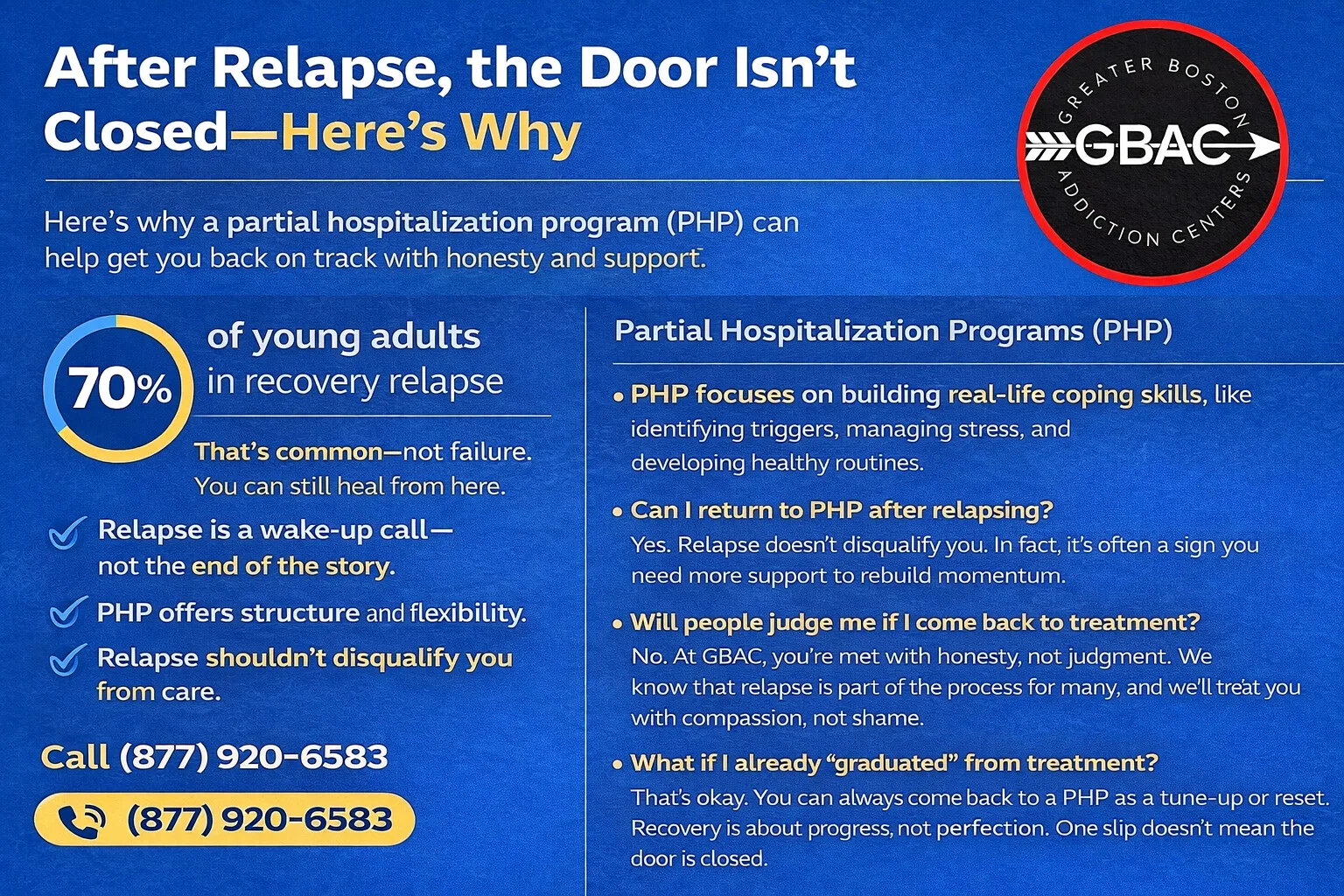
A PHP is a structured, intensive form of outpatient treatment. You attend therapy, groups, and activities during the day but return home at night. It’s a great option for people who need more support than standard outpatient care but don’t need overnight monitoring.
Can I return to PHP after relapsing?
Yes. Relapse doesn’t disqualify you from re-entering treatment—in fact, it may mean you’re ready for a different level of support. Many people return to PHP after a relapse to reset their recovery path with structure and compassion.
Will people judge me if I come back to treatment?
At Greater Boston Addiction Centers, the answer is no. Their team understands that relapse happens—and they’ll meet you with honesty, not shame. You won’t be treated like a failure. You’ll be treated like someone who’s still worthy of care.
What if I already “graduated” from treatment?
You can always come back. Recovery isn’t one-size-fits-all, and sometimes we need to return for a tune-up, a reset, or deeper work. Whether you’ve been out for months or just a few weeks, PHP is still an option.
You’re Not Too Far Gone.
Call (877) 920-6583 or visit Greater Boston Addiction Centers PHP Services to learn more about our partial hospitalization program services in Boston. The door is still open—and they’re ready to meet you with honesty, not judgment.
