

When your child is in emotional pain, you feel it in your body.
The late-night pacing. The sharp tone. The hopeless statements that land like glass.
You may feel helpless watching thoughts take over their mind. Cognitive Behavioral Therapy—cbt—is one of the most effective tools we use to help young adults interrupt those harmful thought patterns and regain stability.
It doesn’t silence emotion. It teaches them how to stand up to the thoughts that are hurting them.
And for a parent in crisis mode, that shift can feel like oxygen.
What CBT Actually Is And Why It Matters Right Now
When your young adult says, “I ruin everything,” it doesn’t feel like a passing comment. It feels like a belief that’s taking root.
CBT works by helping them examine those beliefs instead of automatically accepting them as truth.
At its core, CBT is built on one powerful idea:
Thoughts influence emotions. Emotions influence behaviors.
When thoughts are distorted—catastrophic, absolute, self-critical—emotions spiral. Behavior follows.
CBT slows that cycle down.
Instead of reacting automatically, your child learns to pause and ask:
Is this thought accurate? Is it helpful? Is there another way to see this?
That pause can prevent self-destructive decisions.
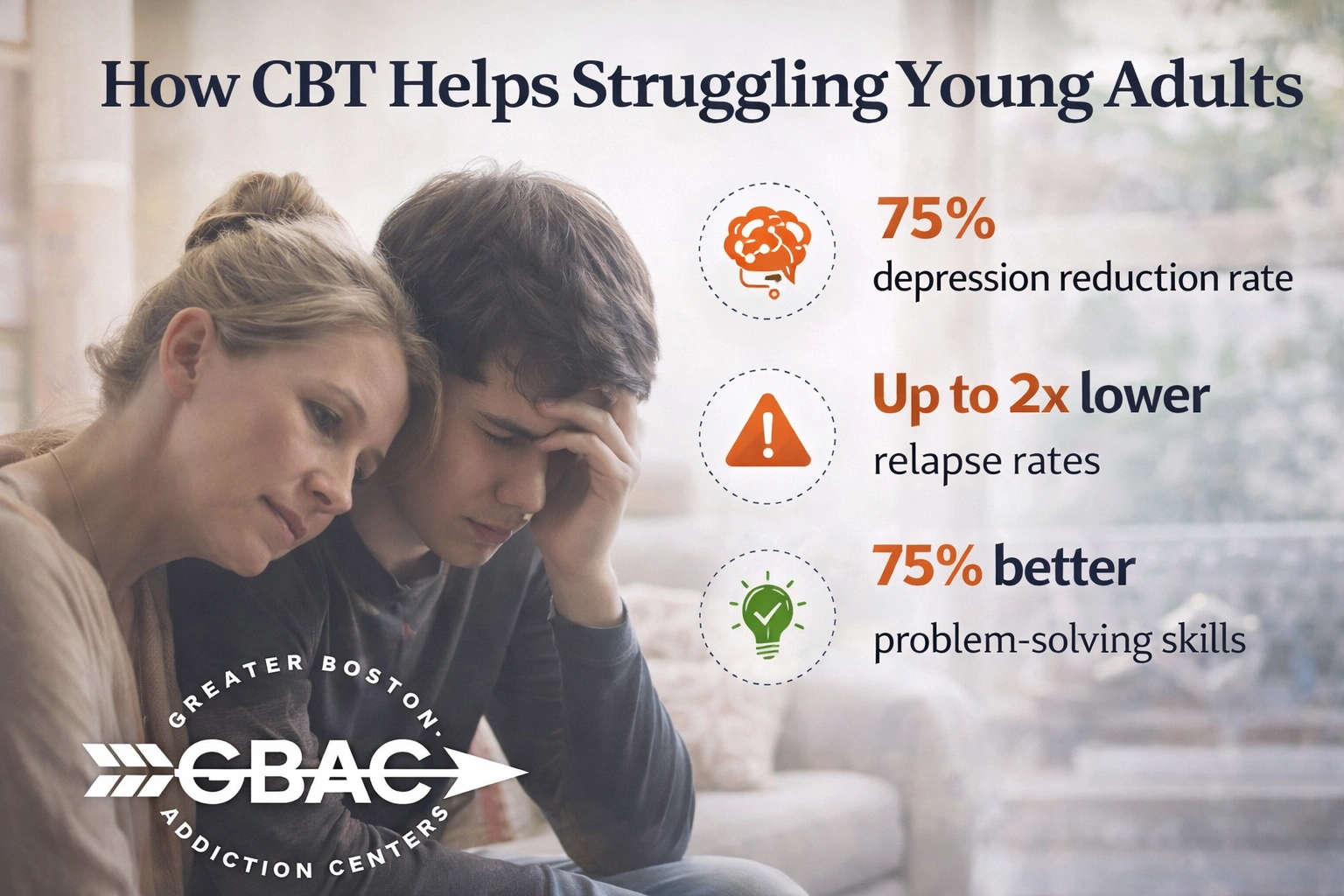
Why Young Adults In Crisis Get Stuck In Mental Loops
The young adult brain is still developing. Emotional centers are strong. Regulatory systems are still maturing.
Add stress, anxiety, depression, or substance use into that mix—and thoughts become louder and more rigid.
You may hear things like:
- “Nothing will ever change.”
- “Everyone hates me.”
- “If I fail once, I’m done.”
- “There’s no point.”
In crisis, these thoughts feel like facts.
CBT gently challenges that rigidity.
We often explain it this way: imagine your child’s mind is a courtroom. In crisis, only the prosecution is speaking. CBT teaches them how to bring in the defense attorney.
It introduces balance.
How CBT Teaches Thought Challenging Step By Step
CBT isn’t abstract. It’s practical.
In therapy sessions, young adults learn to:
1. Identify The Automatic Thought
What ran through your mind right before you felt overwhelmed?
2. Recognize The Distortion
Was it black-and-white thinking? Catastrophizing? Mind-reading?
3. Examine The Evidence
What proof supports this belief? What proof contradicts it?
4. Generate A Balanced Alternative
Not toxic positivity. Not denial. Just something grounded in reality.
For example:
“I failed this exam. I’m a complete failure.”
Becomes:
“I failed this exam. That’s disappointing, but it doesn’t define my intelligence or future.”
That shift may seem small. It isn’t.
Small cognitive shifts create emotional breathing room.
CBT And Emotional Regulation: More Than Positive Thinking
Parents sometimes worry CBT is just telling their child to “think happy thoughts.”
It’s not.
CBT teaches emotional regulation through skill-building. It helps young adults:
- Notice emotional triggers
- Tolerate distress without impulsive behavior
- Separate identity from temporary setbacks
- Reduce shame spirals
- Replace avoidance with action
When emotions feel less overwhelming, behavior becomes safer.
And safety is often what you’re most worried about right now.
When CBT Is Part Of A Higher Level Of Care
Sometimes weekly therapy isn’t enough.
If your young adult is experiencing severe depression, self-harm behaviors, active substance use, or significant instability, a higher level of support may be needed.
CBT can be integrated into structured programming, including treatment options in Residential settings where safety and daily structure are prioritized.
For families in Wellesley, Massachusetts, this often means accessing comprehensive support while remaining connected to your broader community network.
For those in West Roxbury, Massachusetts, proximity can make structured care more accessible during a time when everything already feels overwhelming.
The goal is never to overreact. It’s to respond proportionately to the level of risk.
Structure is not punishment. It’s protection.
What You Might Notice As CBT Starts Working
Progress rarely looks dramatic.
Instead, you might notice:
- Your child pausing mid-argument instead of escalating.
- Less extreme language like “always” or “never.”
- Willingness to try coping skills.
- A small increase in emotional awareness.
- Fewer impulsive reactions.
These are subtle but powerful signs.
CBT doesn’t eliminate pain. It teaches your young adult that they don’t have to obey every painful thought.
That realization builds confidence.
Why Parents Often Feel Helpless During Cognitive Crises
When your child’s thoughts turn dark, you can’t simply “logic” them out of it.
You may feel like you’re walking on eggshells. Afraid to say the wrong thing. Afraid to push too hard. Afraid not to push at all.
CBT gives your child tools you cannot give them yourself.
You can offer love. You can offer support. But only they can learn to challenge their internal dialogue.
CBT puts that power back in their hands.
The Metaphor We Often Share With Families
Imagine your child’s mind is a snow globe.
When crisis hits, someone shakes it hard. Thoughts swirl everywhere. Visibility disappears.
CBT doesn’t stop the shaking instantly.
But it teaches them how to set the globe down.
When it’s still, clarity returns.
That stillness is what we aim for—not perfection, not permanent happiness—just clarity.
Frequently Asked Questions
How Long Does CBT Take To Show Results?
CBT is structured and goal-oriented. Some young adults notice small shifts within a few weeks. Deeper patterns may take longer. Progress depends on engagement and consistency.
Is CBT Effective For Substance Use And Mental Health Together?
Yes. CBT is widely used to address both addiction and co-occurring mental health conditions. It helps identify triggers, manage cravings, and challenge distorted beliefs fueling substance use.
What If My Child Refuses Therapy?
Resistance is common in crisis. Sometimes starting with an evaluation or involving a trusted third party can lower defenses. Meeting them where they are—without ultimatums—often opens the door.
Can Parents Be Involved In CBT?
Family involvement can be helpful. While individual sessions focus on your young adult’s thought patterns, family education can improve communication and reduce unintentional reinforcement of distortions.
How Do I Know If We Need More Than Outpatient Therapy?
Warning signs include escalating self-harm behaviors, suicidal ideation, severe substance use, inability to function daily, or intense emotional instability. In those cases, structured programming that includes CBT may be appropriate.
Is CBT Only About Changing Thoughts?
No. CBT also addresses behaviors and emotional responses. It integrates practical exercises, exposure strategies, coping skills, and behavioral activation—not just cognitive reframing.
If you’re reading this as a worried parent, take a breath.
Your fear makes sense. Watching your child battle their own thoughts can feel unbearable.
CBT offers a structured, evidence-based way to help young adults step out of destructive thinking patterns and rebuild emotional stability. It gives them tools instead of lectures. Skills instead of shame.
And sometimes, that’s the beginning of real change.
Call (877)920-6583 to learn more about our Cognitive Behavioral Therapy Near Boston, Massachusetts.
