

There’s a quiet fear many people carry into recovery but don’t say out loud:
What if getting better means losing myself?
If you’ve used substances to feel more alive, expressive, connected, or creative—sobriety can feel like erasure. At Greater Boston Addiction Centers, we work with people who feel that exact fear. And through approaches like DBT, we help you sort out what’s truly you… and what’s just been doing the heavy lifting for too long.
When Survival Looks Like Personality
It’s easy to mistake survival strategies for identity—especially when they’ve been with you for years. Maybe your humor was a distraction. Maybe your impulsiveness kept you from feeling stuck. Maybe your substance use felt like the only way to quiet the constant noise in your head.
What makes this confusing is that many of these behaviors also earned praise:
“You’re so fun.”
“You’re fearless.”
“You light up the room.”
But what people couldn’t see was the cost. How much energy it took to maintain the performance. The pain hiding behind the punchlines. The aftermath of every high, every outburst, every crash.
These aren’t “bad habits.” They’re survival skills. And survival skills are smart—they show us how deeply we wanted to stay alive. DBT honors that, even as it helps you gently let go of what’s hurting more than helping.
What Is DBT—and Why Does It Help So Much?
Dialectical Behavior Therapy (DBT) is a skills-based therapy originally developed for people who feel intensely and struggle to manage overwhelming emotions, self-harming behavior, or unstable relationships.
At its core, DBT is built on a radical idea:
Two things can be true at once.
You can accept yourself and want to change.
You can feel intense emotion and learn to manage it.
You can love the parts of you that got you through… and still decide not to keep all of them.
This both/and approach is especially powerful for people in recovery who are scared that healing means silencing something essential inside them.
DBT Gives You Tools to Stay Fully You—Without Staying in Chaos
Here’s what DBT teaches—not in a theoretical way, but through structured practice:
1. Mindfulness:
Learn how to stay present without judging your thoughts or feelings. You don’t have to fix everything—you just have to notice it. That awareness creates space to respond instead of react.
2. Distress Tolerance:
Life hurts sometimes. DBT teaches you how to survive the tough moments without reaching for substances, self-destruction, or shutdown.
3. Emotional Regulation:
This is where DBT really shines. You learn how to name your feelings, reduce emotional overwhelm, and still feel like you—not a muted version of yourself.
4. Interpersonal Effectiveness:
Many people worry that being sober means being passive or quiet. DBT teaches assertiveness, boundary-setting, and how to keep connection alive without drama or chaos.
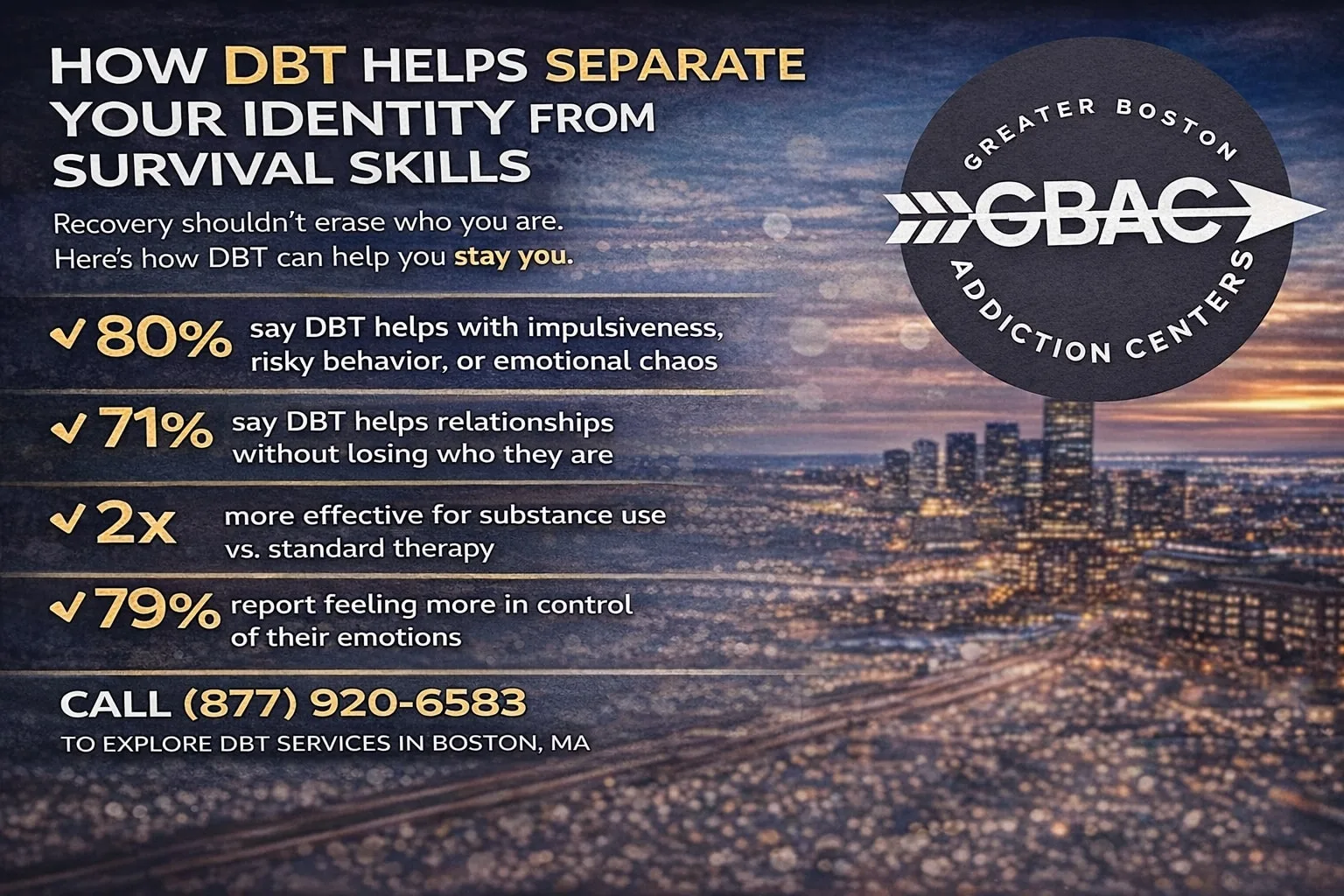
Each of these skill sets helps you unhook your identity from your emergency responses. You get to keep your sensitivity, your fire, your humor—but now with control and clarity.
When the Fear of Losing Yourself Is Actually a Clue
If you’re scared that sobriety will flatten you, dull you, or take away your creativity—you’re not alone.
In fact, that fear often signals that you care about your voice, your presence, and your place in the world. That’s not something to be ashamed of. It’s something to protect.
DBT helps you protect those parts—not by clinging to behaviors that hurt you, but by building new ways to express your full self. You get to be complex, intense, alive.
As one of our clients put it:
“Before treatment, I felt like my emotions were who I was. If I wasn’t dramatic or wild, I felt invisible. DBT didn’t take that away—it helped me learn how to be seen without setting myself on fire.”
Letting Go Doesn’t Mean Letting Go of You
There’s grief in recovery. Not just for relationships or time lost—but for the parts of yourself that you built in survival mode.
DBT doesn’t rush you past that grief. It honors it. And as you gain more stability, you also gain something else:
A clearer view of the self beneath the strategy.
You’ll find that the things you feared losing—your depth, your insight, your ability to connect—weren’t actually rooted in substances or chaos. They’ve been in you all along.
Recovery isn’t about replacing you. It’s about uncovering you.
Why DBT Matters for Creative and Charismatic People in Recovery
Some people enter treatment with shame about how they used. Others enter with shame about how much they loved it.
If substances made you feel more you—more social, more free, more open—then losing them can feel like losing your sparkle.
We see that. And we want you to know:
You don’t have to trade vibrance for safety.
You don’t have to become someone else to get better.
You just need space to sort what’s yours… from what isn’t.
That’s what DBT offers.
Is DBT Right for You?
DBT might be especially helpful if:
- You feel emotionally intense or “too much”
- You’ve struggled with impulsive or risky behaviors
- You fear becoming “boring” or flat in recovery
- You want tools to manage relationships without losing yourself
- You’re grieving the idea of a version of yourself that used to exist
Whether you’re just beginning recovery or exploring deeper emotional work, DBT can meet you where you are.
Frequently Asked Questions About DBT
What makes DBT different from regular therapy?
DBT focuses on building specific skills, not just talking through problems. It’s structured, practical, and especially useful for people with intense emotional experiences or behavior patterns they want to change.
Will DBT change my personality?
No. DBT helps you separate your reactions from your identity. It gives you space to keep what’s truly you, while letting go of what’s causing harm.
Is DBT just for people with borderline personality disorder?
While DBT was originally developed for borderline personality disorder, it’s now widely used for addiction recovery, trauma, emotional dysregulation, and more. You don’t need a specific diagnosis to benefit from DBT.
How long does DBT take to work?
Many people notice small changes within weeks. Full DBT programs often last several months, but even short-term work can give you tools you’ll use for life.
Can I do DBT if I’m still using?
DBT works best when you’re engaged in recovery—but it can also be a helpful bridge into stability. If you’re using occasionally or struggling with consistency, DBT may still support your progress.
Explore DBT Services in Boston, MA
If you’re afraid that recovery will erase something essential, we want you to know:
Healing doesn’t mean disappearing.
At Greater Boston Addiction Centers, our DBT programs help you stay emotionally full and grounded—so you can move forward without losing the parts of you that matter most.
Ready to talk? Call (877) 920-6583 or learn more about our DBT services in Boston, MA. We’ll meet you right where you are.
