

Starting therapy isn’t easy. It takes guts to say, “I need help.” But even after that first brave step, confusion often follows: What kind of therapy is right? What if I choose the wrong one? Why do some programs feel so rigid?
If you’re exploring DBT, or you’ve heard it’s more structured than other approaches, you’re not wrong—but that structure exists for a reason.
And if you’re someone whose emotions feel too big, too fast, or too unpredictable, that structure might be exactly what makes DBT finally work.
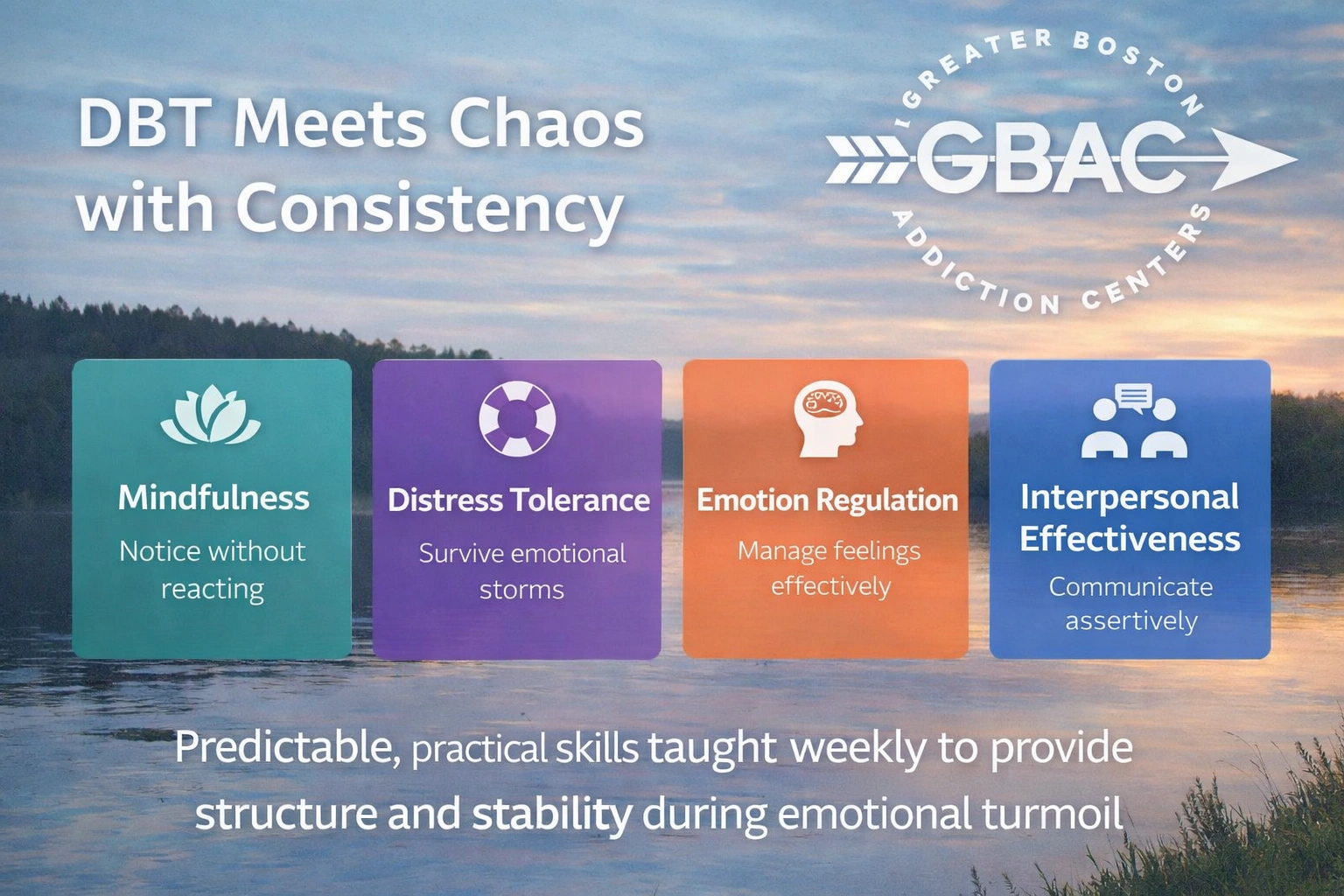
DBT Meets Chaos with Consistency
Let’s be honest: when your inner world is spinning, you don’t need more freedom—you need something solid.
That’s what DBT offers. Not as a punishment. Not as control. But as a way to keep you tethered when your mind wants to bolt.
You’ll hear the term “structured” used often with DBT. But what that really means is: predictable, intentional, safe. There’s a rhythm to it. Weekly group sessions. Individual check-ins. Concrete skills taught in a clear sequence.
Why does that matter? Because when your emotions have no map, the structure becomes the compass.
Four Skill Sets, Taught Step by Step
DBT focuses on four key areas:
- Mindfulness: noticing what’s happening without getting swept away
- Distress Tolerance: surviving emotional storms without self-destruction
- Emotion Regulation: making space for intense feelings without being controlled by them
- Interpersonal Effectiveness: asking for what you need (without exploding or disappearing)
Each skill set builds on the others. You don’t start with the deep stuff. You build capacity—like a workout, but for your emotions. And the way it’s taught isn’t abstract—it’s practical, almost like life training.
For example, during distress tolerance sessions, you might actually practice what to do when you’re about to spiral—not just talk about it afterward.
Why Structure Helps Brains in Survival Mode
If you’ve been living in fight, flight, or freeze for a while, your nervous system doesn’t respond well to vagueness.
Unstructured therapy can feel like showing up to a storm with no umbrella. You sit in a room and talk… but nothing really changes.
DBT provides a containment system—not to keep you small, but to keep you held. The routines, the homework, even the acronyms—they aren’t arbitrary. They’re anchors. So that even on your hardest days, you still have something to reach for.
For someone in Dedham, Massachusetts, where day-to-day life might already feel like juggling jobs, family, or hidden emotional overwhelm, the DBT format provides calm within chaos—no guesswork required.
Group Isn’t Just for Sharing—It’s for Practicing
A common misconception is that group therapy means sitting in a circle, talking about trauma. In DBT, that’s not the goal.
The group format is a skills class, not a confessional. You’ll learn concepts, practice exercises, ask questions, and get real-time support. But you’ll never be pressured to share beyond your comfort zone.
This matters especially for people who’ve never done therapy before. DBT doesn’t ask you to be raw in front of strangers. It asks you to try, reflect, and repeat. That’s a big difference.
It’s Not a Personality Overhaul—It’s a Toolkit
Some clients come to DBT afraid they’re going to be changed into someone else. That they’ll have to lose parts of themselves to “heal.”
But DBT doesn’t erase who you are. It helps you live with who you are—with less damage, more control, and a clearer sense of what actually helps.
You’re still you. Just with better tools.
That might look like pausing before lashing out. Or noticing a panic spiral before it hijacks your day. Or knowing how to say no without a guilt hangover.
If you live in Newton, Massachusetts and you’ve struggled to find a therapy that makes sense in the moment—not just in reflection—DBT may feel like the missing puzzle piece.
The Structure Makes Progress Visible
One of the hardest things about starting therapy is not knowing if it’s “working.”
DBT solves this by giving you ways to track your patterns—skills you’ve used, urges resisted, emotions managed. This isn’t about perfection. It’s about proof. Proof that even when your mind tells you nothing’s changing, the data says otherwise.
Whether it’s a diary card, a repeated module that feels easier the second time, or a conversation you handled better than last month—that’s progress. And progress in DBT doesn’t depend on mood. It depends on movement.
What If I Miss a Session or Fall Behind?
You’re not kicked out. You’re not scolded. DBT programs understand that real life happens—especially when you’re in the thick of emotional healing.
Structure doesn’t mean rigidity. If you miss a session, your therapist helps you catch up. If you feel overwhelmed, your pace can adjust. The goal is to support—not shame.
And if life feels too unstable for outpatient DBT to work right now, Greater Boston Addiction Centers also offers help in Residential settings. Some clients begin there, stabilize, and then step down into structured outpatient therapy like DBT.
FAQs: Understanding DBT Structure
Why is DBT more structured than other therapy?
Because people in crisis—or navigating intense emotions—often need clear steps. The structure keeps therapy grounded and consistent, even when you don’t feel that way inside.
Do I have to do both group and individual therapy?
Ideally, yes. DBT is most effective when it includes skills group and 1:1 therapy. Each supports the other. But some programs offer flexible formats if that’s not possible right away.
What if I’m not good at routines or focus?
That’s actually very common in DBT clients. The program is built for people who struggle with consistency. The structure isn’t there because you’re expected to be perfect—it’s there because you’re not.
Will I be judged for having big emotions?
Never. DBT starts with the belief that your emotions are valid—even the intense ones. The work isn’t to fix them. It’s to learn how to live with them in a way that doesn’t hurt you (or your relationships).
What if I’m scared to start?
That’s okay. We expect that. You don’t have to feel brave. You just have to be willing to try. And we’ll help with the rest.
DBT Is Structured Because Your Healing Deserves Support—Not Guesswork
When you’re overwhelmed, hurt, or numb, structure isn’t restrictive—it’s reassuring.
DBT doesn’t ask you to pour your soul out or uncover trauma you’re not ready to face. It asks you to learn—one skill at a time—how to stay in your own life without drowning in it.
That’s why it’s structured the way it is. Not to trap you—but to hold you steady.
If you’ve been waiting for the “right time” to get help, or for therapy to finally feel like something you can understand, DBT might be the kind of support that makes healing feel… possible.
Want to try a therapy format that’s stable, clear, and actually built to support emotional overwhelm?
Call (877) 920-6583 to learn more about our Dialectical Behavior Therapy in Massachusetts.
