
Here’s a fear people rarely say out loud—especially the artists, the deep-feelers, the ones who always had something a little different about them:
What if sobriety takes away the parts of me I actually like?
You don’t fear getting healthy. You fear losing your edge. Your creativity. Your spark. That strange, beautiful, sideways way you see the world. The version of you who throws out one-liners like poetry, feels everything too much, or writes songs at 2 a.m. after a drink or a hit loosens the truth.
And when someone says “treatment,” all you hear is structure. Uniforms. Labels. Clinical settings. People who might want to fix what never felt broken to you—at least not all of it.
If that’s where you are, this story is for you.
Because you are not the only one who’s scared that getting well means giving something up.
The Myth That Your Identity Lives in the Struggle
Before I got help, I clung to the idea that my chaos was the source of everything good about me.
I’d say things like:
- “My brain works better when it’s a little wired.”
- “I can’t write unless I’m in a dark place.”
- “I only connect when I’m high or drunk—I’m too shut down otherwise.”
It wasn’t just that I didn’t want to give up substances. I didn’t want to give up me.
Because if my intensity came from pain, what would be left of me once the pain went away?
But that belief? It came from fear, not fact.
Drug Addiction Treatment Didn’t Make Me Less Me—It Made Me More Honest
The biggest surprise I found in treatment was this: no one wanted to erase me.
No one told me to stop being emotional or creative or sensitive.
What they did was help me separate the real parts of me from the parts that were protecting me in the only ways I knew how—through overuse, avoidance, and constant numbing.
They didn’t rip the paintbrush from my hand. They just asked why I only picked it up when I was two drinks in.
They didn’t judge my love of late-night playlists and emotional depth. They helped me find out why I only felt safe expressing it while high.
Sobriety didn’t quiet my mind. It helped me hear what it was actually trying to say.
Creativity Isn’t Born from Chaos—It Grows in Safety
We glorify the tortured artist. The manic genius. The soul who burns so brightly they collapse.
But real creativity? It needs room. Room to try. To fail. To feel and come back from it.
In recovery, I finally had the mental space to experiment without falling apart.
My focus came back. My process deepened. My writing changed—not because it became softer or safer, but because I was no longer rushing to outrun myself.
At Greater Boston Addiction Centers, they encouraged me to keep creating as part of my healing. Journaling. Art. Music. Therapy isn’t a blank room. It’s a space to bring all of you into the light—without apology.
Whether you’re looking for drug addiction treatment in Boston or nearby towns like Needham, this kind of care is available.
You Don’t Need to Be “Fixed” to Heal
One of the reasons I avoided treatment for so long was that I didn’t want to be “normalized.” I feared losing my quirks. I didn’t want to be told my personality was a problem to solve.
The clinicians I met didn’t treat me like a checklist. They treated me like a person with a story.
And when I finally said out loud, “I’m scared sobriety will make me boring,” they didn’t dismiss it. They helped me understand where that belief came from.
Turns out, when you’ve used substances to manage intensity for long enough, your nervous system forgets what calm even feels like. Recovery doesn’t flatten you—it regulates you. So you can still be intense, weird, creative, deep—but without burning out constantly.
The Right Kind of Structure Doesn’t Limit You—It Grounds You
I used to think structure was for other people. “Neurotypicals.” Morning people. People who color inside the lines.
But my unstructured life wasn’t freedom—it was survival. Constantly reacting. Never resting. Stuck in cycles of binge, crash, escape, repeat.
In treatment, I found structure that didn’t box me in—it held me up.
I started:
- Sleeping through the night
- Eating real meals
- Noticing when I needed to slow down
- Creating from clarity instead of panic
It wasn’t discipline for its own sake. It was care. And with that kind of care, my ideas got bigger, not smaller.
Recovery Gives You a Mirror, Not a Mask
The substances weren’t my personality. They were the filter I saw myself through.
Without them, I finally saw what parts of me were real—and which were just survival habits.
I found out I’m funnier than I thought. Calmer than I believed. Still messy, still imperfect, but not lost. And definitely not boring.
Drug addiction treatment didn’t overwrite me. It introduced me to a version of myself I hadn’t had the chance to meet yet.
One that’s not defined by damage.
One that can make art from the center of the storm—and still come home safe.
FAQs: Afraid Treatment Will Change You?
What if substances feel like the only way I connect to my art?
This is more common than you think. Treatment doesn’t ask you to stop creating—it helps you build healthier pathways to tap into that creativity without relying on numbing or risk.
Will treatment make me boring or generic?
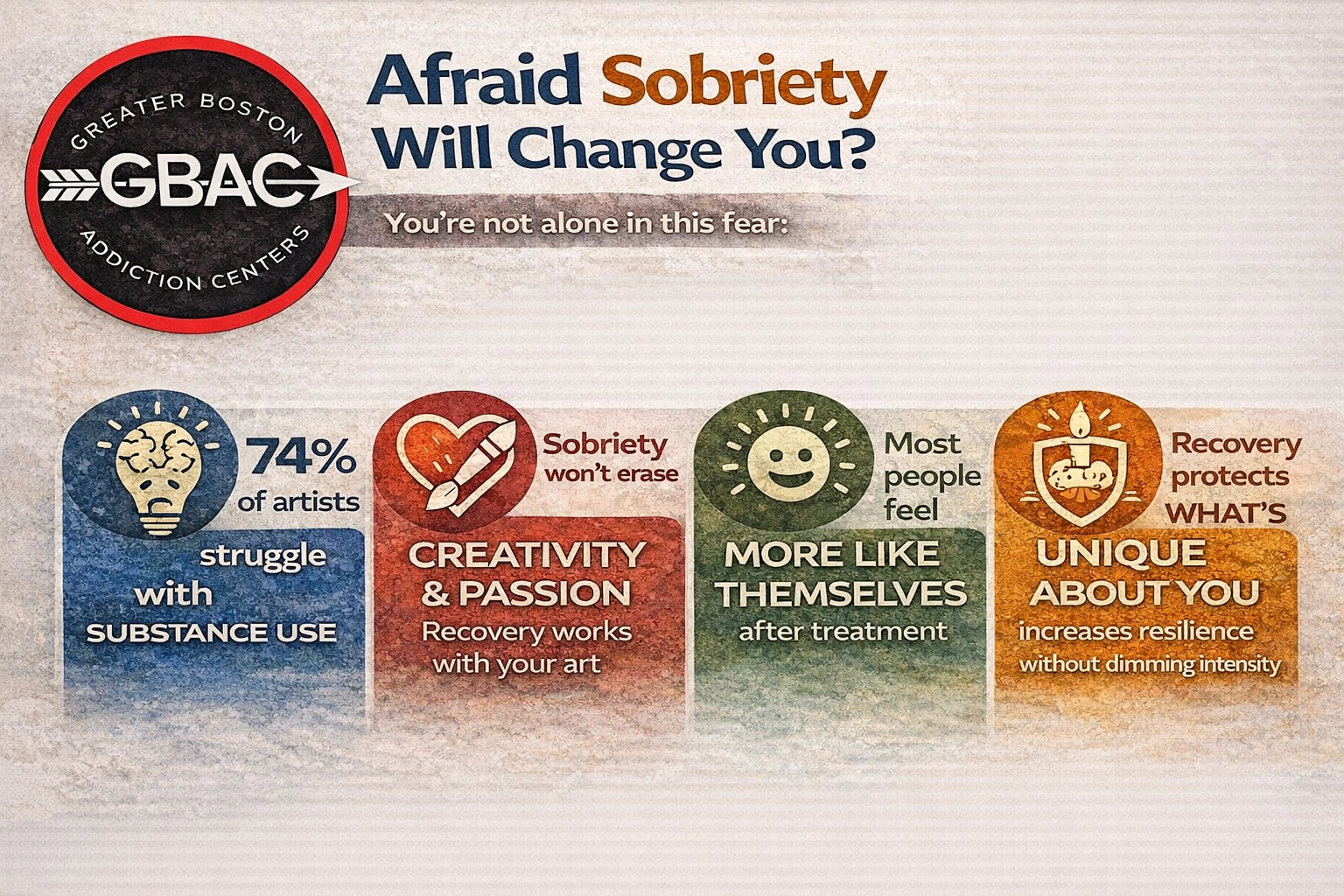
Not at all. In fact, most people report feeling more like themselves after treatment. Recovery helps you reclaim your natural intensity, but with clarity and control.
I’m scared to lose the part of me that’s emotional or deep. Is that valid?
Absolutely. But emotions aren’t erased in recovery—they’re respected. You learn to feel without drowning, which actually expands your emotional capacity.
Can I still write, paint, or make music in treatment?
Yes. Many programs encourage expressive therapy and creative work. At GBAC, we understand that creativity can be central to recovery—not separate from it.
What if my identity is wrapped up in my party lifestyle or social scene?
That’s real. Treatment gives you space to explore who you are outside of performance. You don’t lose connection—you build more honest, sustainable ones.
You don’t have to disappear to heal. You just have to show up.
Call (877) 920-6583 to learn more about our drug addiction treatment services in Boston, MA. Sobriety isn’t the end of who you are—it’s where you meet the version of you who doesn’t need to run.
