

When your child relapses—especially after a stretch of real progress—it’s more than just discouraging. It’s disorienting.
You may find yourself thinking:
- They were doing so well… what happened?
- Didn’t treatment work the first time?
- How are we here again?
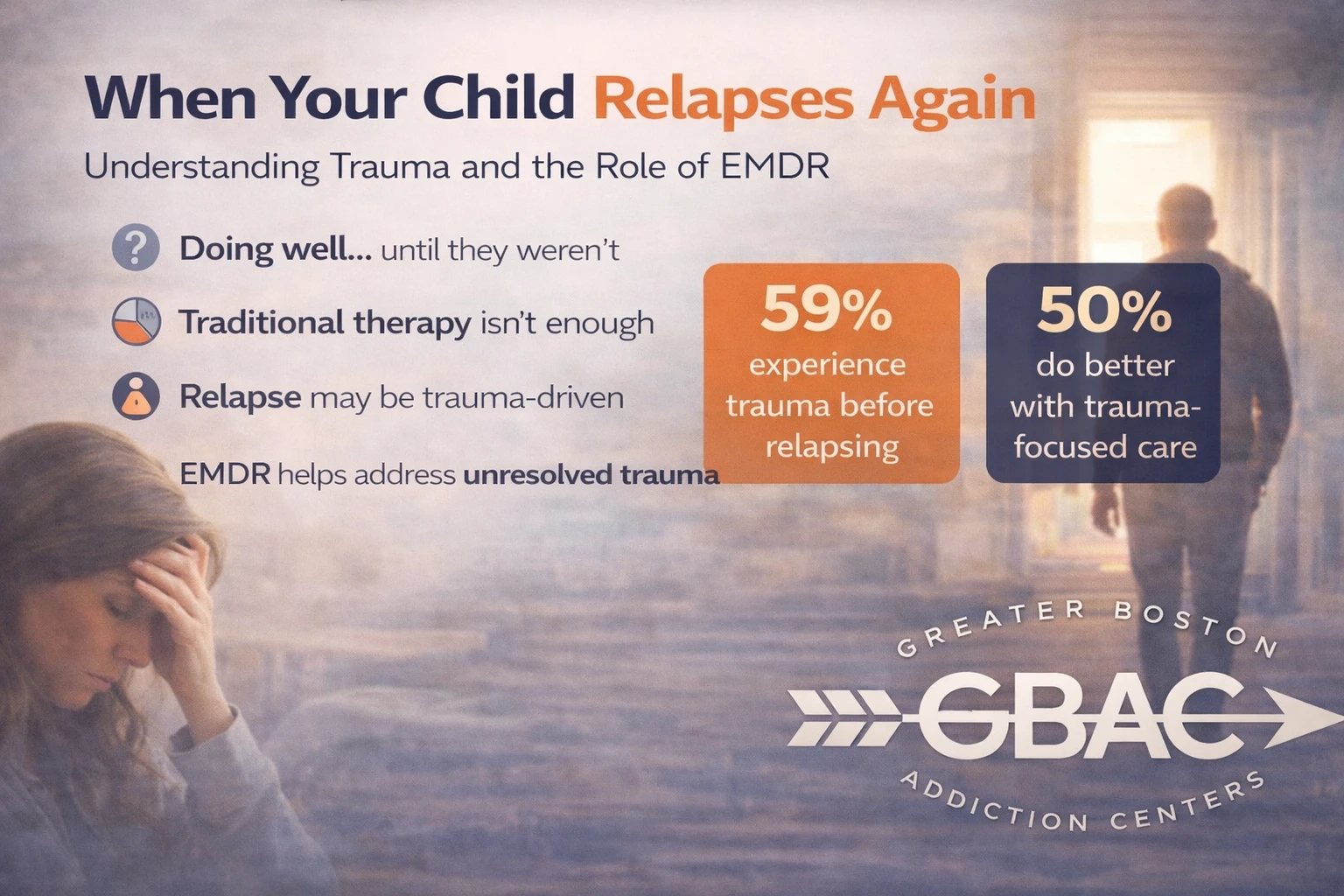
What you might not realize—and what many parents are never told—is this: relapse isn’t always about rebellion or resistance. Sometimes it’s the nervous system calling for help the only way it knows how. Often, the real issue is unresolved trauma.
That’s where EMDR comes in.
Trauma Doesn’t Just Haunt the Past—It Hijacks the Present
We tend to think of trauma as a memory. But for many young adults, trauma doesn’t live in the past—it keeps firing in the present.
That’s because unprocessed trauma changes the brain:
- The amygdala, which sounds the alarm in danger, becomes overactive
- The prefrontal cortex, responsible for decision-making, gets overridden
- The hippocampus, the memory sorter, can’t tell what’s now and what’s then
The result? Triggers. Panic. Shutdown. And for many, relapse.
Even if your child knows they’re safe now, their body might still be reacting like the danger is still happening. And when that fear becomes overwhelming, returning to substances can feel like the only escape.
Talk Therapy Isn’t Always Enough—And That’s Not Failure
Traditional therapy helps with insight, emotional skills, and structure. But it works best when the nervous system is ready to engage.
If your child shuts down in therapy…
Or avoids appointments after a trauma memory gets stirred…
Or says “I don’t know why I did it” after a relapse…
That’s not defiance. It’s dysregulation.
EMDR helps regulate from the inside out. It works with the way trauma is stored neurologically—so the brain stops looping through survival mode.
How EMDR Works (And Why It Helps Where Other Therapies Can’t)
EMDR stands for Eye Movement Desensitization and Reprocessing. It’s not magic. It’s neuroscience.
Here’s what happens:
- The client brings up a memory or distressing belief (e.g., “I’m not safe,” “I always ruin things”).
- While holding that image, they follow a therapist’s finger or light with their eyes, or tap rhythmically on their body (bilateral stimulation).
- As they do this, the brain reprocesses the memory—moving it out of “emergency mode” and into long-term storage.
The memory doesn’t disappear. But it stops feeling dangerous.
That means less reactivity. Fewer shame spirals. And a lower risk of trauma-driven relapse.
When Your Child Uses Again, It Might Be About Pain—Not Preference
Parents often feel blindsided by relapse. Especially when everything seemed to be getting better.
But relapse after trauma isn’t always about choice. It’s about survival instinct.
Your child might be using because something in their system still feels unsafe. Because their mind and body don’t agree on what’s over and what isn’t. Because sobriety, without trauma support, left them raw.
They’re not “starting over.” They may just be hitting a deeper layer.
EMDR gives them a way to go there—safely, gradually, and without having to explain every detail.
EMDR Is for More Than Just “Big T” Trauma
Trauma isn’t always a single, dramatic event. In fact, most clients seeking EMDR aren’t survivors of war or natural disasters.
They’re people like your child—carrying wounds from:
- Emotional neglect
- Chronic instability
- Bullying or rejection
- Sexual boundary violations
- Growing up with untreated family mental illness
- Losses that were never truly processed
In our EMDR program near West Roxbury, we often meet young adults whose pain never had a name—but still runs the show. EMDR helps bring it to light in a way that’s manageable, not retraumatizing.
The Goal Isn’t Erasure—It’s Relief
One of the most healing parts of EMDR is how it allows your child to revisit pain without becoming overwhelmed by it.
With time, clients often say:
- “I still remember it, but it doesn’t control me.”
- “I can think about it without spiraling.”
- “I don’t feel like I’m back there every time something triggers me.”
For a young adult struggling to stay sober—especially after repeated setbacks—that kind of shift can change everything.
Your Role as a Parent Still Matters—Even Now
You may feel helpless. You may feel blamed. You may feel like you’ve tried everything.
But here’s the truth: You still matter.
Even if your child isn’t ready to talk. Even if they’re pushing you away. Even if they’ve relapsed multiple times.
Your steadiness makes a difference. So does your advocacy.
Ask their provider:
- “Do you offer trauma-informed care?”
- “Is EMDR something they’d be a candidate for?”
- “Could their relapse be connected to something unresolved?”
At Greater Boston Addiction Centers, we work with families in Newton, Needham, and throughout the Boston area who are trying to understand this pattern—and respond to it with more than tough love.
You don’t have to fix it alone. But you can help make sure trauma isn’t being left out of the picture.
FAQs for Parents Considering EMDR
Is EMDR safe for someone who recently relapsed?
Yes—with clinical supervision. We often introduce EMDR once a client is emotionally stable enough to begin trauma work. It can be integrated with ongoing addiction treatment.
Will they have to talk in detail about what happened?
No. EMDR doesn’t require full disclosure. Clients stay in control of what they share. The healing process happens internally, at their own pace.
How soon will we see progress?
Every client is different. Some feel relief within a few sessions. For others, it’s a longer process. But for trauma-rooted relapse, EMDR often accelerates deep emotional change.
Is EMDR supported by research?
Yes. EMDR is one of the most studied trauma therapies. It’s used worldwide for PTSD, anxiety, depression, and trauma-related addiction.
Can I request EMDR if we’re already in treatment elsewhere?
Absolutely. You can advocate for an EMDR referral, or consult with trauma-trained programs like ours for next-step support.
Hope Looks Different When Trauma Is Addressed
If you’ve been feeling like you’re watching your child repeat the same heartbreaking cycle, it may not be resistance—it may be trauma in disguise.
There is another way.
Call (877) 920-6583 or visit EMDR services in Boston, MA to learn how we’re helping families across Waltham, Wellesley, and surrounding areas understand the trauma-addiction link—and support healing that finally reaches the root.
Relapse isn’t the end. It might just be the body asking for a deeper kind of help.
We’re here for that.
