

It’s hard to explain to someone who hasn’t been there.
You had 90 days. Maybe more. You were sleeping through the night again, your laugh came back, and your friends stopped looking at you like they were holding their breath. You were doing it—not perfectly, but earnestly. And then, quietly, something slipped.
Maybe it started with stress you didn’t have words for. Or an emptiness that caught you off guard. A drink, a hit, a habit you thought was behind you. And just like that, the calendar reset. You relapsed.
It’s a word that lands heavy. Not just because of what happened—but because of what it seems to say: You failed.
But here’s what we’ve seen, again and again at Greater Boston Addiction Centers: Some alumni return not as failures—but as people finally ready to do the work that early sobriety couldn’t touch.
And for many of them, that work starts with EMDR.
The Relapse That Doesn’t Erase—It Reveals
In the early days of sobriety, most of your energy goes to surviving the day. Getting through cravings. Learning to be with your thoughts again. There’s no shame in that—it’s foundational.
But once that initial fog lifts, what’s left often surprises people: emotions they don’t recognize, memories they didn’t know were there, and reactions that feel disproportionate. Triggers don’t just go away because you know they exist. And that’s where many alumni hit a wall.
For some, relapse is the first honest moment of recognition: There’s something deeper I haven’t dealt with.
EMDR doesn’t fix everything. But it helps you face those deeper emotional loops—shame, grief, anger, abandonment—and process them in a way that talk therapy alone often can’t reach.
Why It Often Takes a Relapse to Want Trauma Work
Let’s be honest: in early recovery, trauma work can feel like a luxury—or a threat.
Many alumni say, “I’ll deal with the past later. Right now I just need to stay clean.” And that makes sense. But trauma doesn’t wait patiently in the background. It leaks into your relationships, your triggers, your cravings.
Sometimes it takes a relapse to make that undeniable. To see the exact moment your defenses crumbled, and realize: This wasn’t about willpower. This was about something deeper I never got to heal.
EMDR helps make sense of the mess. Not by talking it to death—but by letting your brain complete the processing it couldn’t do at the time.
EMDR After Relapse: A Different Kind of Readiness
There’s a difference between being ready to stop using—and being ready to heal.
Many alumni who return after a relapse come in with more humility, but also more honesty. They’re not trying to impress anyone. They’re not performing recovery. They’re just tired of circling the same pain.
That emotional shift changes the entire EMDR experience.
Before, you might have rushed through it. Avoided it. Numbed out halfway in. But now, the stakes feel real. You’ve seen what happens when those emotional splinters stay buried. You want something different.
That kind of readiness isn’t weakness. It’s maturity.
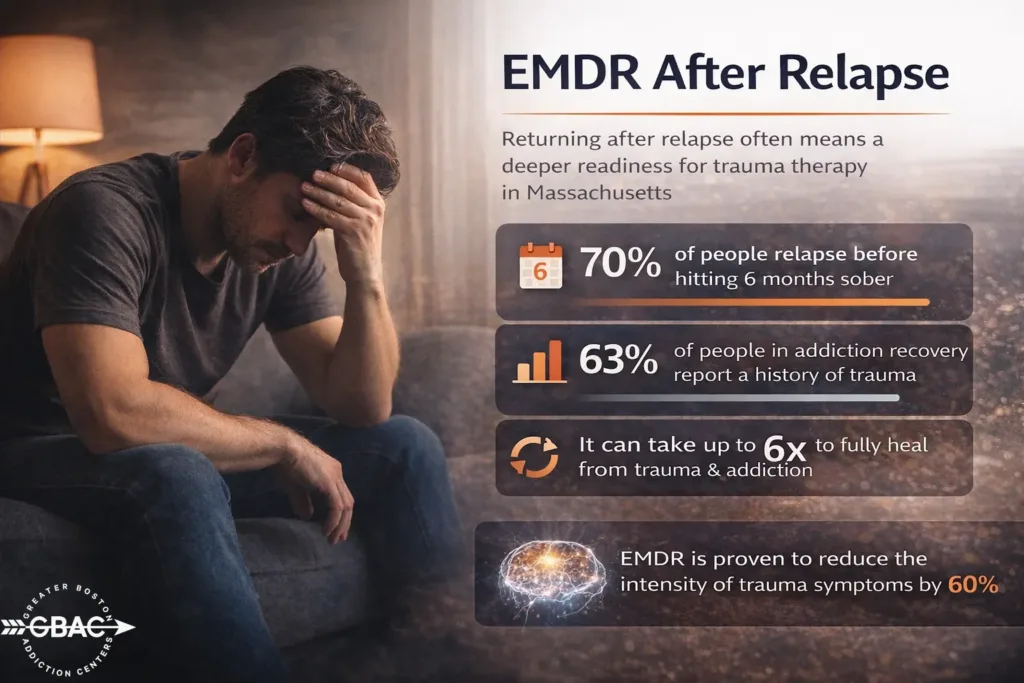
You’re Not Starting Over—You’re Starting Deeper
It’s easy to think you’ve lost all your progress. But here’s what we tell alumni: relapse doesn’t erase recovery. It refines it.
You already know the language. You’ve built coping skills. You’ve sat in group and told the truth with your teeth clenched. That groundwork doesn’t disappear.
What changes now is the direction of the work. You’re not just building from the outside in. You’re going inside—toward the root.
EMDR gives structure to that process. It helps your brain reprocess stored trauma, triggers, or painful memories so they stop hijacking your present. And it does so gently, without forcing you to relive it all.
In Newton, MA, many of our alumni return after relapse not to restart—but to finally reach emotional territory they couldn’t touch before.
What If I Already Tried EMDR and It Didn’t Work?
That happens. Timing matters.
Many people are introduced to EMDR early in treatment. But they may still be emotionally raw, physically unstable, or unsure whether they want to feel anything, let alone everything.
Trying EMDR after relapse is different. You’re not as easily rattled. You’ve been through things. You’re not afraid of the word “trigger” anymore—you just want relief from how deep they cut.
Returning to EMDR with new eyes often means the work lands harder, faster, and cleaner. Not because the therapy changed—but because you have.
The Trauma You Didn’t Know You Were Carrying
Here’s the part most people miss: not all trauma is obvious.
Yes, there are big, capital-T traumas—abuse, loss, violence. But there are also smaller moments of disconnection, humiliation, or abandonment that quietly teach us things like:
- I’m not safe
- I’m not enough
- I’m too much
- I always ruin things
These aren’t just thoughts. They become internal rules that govern our reactions. And in moments of stress, they trigger behaviors we can’t always explain—even to ourselves.
EMDR helps unstick those patterns—not by changing who you are, but by freeing you from the emotional weight you’ve carried way too long.
Why Returning Alumni Often Choose Residential EMDR
Some alumni returning for trauma work choose to integrate EMDR into care in Residential, especially when life outside feels overwhelming.
In Dedham, MA, residential care gives alumni the space to go deeper without life’s constant distractions. You can slow down, regulate your nervous system, and focus on healing. It’s not always about needing more help—it’s about creating the right container for deep work.
That said, EMDR can also be integrated into outpatient care. Our clinicians at Greater Boston Addiction Centers in Massachusetts will help you figure out what level of support fits your needs.
This Isn’t Your First Recovery—It’s Your Next One
Recovery isn’t linear. You know that now. And you also know this: relapse doesn’t mean you’re hopeless. It means you’re human.
You didn’t come back because you failed. You came back because something in you refused to stay lost. And that part of you? That’s the part we work with.
EMDR won’t erase the past—but it will help you stop dragging it into your future. And maybe this time, the work will be the kind that sticks.
In Needham, MA, we’ve seen alumni take their second chance seriously—not because they were forced to, but because this time, it felt like theirs.
Frequently Asked Questions About EMDR After Relapse
Is EMDR safe to do after a relapse?
Yes. In fact, many people find they’re more emotionally ready for EMDR after a relapse than they were during early recovery. Your therapist will help assess whether you’re stable enough to begin.
How long does EMDR take to “work”?
It depends. Some people feel major relief after a few sessions, while others need a longer arc. We often say: it works as fast as your nervous system feels safe to go.
Will I have to talk about everything that happened during my relapse?
No. EMDR isn’t about reliving the past in detail. It focuses on the emotions and body sensations connected to key moments. You don’t have to explain everything to get relief.
Can I combine EMDR with other therapies?
Absolutely. EMDR works well alongside talk therapy, DBT, mindfulness work, and group support. At GBAC, we tailor your plan to support both trauma healing and long-term recovery.
What if I’m scared it won’t work again?
That fear is valid. But you’re not the same person who tried it before. You’ve been through more. You’ve returned with insight. And the very act of trying again means you haven’t given up on yourself.
We’re Still Here—And You Still Belong
You didn’t break the rules. You broke a cycle. You saw what was still unhealed, and you had the courage to come back.
That matters more than any milestone.
Call (877) 920-6583 to learn more about our EMDR services in Massachusetts. If you’re back, it means you still believe something better is possible. And we do too.
