

You already know something needs to change.
Maybe it’s the way you’ve been coping. Maybe it’s how often you feel overwhelmed, flat, or like you’re watching life happen instead of living it. Maybe it’s the pain you’ve never said out loud but feel every single day.
You don’t need convincing that healing is necessary.
What you need is a way to start that doesn’t feel like too much. Something that meets you where you are—even if that place is anxious, unsure, or deeply tired.
That’s where EMDR comes in.
It’s not just a trauma therapy. It’s a gentle but powerful way to begin healing the parts of you that never felt fully seen, processed, or released. And for many first-time treatment seekers, EMDR is the step they never knew they needed—until it finally clicks.
EMDR Isn’t Talk Therapy—and That Might Be a Good Thing
If you’ve been avoiding therapy because the thought of “opening up” sounds terrifying, exhausting, or impossible—EMDR might feel like a relief.
Unlike traditional talk therapy, EMDR doesn’t require you to explain every detail of what happened. You don’t have to go through your story in chronological order. You don’t have to “make sense” of it all first.
EMDR works directly with how trauma is stored in the brain and body—through images, sensations, and survival responses that don’t always come with words.
With the help of bilateral stimulation (like eye movements or tapping), your brain begins to reprocess painful experiences. Not by reliving them—but by moving them out of the fight/flight/freeze zone and into long-term, stable memory where they don’t control you anymore.
It’s not magic. It’s neuroscience. But it often feels like relief for people who’ve never been able to get there with words alone.
You’re Not “Avoidant”—You’re Trying to Stay Safe
If you’ve been putting off getting help, you’re not lazy or avoidant. You’re smart. You’re protective.
Your brain has been doing its best to manage fear, shame, and overwhelm with the tools it had—distraction, denial, substances, control, avoidance.
Those tools kept you afloat. But they weren’t designed to help you heal.
EMDR offers something different. It creates a safe internal space to finally let your guard down—not all at once, but little by little. It works with your system, not against it. And for many people, that’s the first time they’ve felt like therapy was actually doable.
EMDR Helps with the “Old Stuff” You Didn’t Think Mattered Anymore
You might be wondering: Is this really trauma?
Maybe no one ever hit you. Maybe you didn’t survive war or disaster. Maybe your childhood looked “fine” from the outside.
But trauma isn’t just what happened. It’s how your system experienced it. What it had to carry. How it learned to cope. And whether those old emotional survival strategies are still driving your decisions now.
At our trauma-focused program in Brookline, we’ve worked with clients who said:
- “I never thought this counted.”
- “I didn’t think it was that bad.”
- “I figured I should be over it by now.”
And yet those same clients often find that EMDR unlocks a level of healing they didn’t know they were missing. Because when your system stops reacting to the past like it’s still happening? Everything gets quieter.
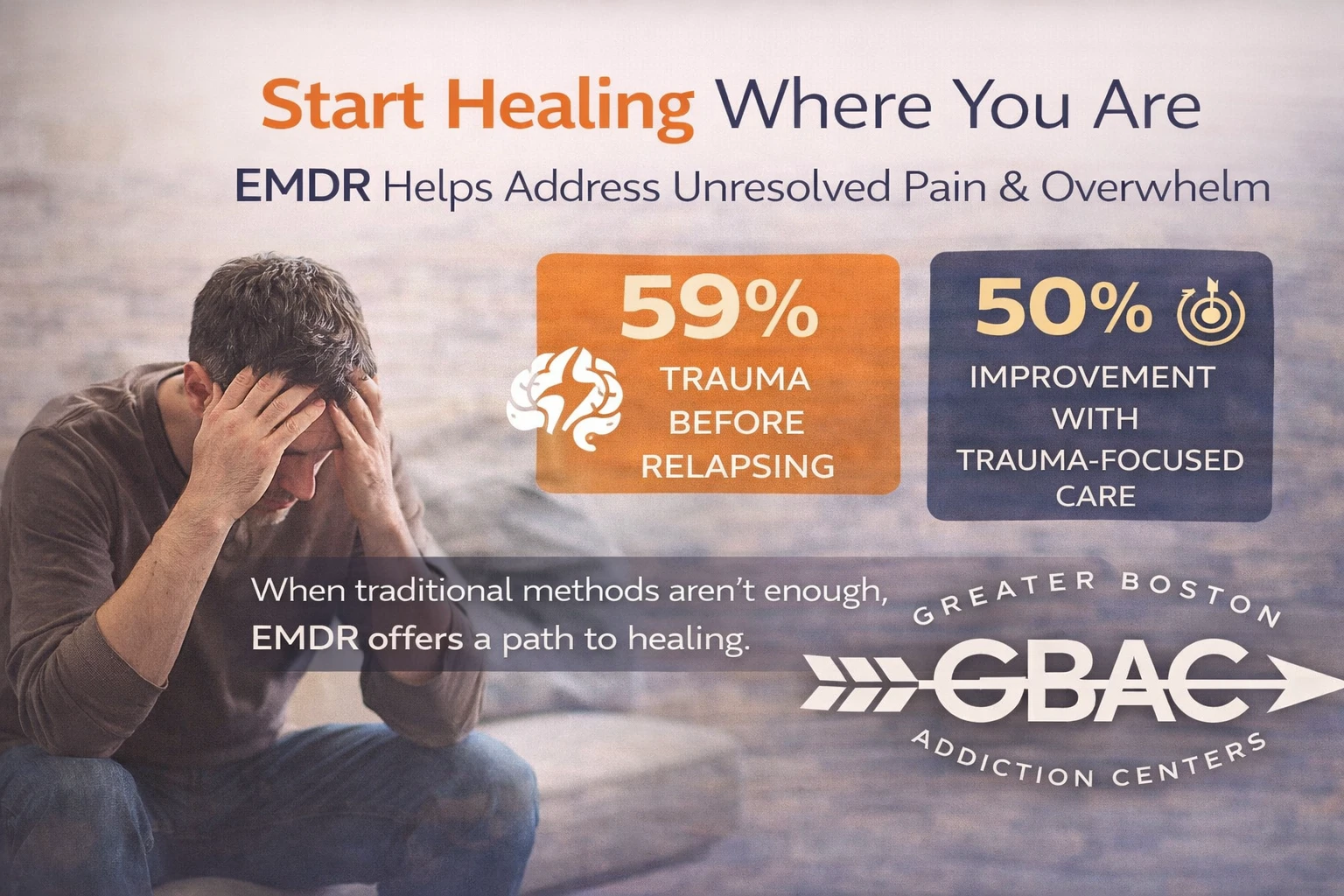
What You’re Feeling Now Might Be a Sign You’re Ready
People don’t walk into therapy when everything is fine. They come in when they’re cracked open just enough to be honest.
If you’re:
- Easily overwhelmed by emotions
- Numbing out more than you want to admit
- Tired of being “the strong one”
- Reacting to things in ways you can’t explain
- Quietly scared of what happens if you stop pretending you’re okay
You’re not weak. You’re ready.
And you don’t have to fall apart to deserve support. You just have to be willing to explore something new—something that helps you feel differently, not just think differently.
Real People. Real Changes. Real Safety.
We’ve had clients come into our Waltham office completely unsure if they could do this.
They weren’t sure they could sit with the pain. They weren’t sure they could trust anyone. They weren’t even sure they had trauma—just a lifetime of carrying too much.
One man said: “I didn’t think I had trauma. I just thought I was difficult. But EMDR helped me realize I’ve been surviving things my brain never had a chance to process. It gave me space to let go of all that shame I didn’t even know I had.”
That’s what makes EMDR different. It doesn’t ask for perfect words or total emotional clarity. It just asks for honesty. Willingness. And a belief—however fragile—that something more is possible.
Why EMDR Is Often a Better First Step Than You’d Think
There’s a myth that EMDR is only for people with a PTSD diagnosis, or for folks deep into trauma recovery.
But it’s actually one of the most effective early interventions for:
- High-functioning individuals dealing with emotional numbness
- First-time treatment seekers who are skeptical of talk therapy
- People exploring sobriety or emotional recovery for the first time
- Adults who never realized their “normal” was actually survival mode
In our Boston-area programs, we integrate EMDR early on for people who don’t want to spend six months getting comfortable in therapy before anything starts to shift.
Because for many, time matters. Relief matters. Feeling like something is working matters.
You’re Not Broken—You’re Burdened
There’s a line we say often: You’re not broken. You’re burdened.
That burden might look like anxiety. Numbness. Detachment. Hyper-independence. Overachievement. Self-sabotage.
But underneath all of that is someone who wants to heal. Who’s tired of surviving. Who’s ready to feel safe inside their own body again.
EMDR helps you do that.
And whether you’re from West Roxbury, Dorchester, or just scrolling late at night wondering if therapy would even work for someone like you—we want you to know: it’s not too late. You’re not too complicated. And the healing you’ve been avoiding might be the safest thing you’ve ever done.
FAQs for EMDR Therapy at Greater Boston Addiction Centers
Do I need to be diagnosed with PTSD to do EMDR?
Not at all. While EMDR is highly effective for PTSD, it also helps with anxiety, depression, emotional reactivity, substance use triggers, and more.
Will I have to relive painful memories?
No. EMDR is designed to reduce distress—not increase it. You stay in control the entire time, and you don’t need to share every detail out loud.
How many sessions does it take?
Every person is different. Some feel significant relief within 6–10 sessions. Others integrate EMDR into longer-term therapy. We tailor the process to your pace.
Can I try EMDR if I’ve never done therapy before?
Absolutely. EMDR is often easier to engage with than traditional talk therapy—especially for people who struggle to explain what they’re feeling.
Is this only for people in addiction recovery?
Not at all. We work with people at all stages—those exploring sobriety, managing anxiety, recovering from toxic relationships, or navigating burnout.
This Might Be Your First Step—But It Doesn’t Have to Be Alone
You’ve carried a lot. Quietly. For years.
You’ve minimized it, managed it, maybe even made a life around it.
But now it’s asking to be acknowledged. Healed. Released.
Call (877) 920-6583 or visit EMDR services in Boston, MA to start a conversation about what’s possible.
We serve individuals in Needham, Newton, and the greater Boston area with trauma-informed care that’s as respectful as it is effective.
You don’t have to do this alone. And you don’t have to wait until you fall apart.
We’ll meet you right where you are.
