

You didn’t fall apart. You kept going.
You held it together through the late nights, the care-taking, the performance reviews, the parenting, the pressure. You were the one people leaned on—until one day, even a good morning text felt like a task. And still, you showed up.
But something inside you quietly shut down.
If you’re here, you may already know that this isn’t just “being tired.” It’s not laziness, or a bad week, or something you can fix with a bubble bath. It’s a kind of emptiness that sleep can’t touch.
That’s burnout. And for many of our clients, EMDR is what finally helps.
At Greater Boston Addiction Centers, we work with people who are emotionally exhausted—not because they’re weak, but because they’ve carried too much for too long. And if rest hasn’t helped? EMDR can.
Burnout Lives in the Nervous System, Not Just the Mind
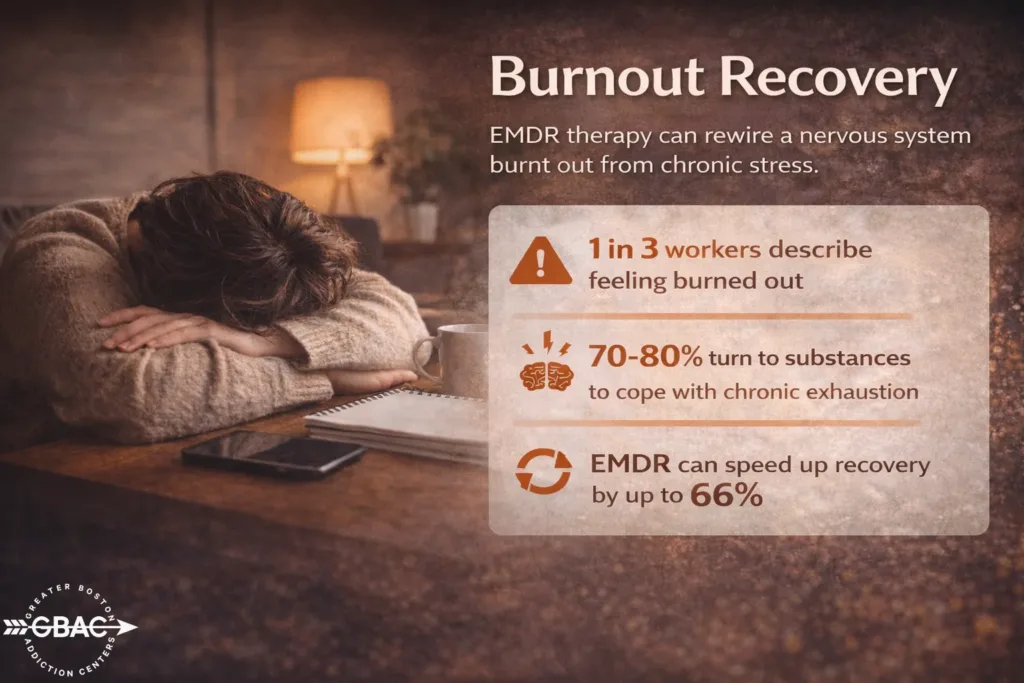
Burnout is a nervous system stuck in overdrive. It’s your body holding tension even when you’re lying down. It’s your brain cycling through scenarios even when no one’s asking anything of you.
It’s what happens when you’ve been “on” too long and never fully come down.
This is why vacations don’t help. It’s why a nap doesn’t change anything. Because burnout isn’t about energy. It’s about your entire system being wired to survive, not rest.
EMDR reaches that system.
It speaks directly to the parts of your brain that learned to be alert, pleasing, apologetic, or perfect—and never learned how to power down. It doesn’t ask you to talk it out. It helps your brain finish what it never got to process in the first place.
Talking About It Doesn’t Always Shift It
You may have already tried therapy. You may be good at explaining yourself. You might even be too good at it—logical, insightful, aware. But still stuck.
That’s because your burnout may not be driven by conscious thoughts. It may be stored in your body’s implicit memory—the way your shoulders stay tight, the way you flinch at kindness, the way you say “yes” even when your whole body says “no.”
EMDR works with that.
It helps reprocess those internal signals, so your body can register that you are safe now—even if it didn’t feel that way for years. And that shift? That’s the beginning of real rest.
Emotional Exhaustion Is What Happens When Survival Becomes a Personality
Maybe your burnout comes from care work. Or from being “the strong one.” Or maybe it’s from growing up in an environment where emotions were dismissed, danger was unpredictable, or needs were too much to ask for.
Either way, your nervous system adapted. You learned to function under pressure, to silence your needs, to keep going. But now you’re not in that environment anymore—and your body hasn’t gotten the memo.
That’s not dysfunction. That’s loyalty.
And it’s exhausting.
EMDR doesn’t shame your patterns. It honors how they helped you survive—and then helps your brain gently let them go.
Real Rest Isn’t Escape—It’s Presence Without Panic
Here’s what one client from Wellesley, MA told us after her fourth EMDR session:
“For the first time in years, I sat on my porch and didn’t think about what I should be doing. I just… existed. It felt like exhaling for the first time.”
That’s not just relief. That’s regulation.
EMDR helps clients stop bracing for the next demand, disappointment, or disaster. It doesn’t erase the past. It just helps the past stop hijacking your present. And that’s where rest becomes real.
Burnout Recovery Often Starts with Saying, “I’m Done Coping”
By the time people find EMDR, they’ve usually tried everything else. Planners. Meditations. Podcasts. Supplements. “Fixing” themselves in private.
But what if burnout isn’t something you fix?
What if it’s something your body lets go of—once it feels safe enough?
That’s what EMDR can offer. A reset that isn’t just mental. A shift that doesn’t depend on “trying harder.” A healing process that doesn’t ask you to perform your pain.
You just show up. And we meet you there.
Why Some Clients Choose Residential EMDR
For some clients, even attending weekly sessions feels like a mountain. That’s why a short stay in support in Residential can make all the difference.
In Needham, MA, we offer trauma-informed residential care that includes EMDR in a slower, quieter, more supportive space—so you’re not doing deep healing in between grocery runs and emails.
This isn’t about being “too far gone.” It’s about giving your system the space to come back online—without the noise of everyday life.
It’s Not About Going Back to Normal—It’s About Finding a New One
One of the biggest fears for burned-out clients is: What if I never feel like myself again?
Here’s the truth: You may not go back to who you were. But what you find on the other side of burnout might be more honest, more grounded, and more free than you’ve ever known.
In Waltham, MA, we’ve seen clients step into a version of themselves that isn’t built on adrenaline, approval, or constant doing. EMDR didn’t give them a new identity—it helped them return to one they’d never had the safety to live in before.
Frequently Asked Questions About EMDR for Burnout
Can EMDR help if I’m just “tired all the time”?
Yes—especially if that tiredness comes with emotional numbness, irritability, anxiety, or feeling disconnected from yourself. It’s designed for more than trauma—it helps with emotional stuckness, too.
Do I have to talk about painful memories?
Not in detail. EMDR focuses on how memories and beliefs are stored in your nervous system. You can share as much or as little as you want. You’ll never be pushed.
Is this for people with “real trauma” only?
No. Burnout from emotional caregiving, chronic invalidation, or long-term stress can be just as impactful on your system as acute trauma. EMDR meets you wherever the pain began.
How long does EMDR take?
It varies. Some clients experience noticeable shifts in a few sessions. Others do deeper work over several months. We move at your pace—never faster than your nervous system can handle.
Can I start EMDR without knowing what’s “wrong”?
Absolutely. Many people come in saying, “I don’t even know why I feel this way.” That’s okay. EMDR helps reveal and reprocess stuck emotions—even if you can’t name them yet.
Burnout Isn’t a Personality Flaw—It’s a Signal to Stop Carrying It Alone
If you’re exhausted, disconnected, or quietly disappearing inside yourself, you’re not broken. You’re likely just overdue for a kind of healing no one ever offered you.
Call (877) 920-6583 to learn more about our EMDR services in Massachusetts. Let’s help you come home to yourself—without guilt, without grind, and without going it alone.
