

Some people hit bottom. Others keep showing up—to work, to dinner, to every expectation on the calendar—while secretly unraveling. If that’s you, you’re not alone. Holding it all together can become its own kind of crisis.
At Greater Boston Addiction Centers, we understand the quiet collapse that high-functioning people go through—and how an intensive outpatient program in Boston can offer a structured, respectful way back to balance. You don’t have to wait for your life to fall apart to start caring for yourself.
You Don’t Have to “Fall Apart” to Deserve Help
If you’re the kind of person who’s always composed in public, the one who people rely on—at work, at home, in your friend group—this part is for you.
Maybe your calendar is full, your responsibilities are met, and on paper, everything looks “fine.” But behind the scenes, you’re relying more and more on alcohol, pills, or another substance to push through. You keep promising yourself you’ll cut back. You keep managing… until you’re not.
The truth is, high-functioning doesn’t mean you’re okay. It means you’ve learned to keep going under pressure. It means you’ve become skilled at hiding what hurts.
But the longer you stay in that mode, the harder it is to see how much it’s costing you.
The Hidden Toll of Pretending Everything’s Fine
It’s subtle at first. You forget what rested feels like. You get snappy with your partner. You start skipping meals or avoiding people you used to love being around. You plan your days around when you can finally drink, or you rationalize needing that pill just to take the edge off.
No rock bottom. Just a slow erosion of joy.
This kind of living chips away at your identity. It’s not loud, but it’s painful. And that pain often gets dismissed—by others and by yourself—because you’re still showing up.
But showing up while breaking down isn’t strength. It’s survival.
And you don’t have to keep surviving like this.
What an Intensive Outpatient Program Actually Looks Like
Many high-functioning adults resist treatment because they assume it requires disappearing from their lives. But not all treatment means checking into a facility or taking a leave from work. That’s where IOP—intensive outpatient programming—comes in.
At Greater Boston Addiction Centers, our IOP is structured specifically for people who need flexibility and discretion—without sacrificing quality of care.
Here’s what to expect:
- Sessions 3–5 days per week, typically in the morning or evening
- Group therapy, focused on real-life coping skills, stress management, and substance use
- Individual counseling, to explore deeper patterns and emotional triggers
- Recovery education, designed to build resilience without overwhelm
- Optional family support, if you’re ready to include loved ones in your healing
It’s real care, for real life. You don’t have to stop everything to start getting better.
Why IOP Works for High-Functioning People
The appeal of IOP isn’t just the flexible schedule—it’s the emotional fit. High-functioning individuals often struggle with asking for help because their struggles are invisible to others. They feel shame for not being able to fix it themselves. They fear being seen as “weak” or “dramatic.”
Our IOP in Boston is designed to counter those fears.
- It’s private. You come to therapy and return to your life—not a dramatic disappearance.
- It’s intelligent. We don’t talk down to you or oversimplify your experience.
- It’s customized. You can maintain work, parenting, or school while engaging in real change.
We work with people from all walks of life—corporate leaders, parents, students, entrepreneurs—who share one thing in common: they’re tired of holding it all together while falling apart inside.
You Might Not Look “Sick”—But You Know You’re Not Well
If you’ve ever thought…
- “I’m not that bad.”
- “No one would believe I need help.”
- “What if getting help messes everything up?”
…then you’re exactly the kind of person IOP was built for.
Struggling in silence is still struggling. Your pain counts. And there is support available that fits your life—not the life you’ll have to destroy to get help.
Whether you’re in the city or looking for an intensive outpatient program in Needham, we’re close, and we’re ready.
Signs You Might Be Functioning—But Not Thriving
If you’re not sure whether IOP is right for you, here are a few signals worth noticing:
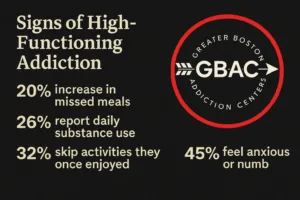
- You feel like you’re constantly “on,” but internally anxious or numb
- You use alcohol or drugs to cope with stress, sleep, or socializing
- You’ve tried to cut back—and failed more than once
- You dread being alone with your thoughts or without a substance
- You’ve thought, “If people knew how I really feel, they’d be shocked”
You don’t need to check every box to seek help. One is enough. And even noticing these signs means you’re paying attention to your inner life—and that matters.
Why Greater Boston Addiction Centers?
We specialize in meeting people where they are. We don’t expect you to call yourself an “addict.” We don’t believe in shame. We believe in building real connections, offering practical tools, and treating the whole person—not just the symptoms.
Our team includes licensed therapists, clinical addiction specialists, and support staff who understand both the science of substance use and the emotional complexities that come with high-functioning struggles.
At our Boston facility, you’ll be surrounded by people who see beyond the surface—and who respect your privacy, your intelligence, and your dignity.
What Happens If You Wait?
Here’s what we hear from people who delayed treatment:
“I thought I had more time.”
“I didn’t think anyone would understand.”
“I was scared of what it meant to need help.”
Here’s what we hear once they start IOP:
“I wish I’d done this sooner.”
“I finally feel like I can breathe.”
“This saved my life—and no one at work even knew.”
Waiting won’t make it easier. It just prolongs the fatigue. And it makes the climb back steeper.
The sooner you begin, the sooner the pressure starts to lift.
FAQs About Intensive Outpatient Programs
Do I have to stop working to enroll in IOP?
No. IOP is designed for people who need support while continuing to work, parent, or study. Many programs offer morning or evening options to fit your schedule.
Will I be judged or labeled?
Absolutely not. We work with people at all stages of awareness—from “I think I might have a problem” to “I’m ready to stop completely.” There is no pressure to adopt a label.
Is IOP confidential?
Yes. Your participation is protected by confidentiality laws, and we prioritize discretion. No one outside of your treatment team will know you’re attending unless you choose to share.
How long does IOP last?
It varies. Most people stay in IOP for 6–12 weeks depending on their needs and progress. We also offer step-down services if you want to continue care in a less intensive format afterward.
What if I’m not ready to quit entirely?
You don’t have to be. Many people come to IOP simply to get clarity, reduce harm, or understand their relationship with substances better. There’s space for exploration—not perfection.
You Can Step Back Into Your Life—Fully
The truth is, you’re not broken. You’re burnt out, overwhelmed, maybe scared. And that’s okay. There’s no shame in saying, “I need help.” There’s wisdom in it.
An intensive outpatient program won’t fix everything overnight. But it can give you space to exhale, to feel, to reconnect with who you are underneath the performance.
If you’ve been living like a house that looks beautiful on the outside but has cracks running through the foundation—IOP is the crew that helps you reinforce, rebuild, and rest.
Ready to feel like yourself again?
Call (877) 920-6583 or visit Greater Boston Addiction Centers to learn more about our intensive outpatient program services in Boston, MA.
