
When you’re newly sober, six months can feel impossibly far away.
The days move slow. The emotions hit hard. And even when things are technically “going well,” you might still feel hollow, unsure, or like you’re watching your own life from a distance.
You’re not doing it wrong.
Early recovery can be painfully quiet. And when everyone around you is telling you to be proud, but you still feel empty or unsure—it’s hard to believe anyone understands.
This is for you if you’re somewhere in that first stretch of sobriety. Maybe you’re in a structured alcohol treatment program. Maybe you’re doing outpatient. Maybe you’re just trying to hang on, one sober day at a time.
Wherever you are—this is what the six-month mark might actually look and feel like.
Will I Still Feel Lonely at Six Months?
Possibly—but not in the same way.
In the early weeks, loneliness can feel unbearable. You’re suddenly cut off from the people, places, and routines that filled your time—even if those things were hurting you. And in that space? It’s just you, your thoughts, and silence that used to be drowned out.
At six months, that silence becomes more familiar. You may still miss things, but the grief softens. Some days, it even turns into peace.
By now, you might have a few connections—maybe someone in group you trust, a counselor who remembers your story, or a friend who checks in. The loneliness doesn’t always vanish. But you stop feeling invisible.
Will I Feel Proud of Myself Yet?
Probably not all the time. But more often than you think.
Here’s the thing: pride in recovery doesn’t show up like you might expect. It doesn’t always feel like fireworks or breakthroughs. Sometimes it’s just… realizing you showed up when you didn’t want to. Or you didn’t lie. Or you cried in group and stayed in the room.
These aren’t flashy victories. They’re the kind that rebuild your self-respect quietly, day by day.
Six months in, that kind of pride might still feel fragile. But it’s there. It’s in the way you speak more honestly. In how you answer the phone. In how you’re learning to face discomfort without numbing.
What Will Change Emotionally?
You’ll still have highs and lows. But the swings might not be as sharp.
By six months, your nervous system has had some time to adjust. The extreme emotional spikes of early detox or early withdrawal tend to settle. You may still cry in group or get angry over small things—but you’ll also start to feel more grounded.
This is also when deeper emotions can emerge. You might start grieving parts of your past. Or noticing how long you’ve gone without feeling joy. That’s not failure—it’s evidence that your emotions are waking up again.
And that means you’re healing.
What If I Don’t Feel Better Yet?
That’s common—and it doesn’t mean something’s wrong.
There’s a phase in recovery where the chaos quiets, but the joy hasn’t shown up yet. It can feel like floating in space.
Six months might be that time. You’re no longer in crisis. You’ve been doing the work. But you still feel… disconnected. Maybe even numb.
This doesn’t mean the program isn’t working. It means you’re hitting the stage where deeper shifts are happening—often beneath the surface. Keep going. Keep talking. This part doesn’t last forever.
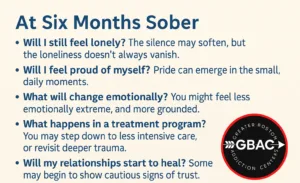
What Happens in a Treatment Program Around Six Months?
At the six-month mark, you might:
- Step down to a less intensive level of care
- Start integrating work or school back into your routine
- Get assigned a sponsor or peer mentor
- Revisit deeper trauma or co-occurring mental health issues
It’s also common to re-evaluate your goals. You may realize you want to stay longer, or explore new layers of growth.
If you’re in a structured alcohol treatment program in Needham or Boston, talk to your counselor about how your plan can adapt—not just to keep you sober, but to help you want to stay.
Will My Relationships Start to Heal?
Some, yes. Others might take longer.
By six months, some people in your life may start to trust you again. They might say things like “You seem different,” or “I’m proud of you.” That can feel amazing—or overwhelming.
Other relationships may still be strained. Some people might keep their guard up. And that can hurt, especially when you’ve worked so hard.
Try to remember: trust isn’t just about staying sober. It’s about consistency. Boundaries. Honesty. If you’re showing up differently, people will start to notice. It just might take longer than you want.
Will I Still Crave Alcohol?
Yes—but probably differently.
By this point, cravings often shift. They become less about the physical urge and more about stress, boredom, loneliness, or celebration.
You might not want the drink—you might just want what the drink used to offer: relief, connection, escape.
The good news? By now, you probably know what your triggers are. You’ve practiced ways to ride them out. And maybe—just maybe—you’re starting to believe you deserve better than going back.
What Will I Have Gained?
By six months, here’s what you might be holding in your hands:
- Mornings that don’t start in shame
- A sense of clarity you didn’t know was possible
- A few real relationships built on honesty
- A voice in your head that’s slightly kinder
- The ability to sit with discomfort, even if it sucks
These things are quiet. They don’t get applause. But they are your foundation now.
What If I’ve Slipped Along the Way?
You are not disqualified.
Recovery isn’t a staircase. It’s a path with uneven ground. If you drank at month four, or lied to your sponsor, or missed a group session—you haven’t failed. You’ve just hit a human moment.
The question isn’t, “Did I slip?” The question is, “Am I still showing up?”
And if the answer is yes—even with shame in your chest and doubt in your heart—you are still in recovery. You are still moving forward.
What If I’m Still Not Sure I Want This?
That’s okay.
You don’t have to be 100% sold on sobriety to keep going. You’re allowed to have days where you miss it. You’re allowed to be sad about what you lost—even if what you lost was killing you.
At six months, it’s normal to question everything. Keep questioning. Keep talking. Keep showing up.
Doubt isn’t the enemy. Isolation is.
Still finding your footing in recovery? You’re not alone.
Call (877) 920-6583 or visit Greater Boston Addiction Centers’ Alcohol Treatment Program to explore compassionate care that meets you in the middle—whether you’re hopeful, hurting, or still figuring it out.
