

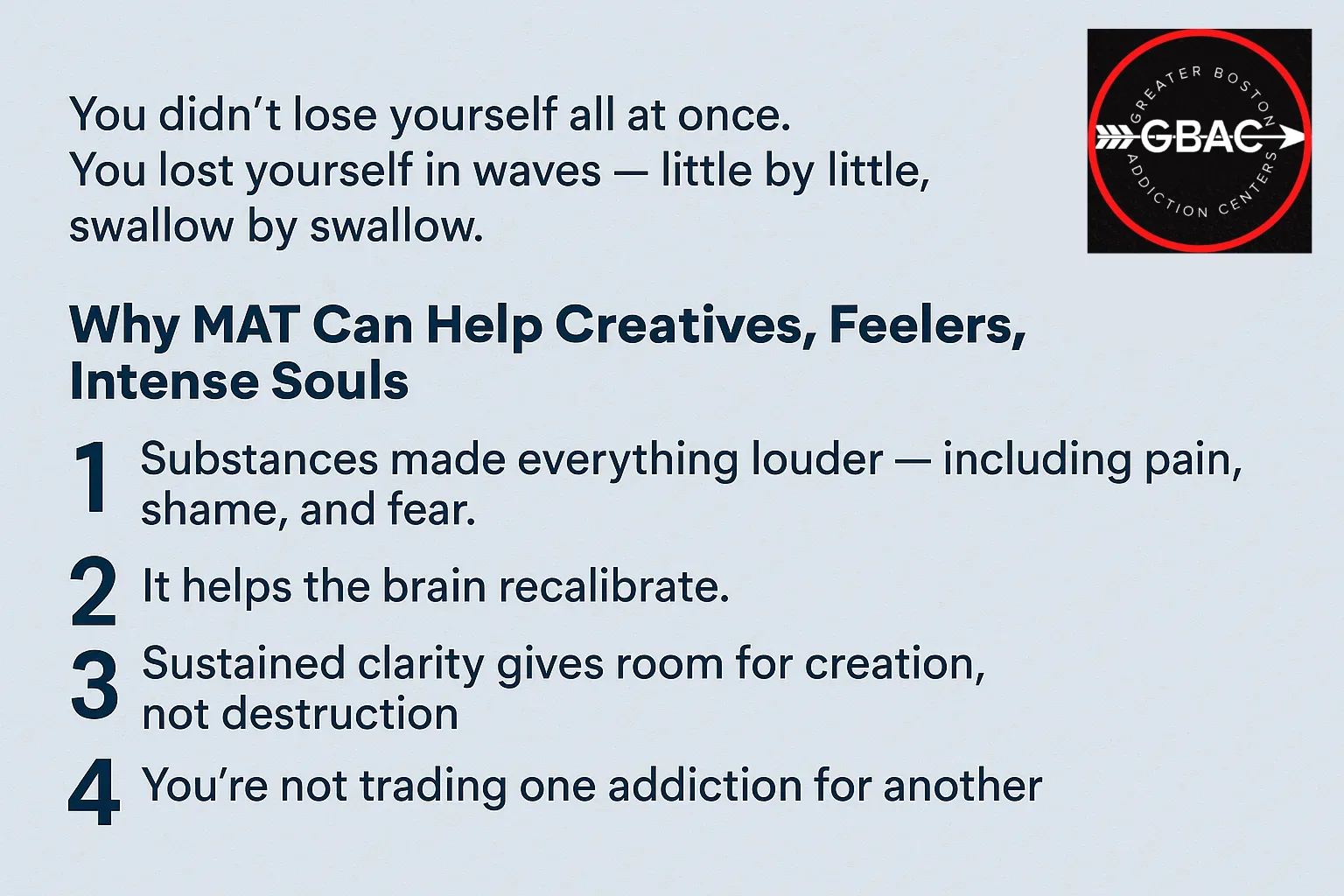
You didn’t lose yourself all at once.
You lost yourself in waves — little by little, swallow by swallow, shut-down moment by shut-down moment.
When you started thinking about getting help, the phrase medication assisted treatment might have felt like a betrayal to the person you thought you were. A shortcut. A crutch. A dangerous turn into blandness. But what if… instead of losing yourself, you actually found your way back?
At Greater Boston Addiction Centers’ medication assisted treatment program, we’ve seen it happen — and often for people who believed sobriety meant giving up the part of themselves that mattered most.
I Thought My Creativity Needed Chaos
Growing up, chaos felt like the only way to stay awake. Whether it was late-night writing, coffee-fueled energy surges, music loud enough to shake the walls — I believed that if I slowed down, fizzled out, or even took a break, I’d vanish. My art, my rhythm, my self… all part of the same dangerous spark.
Drugs, alcohol, whatever kept me going: I called that fuel. But the truth was, over time, I stopped creating. I was no longer alive — I was surviving. My mind became a murky river. Thoughts blurred. Feelings deadened. Hope leaked away.
And suddenly, I didn’t recognize the person I once was.
I wasn’t asking to go numb. I was asking to get back. Back to clarity. Back to color. Back to waking up and writing without fighting a blackout.
That’s when I heard about medication assisted treatment (MAT). I tensed. My gut clenched. What if choosing MAT meant surrendering the only rhythm I had left?
MAT Isn’t About Substituting One Crutch for Another
The common image of MAT is legalism, replacement, maybe even a different kind of fog. But what we do at Greater Boston isn’t about swapping one thing for another. It’s about healing the nervous system enough to remember who you actually are.
Medication is one piece. Counseling, therapy, community, structure — that’s the rest.
So while medications help stabilize the physical chaos, therapy and support guide you back to yourself.
You don’t lose your spark. You rebuild around it.
Why MAT Can Help Creatives, Feelers, Intense Souls
- Substances made everything louder — including pain, shame, and fear. For some of us, that intensity felt like color. Like life. But over time, it oversaturated until nothing was left but noise. MAT can dampen the noise enough that you can hear yourself again.
- It helps the brain recalibrate. Addiction rewires reward systems, stress responses, and emotional regulation. This rewiring often leaves creators feeling cut off from their own inner lives. With the right medication and therapies, MAT can restore balance — giving your brain a chance to catch up with what you always felt, but couldn’t hold.
- Sustained clarity gives room for creation, not destruction. You wake up stable, without withdrawal, without anxiety spirals. And suddenly, you have margin — for music, for writing, for relationships, for being.
With MAT, you’re not trading one addiction for another. You’re giving your brain a chance to rebuild its wiring, to remember the rhythms that made you.
What Recovery Looks Like on MAT, in Real Life
Here’s a walk-through of a day, after MAT helps settle the edges:
- You wake up and your head isn’t pounding. There’s no shame for what you did last night.
- You have thoughts again. Coherent thoughts. Not scattered, or buzzing. Your mind settles enough to catch the edges of meaning.
- You sit down with your journal, sketchbook, or instrument — and you don’t flinch away. You greet that old voice that’s been waiting for you.
- Emotions come — grief, hope, fear — but they don’t hijack you. You can sit with them. Breathe through them. Channel them without combusting.
- You show up to therapy or group sessions, where someone listens, really listens — to the pain, the anger, the heartbreak, the art. And you realize you’re not alone.
- At the end of the day, you sleep. Real sleep. No shakes. No regrets.
That’s not recovery as dullness. That’s recovery as return. Return to self.
Changing the Story: From “Addict” to Artist, From “Broken” to Alive
When you first get clean — with or without medication — maybe the chaos quiets down so much you feel empty. Like the stereo turned off.
That fear is real. It’s valid.
But what most people don’t tell you is: emptiness often means resetting. Clearing the debris. And from that blank space, creativity, art, connection — real, raw, breathing life — can start again.
One of our clients shared something simple but powerful:
“It felt like all my wires had short‑circuited. MAT didn’t replace the electricity. It repaired the circuit.”
That’s the kind of reclamation MAT can offer — a second chance at living in your full spectrum.
MAT Is a Bridge — Not a Crutch (Unless You Ever Want It to Be)
This isn’t about relying forever. This is about recovering enough to make a choice again.
For some, that means staying on medication for a long time — to preserve balance, creativity, mental ease. For others, it’s a bridge: once things stabilize, they step off and keep walking on their own.
It’s not about “good” or “clean.” It’s about living.
Addressing the Shadow Side of Fear: What I Was Afraid Would Happen
| Fear | Reality (Often Better Than Expected) |
|---|---|
| “Medication will dull my creativity.” | Many artists say their work gets more focused, more honest — not hollow. |
| “I’ll become a zombie, staring at walls.” | Balanced meds + therapy = mental clarity, emotional ground, creative flow. |
| “It will feel like a surrender.” | Sometimes surrender is survival. And survival can be the first brushstroke on a new canvas. |
| “People will judge me.” | The people who care don’t judge. And those who do? Their judgment isn’t your burden. |
What This Path Actually Requires — and What It Doesn’t
It Requires:
- Honesty — with yourself and with the clinicians helping you
- Consistency — showing up, medication as prescribed, therapy, self‑reflection
- Trust — that you deserve care even when you feel unworthy
It Doesn’t Require:
- Giving up who you are (or were)
- Becoming a different person entirely
- Surrendering control forever
This path doesn’t demand a mask. It asks for courage. And that courage is yours — whether you feel like it today or not.
Frequently Asked Questions From Creatives Considering MAT
Will medication change my personality or dull my art?
Not usually. For many, MAT actually improves focus and creativity by calming the chaos enough to make space for creation. Your core remains. The medication only helps quiet the noise around it.
If I start MAT, will I depend on medication forever?
That depends on your needs, not a preset schedule. Some stay on it long-term for stability. Others taper off when they feel ready. The choice is yours, with guidance. What matters is sustainability — not an arbitrary “clean date.”
What if I’ve tried sobriety before and relapsed?
You’re not a failure. Relapse often means your brain and body needed more support than you had at the time. MAT is a valid, evidence-based option precisely for people who struggle with relapse but want to keep trying — with better tools.
Will I lose the intensity that used to fuel me?
You might lose some of the overstimulated chaos. But that doesn’t mean losing the intensity that actually matters — the intensity of emotion, of art, of clarity. MAT can help you feel deeply again, without burning yourself out.
Is Medication Assisted Treatment just for “hard” addictions?
No. MAT supports recovery whether your situation feels dire or if you’re still functioning but masked the struggle with substances. If substance use is affecting your emotional life, relationships, mental health, or creativity — MAT might help.
If You’re Waiting for Permission — This Is It
You don’t owe anyone a performance.
You don’t need to prove that you’re “sick enough.”
You just need to be honest enough to ask for help.
Medication assisted treatment isn’t a shortcut.
It’s a lifeline.
A lifeline for your brain.
A lifeline for your art.
A lifeline for the person you were meant to be — flawed, brilliant, alive.
Ready to talk with someone who gets it — instead of judging it?
Call (877) 920-6583 or visit Greater Boston Addiction Centers’ MAT program to learn more about how medication assisted treatment can help you rebuild — without erasing what makes you you.
