

There’s a myth that lingers quietly beneath so much of our culture—especially for those who feel deeply, express vividly, and create as if their lives depend on it.
The myth says: You have to suffer to be interesting.
It says your best work comes from pain. That the chaos, the late nights, the numbing and the crashing are just part of being an artist, a writer, a performer, a deep-feeling human.
And if you’re starting recovery—especially with medication assisted treatment (MAT)—you might be afraid of what you’ll lose. Will you still feel as deeply? Will you still write honestly? Will your friends still see you as magnetic, wild, alive?
At Greater Boston Addiction Centers, we know that fear. We’ve seen it in people who dance, direct, sketch, sing, teach, parent, design, and dream. And we’re here to say this clearly:
You don’t have to suffer to be interesting. You don’t have to stay broken to be expressive. And medication assisted treatment doesn’t silence your art—it helps it breathe.
Addiction Doesn’t Fuel Your Genius—It Steals From It
For a while, the high can feel like a shortcut to connection. A lubricant for emotions. A boldness button for social anxiety. It lowers your inhibitions just enough to pour truth onto a page or speak your mind in a crowd.
But eventually, it stops enhancing. It starts replacing.
You write less—not more. You spend more time recovering than creating. You start forgetting things you swore you’d remember. And the version of yourself that was “so alive” on the outside starts to feel distant, even to you.
Addiction doesn’t give you access to your magic. It turns the volume up so loud that eventually, it drowns out your own voice.
How Medication Assisted Treatment Actually Works
Many creatives resist MAT because they’re afraid it will flatten them. That it will make them dull, robotic, too “normal.” But MAT isn’t sedation. It’s support.
When you begin medication assisted treatment in Boston at our center, it’s not just about prescriptions. It’s about safety. About stabilizing your brain and body so you can access more of yourself—not less.
MAT typically includes:
- FDA-approved medications like Suboxone, buprenorphine, or Vivitrol to reduce cravings and withdrawal
- Regular check-ins with a medical provider to monitor how your body is responding
- Individual and group therapy to process emotional patterns and reconnect with identity
- Optional support for family or partners if that’s part of your healing landscape
You’re not giving up your edge. You’re protecting it.
Your Art Doesn’t Come From Your Pain—It Comes From You
One of the lies addiction tells is that you need it to access beauty, sadness, truth, or connection. But if that were true, why does the work start drying up? Why does it get harder to focus, to feel, to create?
The truth is: your creativity was never in the bottle or the pill. It was always in you.
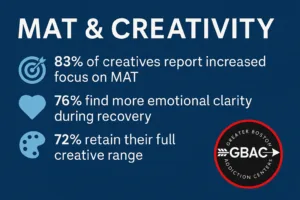
MAT helps you hold still long enough to find that version of yourself again. The one who can stay up writing—not because they’re spun out, but because the words are finally flowing. The one who can cry watching a film and feel proud of their softness instead of ashamed.
Creativity doesn’t go away when the chaos stops. It just stops competing for air.
You Don’t Have to Keep Performing Pain to Be Valid
Some people use performance to hide. You know how to make people laugh, light up a room, talk about the hard stuff without actually showing how bad it hurts.
If you’ve ever thought:
- “People only like me when I’m the fun one.”
- “If I’m not a mess, I’m boring.”
- “I need the chaos to feel real.”
…then MAT might feel like a threat to your identity. But here’s what we’ve learned from the thousands of creative souls who’ve walked through our doors: underneath the performance is someone worth keeping.
MAT doesn’t mute you. It gives you the space to stop pretending.
MAT for Artists, Thinkers, Performers—and Everyone in Between
We’ve worked with people at every level of creative expression—some with careers, some with private sketchbooks, some just trying to get through the week without spiraling.
Whether you’re a high school teacher who used to act in local plays, or a graphic designer with a gallery opening next month, MAT is designed to fit your life.
And if you’re looking for medication assisted treatment in Wellesley or a surrounding area, we’re close enough to support you without pulling you away from what you’re building.
Stability Isn’t Boring. It’s Freedom.
We know how seductive it is to believe that drama makes life richer. That high highs and low lows are part of what makes you you.
But what if freedom isn’t found in the intensity?
What if freedom is being able to write in the morning because you’re not hungover? To sit with sadness without needing to escape it? To feel awe at a painting or a poem and not need a drink to access it?
Stability doesn’t kill your voice. It gives you the tools to use it more clearly, more often, and without burning out.
What If You’re Still on the Fence?
If you’re not sure whether MAT is “real recovery,” or you’re worried about needing medication at all, that’s okay. Doubt is normal—especially for people who’ve relied on substances not just to cope, but to exist.
But here’s the truth: needing help doesn’t make you less strong. And choosing medication isn’t giving up—it’s getting clear.
At Greater Boston Addiction Centers, we don’t shame you for being unsure. We’ll walk with you while you figure it out.
Even if all you can say right now is, “I want to feel more like myself again.”
FAQs About MAT for Identity-Driven Recovery
Will MAT change my personality or creative voice?
No. If anything, MAT removes the static so your voice can come through more clearly. It stabilizes the extremes, but it doesn’t limit emotional depth.
Can I be on MAT and still perform, teach, or create?
Yes. Many of our clients maintain their careers and passions while on MAT. It’s designed to support your functioning—not sideline you from your life.
How long will I need to be on MAT?
There’s no one answer. Some people stay on it for months, others for years. You’ll make that decision with your provider based on your goals and stability.
Is MAT just for people who’ve “hit bottom”?
Not at all. We work with many people who are high-functioning but emotionally exhausted. MAT can be preventive, stabilizing, or long-term—depending on your needs.
You Don’t Need to Hurt to Make Something Beautiful
You don’t have to relive your worst nights to write with truth.
You don’t have to go off the rails to be raw, or tear yourself down just to feel something real.
MAT isn’t a shortcut. It’s not cheating. It’s a bridge. A way back to the parts of you that were never broken—just buried.
You deserve a version of your life that isn’t on fire. A version where your art, your emotions, and your voice don’t have to cost you everything.
Let’s help you stay connected to what matters most—without losing yourself in the process.
Call (877) 920-6583 to learn more about our medication assisted treatment services in Boston, MA.
