

Somewhere between wanting to disappear and wanting to feel okay, I went silent. I didn’t want to die. I just didn’t know how to keep living with the weight I was carrying. Smiling hurt. Breathing hurt. Existing felt like dragging around something invisible and unbearably heavy.
I didn’t have the words for any of it. Not when my friends asked, “Are you okay?” Not when my family said, “You’ve been quiet lately.” I lied because it felt safer than the truth. I thought if I told someone how bad it really was, they’d either panic or turn away.
What I didn’t expect was finding a place where I didn’t have to hold it in anymore—a place where being honest didn’t mean losing control. That place was the partial hospitalization program in Boston at Greater Boston Addiction Centers.
When Silence Became Its Own Kind of Pain
It wasn’t dramatic. There was no breakdown in the middle of a crowded room. It was small moments—sitting on my bed, not moving for hours. Driving home and thinking how peaceful it would be to not have to do any of this tomorrow. Passing mirrors because I didn’t want to look at myself.
People think suicidal thoughts are loud, chaotic. Mine were quiet. Whispers in the back of my mind:
“What if you just didn’t wake up?”
“Would anyone really notice if you disappeared?”
“You don’t want to die, but do you really want to keep living like this?”
That last question stayed with me.
The Day I Finally Reached Out
It was a morning like any other—gray, uneventful. But I felt nothing. Not sadness. Not anger. Just emptiness.
I opened my laptop, typed “partial hospitalization program in Boston,” and just stared. I didn’t even know what I was looking for. I wasn’t in crisis. I wasn’t planning anything. I just knew I couldn’t keep doing this alone.
I clicked on the website for Greater Boston Addiction Centers. Something about the way they described their program—structured support without taking away your freedom—felt like the kind of help I could accept.
It didn’t feel like surrender. It felt like survival.
What a Partial Hospitalization Program Really Is
Before I started, I thought PHP meant hospitals, locked doors, white walls, constant supervision. I imagined losing my phone, my privacy, maybe even myself.
But it wasn’t like that.
A partial hospitalization program is treatment—intense, real, daily—but without requiring you to stay overnight. You arrive in the morning. You leave in the afternoon or early evening. You go home, sleep in your own bed, maybe pet your dog, sit with your thoughts—but you’re not alone anymore.
At GBAC, it looked like this:
- Morning check-ins. Simple questions like, “How are you feeling?” Except you’re allowed to say the real answer.
- Group therapy. Not everyone talks, but everyone listens.
- One-on-one sessions. A space where you can finally say what you’ve been rehearsing in your head for months.
- Meals. Laughter sometimes. Silence sometimes. Both okay.
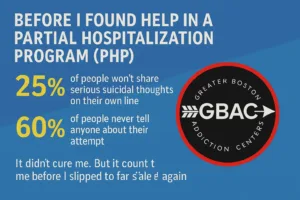
It didn’t cure me. But it caught me before I slipped too far.
The First Time I Said “I Don’t Want to Die, But I Don’t Want to Live Like This”
There was a group session where the therapist asked us to share a thought we were scared to say out loud. My heart was pounding. My hands wouldn’t stop shaking. But I said it.
“I don’t want to die. I just don’t want to be here anymore.”
I expected silence. Or pity. Or panic.
Instead, another person across the room nodded. Someone else wiped a tear. The therapist said softly, “Thank you for trusting us with that.”
Nobody rushed to save me. Nobody called me selfish. Nobody told me to “think positive.”
That moment didn’t fix everything—but it opened a door inside me.
What Safety Looked Like—Even Without Certainty
Safety in PHP didn’t mean everything was okay. It meant:
- I didn’t have to pretend.
- I could say the dark stuff without being treated like I was broken.
- I was seen—not just as a patient—but as a person who was trying.
They taught me how to notice when my mind was slipping into that gray place. How to make a plan before I reached the ledge. How to survive an hour at a time, instead of worrying about a lifetime.
And maybe the most powerful thing—they didn’t ask me to promise I’d be happy. They just asked me to stay.
What PHP Isn’t
People misunderstand it all the time, so let me be clear:
It’s not being locked away.
You go home every day. You still have your life—you’re just not carrying it alone.
It’s not just for people planning to hurt themselves.
It’s also for the ones who are tired of hurting quietly.
It’s not a last resort.
Sometimes it’s the first moment things start to feel possible again.
Leaving Each Day Felt Both Terrifying and Hopeful
After sessions, I’d drive home through Boston traffic. The world looked the same—coffee shops, red lights, people walking—but I felt different. Still tired. Still unsure. But I knew I had somewhere to go the next morning.
For the first time in months, I started to believe maybe staying was an option.
Knowing You’re Not Alone in This City
If you’re in Boston or nearby and wondering if anyone else feels like you—yes. We’re here. Quiet, hurting, but still breathing.
You can even get help if you’re closer to the suburbs—places like the partial hospitalization program in West Roxbury make it easier if Boston feels too loud, too far.
Whether you speak or stay silent—your pain is still real. But silence doesn’t have to be home forever.
FAQs About Partial Hospitalization Programs (PHP)
What is a partial hospitalization program?
It’s a structured mental health treatment program where you receive therapy and support during the day but return home at night. It offers more care than weekly therapy but more freedom than inpatient hospitalization.
Do I need to be suicidal to attend PHP?
No. Many people go because they’re struggling to cope, feel emotionally overwhelmed, or can’t function the way they used to—but they still want help before things get worse.
Will I lose my privacy or freedom?
No. PHP is voluntary. You keep your phone, your voice, your ability to make decisions. You’re encouraged to speak honestly, but nobody forces you.
How long does a PHP last?
It varies. Some people stay a few weeks, some longer. At GBAC, the team works with you to build a plan based on your needs—not a one-size schedule.
What if I’m scared to talk in front of others?
You don’t have to share right away. Listening is allowed. Trust builds slowly. Nobody expects you to spill everything on day one.
Can I work or go to school during PHP?
It depends on your schedule and energy. PHP is usually during the day, so some people take time off. Others work evenings or weekends. Healing is still productive.
What makes Greater Boston Addiction Centers different?
It feels human. Not clinical. Not rushed. People remember your name. They let you exhale—maybe for the first time in a long time.
You Don’t Have to Be “Okay” to Ask for Help
Maybe you’re where I was—searching late at night, wondering if there’s a place that won’t judge you. There is. You don’t need the right words. You don’t need a perfect reason. You just need to want something different than pain.
If you’re ready to talk to someone who understands, even a little—this could be your first step.
Call (877) 920-6583 to learn more about their partial hospitalization program services in Boston, MA.
