

There’s a quiet kind of ache that can creep in during long-term recovery—one you don’t talk about in meetings. You’re not craving. You’re not on the verge. You’re just… off.
Flat. Foggy. Disconnected from the version of yourself that used to feel lit up by the work. You still say “grateful to be sober,” and mean it. But it feels mechanical now. Like you’re saying it with a full mouth and an empty heart.
You’re not broken. You’re not doing anything wrong. And you’re definitely not alone.
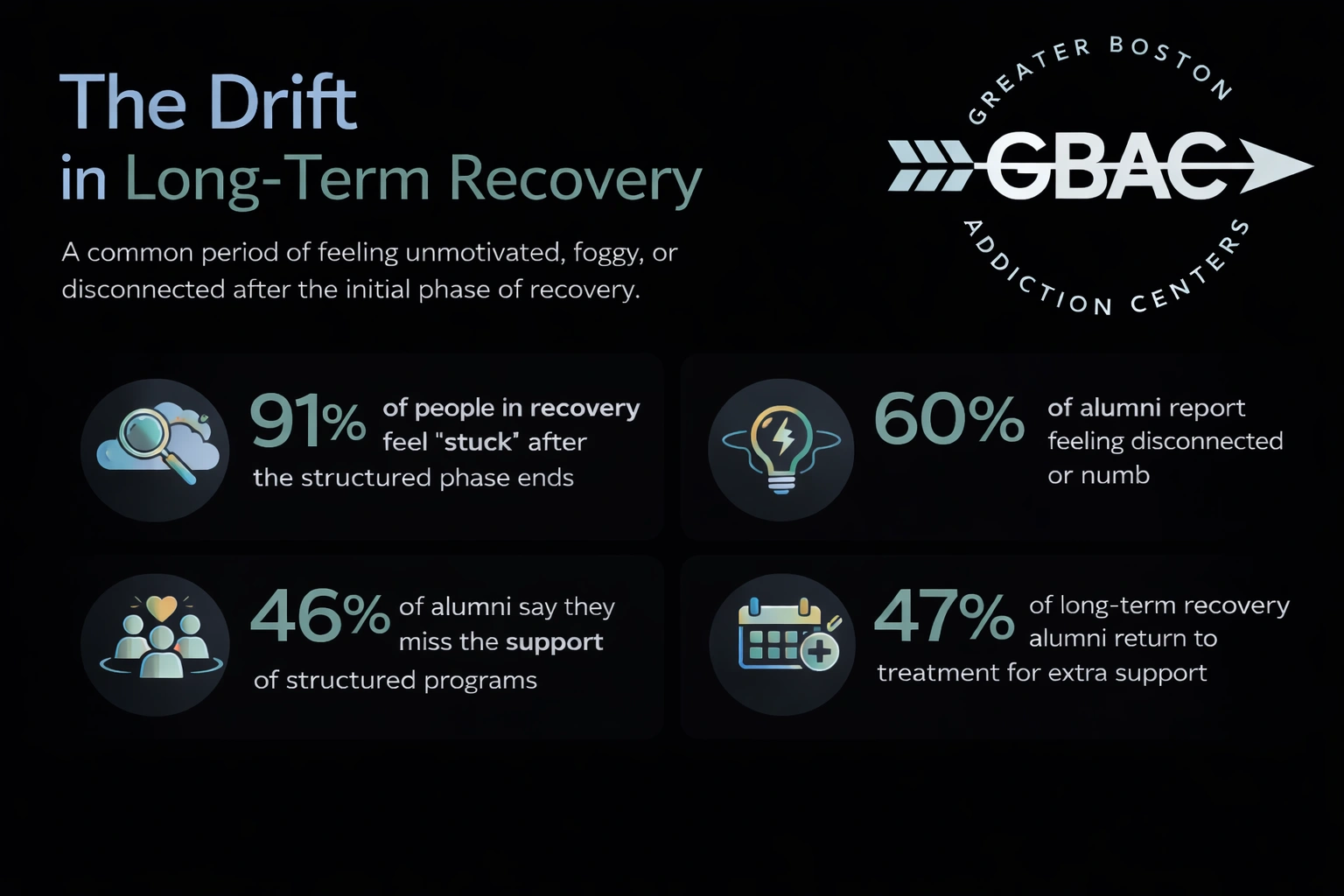
What you’re feeling is a drift. And it’s more common than people admit. Especially for alumni who once thrived inside the structure of a partial hospitalization program—who now find themselves months (or years) out, quietly wondering if the spark they had was just a phase.
At Greater Boston Addiction Centers, we’ve heard it all before. And we’ll say this plainly: structure saved you then—and the truth is, it might be what you’re missing now.
PHP Didn’t Just Stabilize You—It Rewired You
During PHP, your life was shaped by rhythm. You knew where to be and why. You had daily check-ins, community connection, therapy with direction, and a team that noticed when you went quiet.
That wasn’t just about accountability—it was about safety. It gave your nervous system the first real chance to feel held. Predictable structure helped you sleep again. Eat again. Think clearly again.
That structure wasn’t training wheels. It was scaffolding. And it was never meant to be removed all at once.
If you’re drifting now, it’s not because you’re lazy or ungrateful or backsliding. It might just be that your life lacks the rhythm your brain and body actually need.
The Truth: Tools Fade Without Practice
Let’s get honest. You used to journal every night. Practice grounding skills. Stick to sleep routines. Now, the journal’s in a drawer, the bedtime scroll wins more often than not, and group check-ins feel like a box to tick, not a lifeline.
This doesn’t mean you’ve failed. It means life happened. Schedules shifted. Emotions layered up. Maybe you’ve been caregiving. Or overworking. Or isolating “just a little” more than usual.
The thing is—you haven’t lost your tools. They’re still there. But like anything, they get dull when they’re not used.
Your PHP tools weren’t for a season. They were for sustainability. And if you’re not thriving right now, that’s not proof you’re past help. It’s a signal that you’re ready to reengage—just differently this time.
You’re in the Gray Zone—And That’s Where Most People Get Stuck
Early recovery is full of fire. It’s dramatic. Emotional. There are milestones and firsts and big shifts.
But long-term recovery? It’s quieter. It doesn’t offer the same rush of breakthroughs. And if you’re in this phase now, you might be asking:
- Is this all there is?
- Am I just meant to “maintain” forever?
- Why do I feel so numb when nothing’s wrong?
These questions don’t mean you’re ungrateful. They mean you’ve stabilized—and now you’re ready to deepen. And for many people, that requires reconnecting with the structure that once made everything feel possible.
You’re Allowed to Come Back—Even If You’re Not in Crisis
One of the biggest myths in recovery is that you only return to treatment if you’re using again. But the truth is, a lot of alumni circle back when they’re stuck—not spiraling.
We’ve welcomed people back for all kinds of reasons:
- They needed to reset their routines
- They were feeling emotionally disconnected
- Their anxiety came back, harder this time
- They couldn’t remember the last time they felt anything but “meh”
Sometimes that means a few weeks in PHP again. Sometimes it means joining alumni support groups. Sometimes it’s just one call to remember they’re not alone.
If you’re looking for a partial hospitalization program in Waltham or curious if a short-term reset in Wellesley could help, we’ll talk you through your options without pressure.
You Don’t Need to “Earn” More Support
Let’s break another lie while we’re at it: You don’t need to prove that things are bad to deserve help.
If your relationships are intact, your job’s still steady, and no one’s worried about you, it can be easy to gaslight yourself into thinking you’re being dramatic.
But that lingering sense of emptiness? That tension in your chest when you try to meditate and feel nothing? That’s not nothing.
That’s your nervous system asking for something to plug into. Something more than “just stay sober.” Something that reminds you why it mattered in the first place.
What Returning to Structure Can Look Like
Reconnecting with the structure you once had doesn’t mean repeating the exact same schedule. You’re in a different place now. And that’s a good thing.
But it might mean:
- Re-establishing daily rhythms that give your day shape
- Recommitting to tools you used to rely on
- Getting honest about what emotional maintenance looks like now
- Letting yourself be witnessed—without having to fall apart first
And if you decide you need more support? Programs like PHP can be modified to meet you at this stage of recovery.
At Greater Boston Addiction Centers, we understand what it means to be stuck and functioning. We know how to support without assuming you’ve collapsed.
FAQs for Alumni Considering a Return or Reset
Do I have to be in active use to reenter PHP?
Not at all. Many alumni return for support long before relapse. You don’t need to be in crisis to check back in.
What if I don’t want to commit to full PHP again?
That’s okay. We’ll help you figure out what level of care fits—whether that’s a shortened PHP schedule, IOP, alumni programming, or even just a few drop-in groups.
Will I be treated like a new client if I come back?
No. We already know you. We’ll treat your history with respect and offer support based on where you are now—not where you started.
What if I’m embarrassed to say I feel stuck?
You’re not alone. Many long-term alumni feel awkward admitting they need something again. But we’ve been there, and we’ll never shame you for being human.
Do you offer support that fits around work or parenting?
Yes. Many of our alumni have new schedules and responsibilities. We’ll collaborate to create something that works for your life now.
You’re Not Broken. You’re Just at a New Edge.
Sometimes, progress feels like movement. Sometimes, it feels like stillness. But when stillness turns into stagnation? That’s your sign.
If this post is hitting something tender in you, take it seriously. Not as a crisis, but as a compass. A nudge toward reconnection. Toward rhythm. Toward remembering what used to keep you grounded—and reclaiming it without shame.
Call (877) 920-6583 to learn more about our partial hospitalization program services in Boston, MA.
The scaffolding you once leaned on? It’s still here. You don’t need to collapse to deserve a second hold.
