

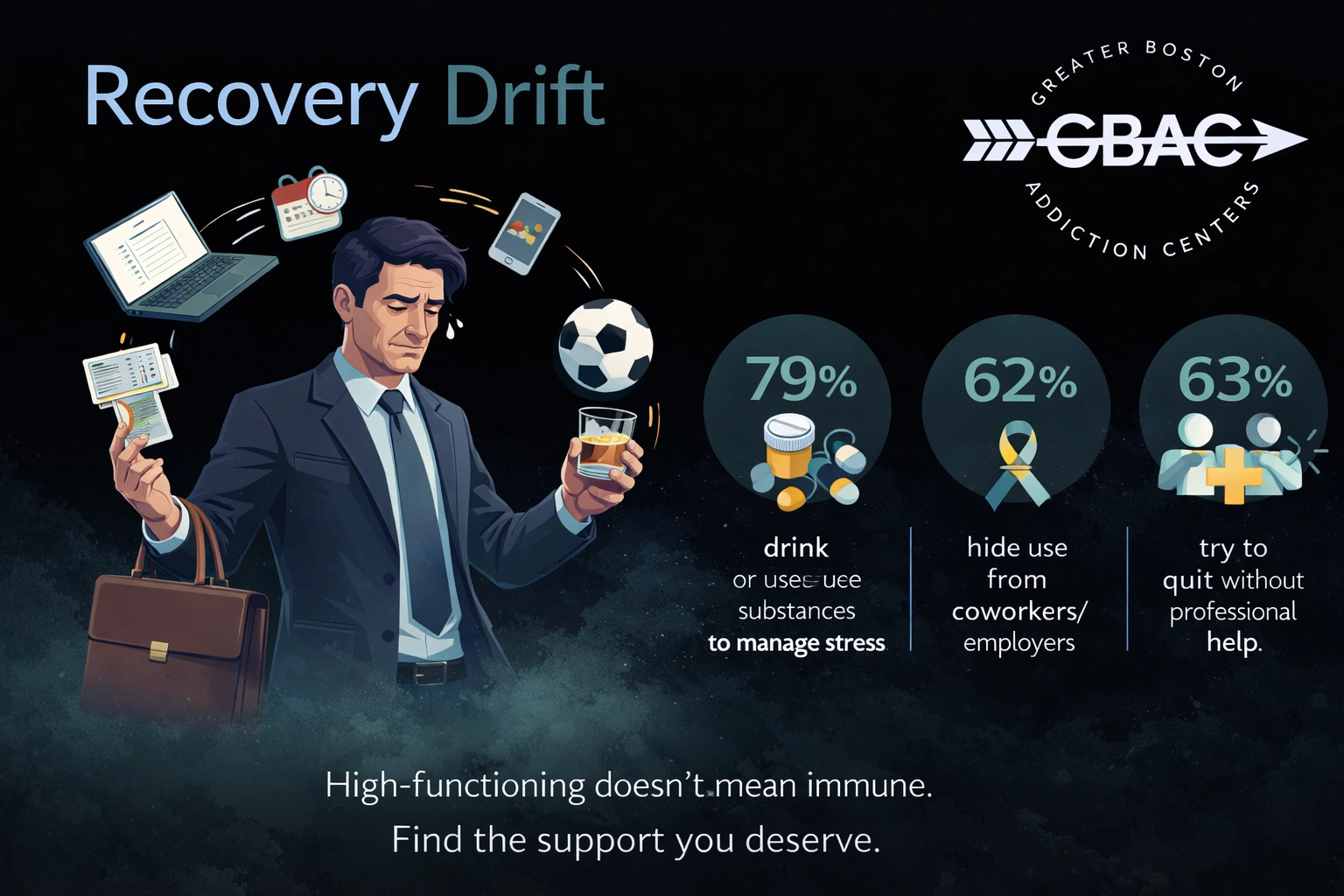
You’ve mastered the juggling act. Meetings. Deadlines. Soccer practices. Social obligations. You look calm, collected, competent. Maybe even impressive.
But beneath it, there’s a thread unraveling.
You drink—or use—strategically. Not recklessly. You stay sharp when needed. You know how to cover your tracks. You make rules: only after 5pm, never before work, always with a reason. You tell yourself it’s manageable, responsible, under control. But it’s not. Not really.
You don’t need a wake-up call. You need a plan. Because “tomorrow” isn’t a treatment strategy. And high-functioning doesn’t mean immune.
At Greater Boston Addiction Centers, we work with professionals, caregivers, business owners, and parents who are still showing up—but slowly wearing down. Many of them find relief and momentum through one transformative entry point: a partial hospitalization program.
You’re Not Too High-Functioning for Help
There’s a trap many people fall into when they appear to be doing fine: they start believing that real support is only for people who’ve hit bottom.
But rock bottom isn’t always dramatic. Sometimes, it’s quieter:
- You dread waking up, even after a full night’s sleep.
- Your “relaxation” routine includes substances you swore were temporary.
- You feel disconnected from joy, purpose, and even your own reactions.
- You keep saying “just one more week like this,” and that week turns into months.
High-functioning people aren’t exempt from addiction. They’re often just better at hiding it—from others and themselves.
You don’t have to wait for a dramatic unraveling. If you’re feeling off, overwhelmed, or emotionally detached, that’s enough reason to reach out.
What a Partial Hospitalization Program Really Is
A partial hospitalization program (PHP) is intensive clinical support without residential treatment. You attend programming for several hours a day, usually five days a week, and return home each night. PHP provides structure, therapy, and stabilization—without pulling you completely out of your life.
At Greater Boston Addiction Centers, our PHP includes:
- Group therapy and psychoeducation
- Individual therapy tailored to your goals
- Medication management and psychiatric support
- Skills for emotional regulation, relapse prevention, and self-leadership
- A team that sees you as a whole person—not just a diagnosis
This isn’t a break from life. It’s a recalibration of how you’re living it.
Why High-Performing Clients Choose PHP
Most of our high-achieving clients say the same thing in early sessions: “I can’t believe I waited this long.”
They weren’t in denial. They were just busy. And they’d normalized their stress, anxiety, and coping patterns because nothing was “bad enough” to raise alarms.
PHP helps change that by providing:
- Daily rhythm: predictability that reduces decision fatigue and emotional chaos
- External accountability: so you’re not managing recovery in isolation
- Confidential support: especially if you’re worried about professional reputation or social stigma
- Tangible progress: instead of just hoping things will improve on their own
Most importantly, PHP doesn’t assume you’re ready to pause everything. It works with your reality—not against it.
Success Story: Darren, 38, Financial Consultant
Darren was a father of two, successful in his firm, and proud of the life he built. But he was drinking nightly—“just to wind down”—and taking pills on high-stress days to stay focused.
“I wasn’t partying. I wasn’t driving drunk. I was just… coping,” he said.
Darren came to us because his wife gave him an ultimatum. He didn’t think he belonged in treatment. But after his first week in PHP, his tune changed.
“I thought I’d lose control if I stopped,” he admitted. “But PHP helped me realize I was never really in control to begin with. Now I have tools. Real ones.”
Six months later, Darren reports stronger relationships, fewer anxiety episodes, and clarity he hadn’t felt in years.
What Starting Looks Like (And What It Doesn’t)
Let’s debunk a few assumptions:
- You don’t need to quit your job. Many clients use short-term leave under FMLA or adjust their workday to make room for healing. We help with the logistics.
- You don’t have to “label” yourself. We care more about what’s working and not working in your life than what you call it.
- You won’t be treated like a crisis. You’ll be met where you are—with dignity, professionalism, and zero judgment.
- You don’t need to be perfect. If you’re still using, that’s okay. PHP is designed to help you stabilize safely and learn to manage the urge.
Who PHP Helps Most
If you’ve been caught in a cycle of promises—”I’ll cut back after this project,” “I’ll reset on Monday,” “I’ll figure it out next month”—PHP offers a grounded alternative to endless delay.
We’ve seen it work for people who:
- Are drinking or using to manage stress, anxiety, or burnout
- Feel emotionally shut down but functional
- Want to stop but feel scared or lost about how
- Have tried therapy alone and found it wasn’t enough
- Are seeking something intensive but temporary—and realistic
If you’re looking for a partial hospitalization program in West Roxbury or in nearby areas like Dorchester, our team at GBAC creates treatment plans that respect your goals, identity, and autonomy.
FAQs About PHP for High-Functioning Professionals
Is PHP confidential?
Yes. We maintain strict confidentiality protocols and can help you navigate disclosure with employers, if necessary.
Can I continue working during PHP?
Many clients adjust their work schedules, take medical leave, or work reduced hours while in PHP. We offer morning and mid-day sessions to allow for flexibility.
Is PHP covered by insurance?
Most commercial health insurance plans cover partial hospitalization programs. Our staff will verify your benefits and help you understand your coverage.
Do I have to be sober to start PHP?
Not necessarily. If detox is needed, we can help arrange that first. PHP is designed to support clients early in recovery—even if they’re still using when they arrive.
How long does PHP last?
The average program runs 2–4 weeks, but your treatment plan is customized to your needs. Some clients step down to IOP (intensive outpatient) afterward.
Is PHP only for substance use?
No. Many clients come to us for co-occurring challenges, including anxiety, depression, trauma, and burnout—especially when those conditions fuel substance use.
You Don’t Have to Be Falling Apart to Ask for More
Most people picture treatment as the last resort. But what if it’s the start of something better?
You’ve spent so much time holding everything together. Performing. Managing. Hiding the cracks.
Now, you’re allowed to pause. Recalibrate. Learn how to live without leaning on habits that only make things worse in the long run.
At Greater Boston Addiction Centers, we believe you don’t need to wait for a collapse to rebuild something healthier.
Call (877) 920-6583 to learn more about our partial hospitalization program services in Boston, MA.
Tomorrow doesn’t have to keep winning. If you’re ready to start today, we’re ready to walk with you.
