

When your child is in crisis — emotionally, behaviorally, or struggling with substance use — your heart doesn’t wait for a “rock bottom” moment to start pounding. You sense the fear long before others see it. You’ve watched mood swings tighten, communication break down, and hope fade into turmoil you can no longer fix on your own.
You don’t want your child to fail before they get help. You want support earlier, before consequences spiral, before behaviors worsen, before the fear becomes reality.
That’s exactly where a partial hospitalization program can make a difference. It’s more than an interim step. It’s an early, structured, clinical intervention that helps stabilize your young adult before a full crisis. It offers real skills, therapeutic connection, and supervision — all while keeping family and community ties intact.
At Greater Boston Addiction Centers, we guide families through this early, pivotal moment with compassion, clarity, and evidence‑based care.
What Is a Partial Hospitalization Program?
A partial hospitalization program (PHP) sits between basic outpatient therapy and full residential treatment. It provides intensive daily therapy and clinical oversight without requiring your child to live away from home.
Unlike once‑a‑week counseling, PHP typically involves:
- Several hours of structured therapy each day (often Monday–Friday)
- Group sessions that build social support and communication skills
- One‑on‑one clinical counseling tailored to individual needs
- Skills training for coping, emotional regulation, and relapse prevention
- Opportunities for family involvement and education
This level of care offers stability — and it can be especially effective when your young adult is overwhelmed but not necessarily in immediate danger. PHP is about early support, not just emergency response.
Early Intervention Can Change the Trajectory
Some parents believe that help only matters once everything has fallen apart. It’s a fear-based assumption that waiting will make things clearer or easier. But the truth is that waiting often makes recovery harder. Patterns become entrenched. Trust erodes. Consequences multiply.
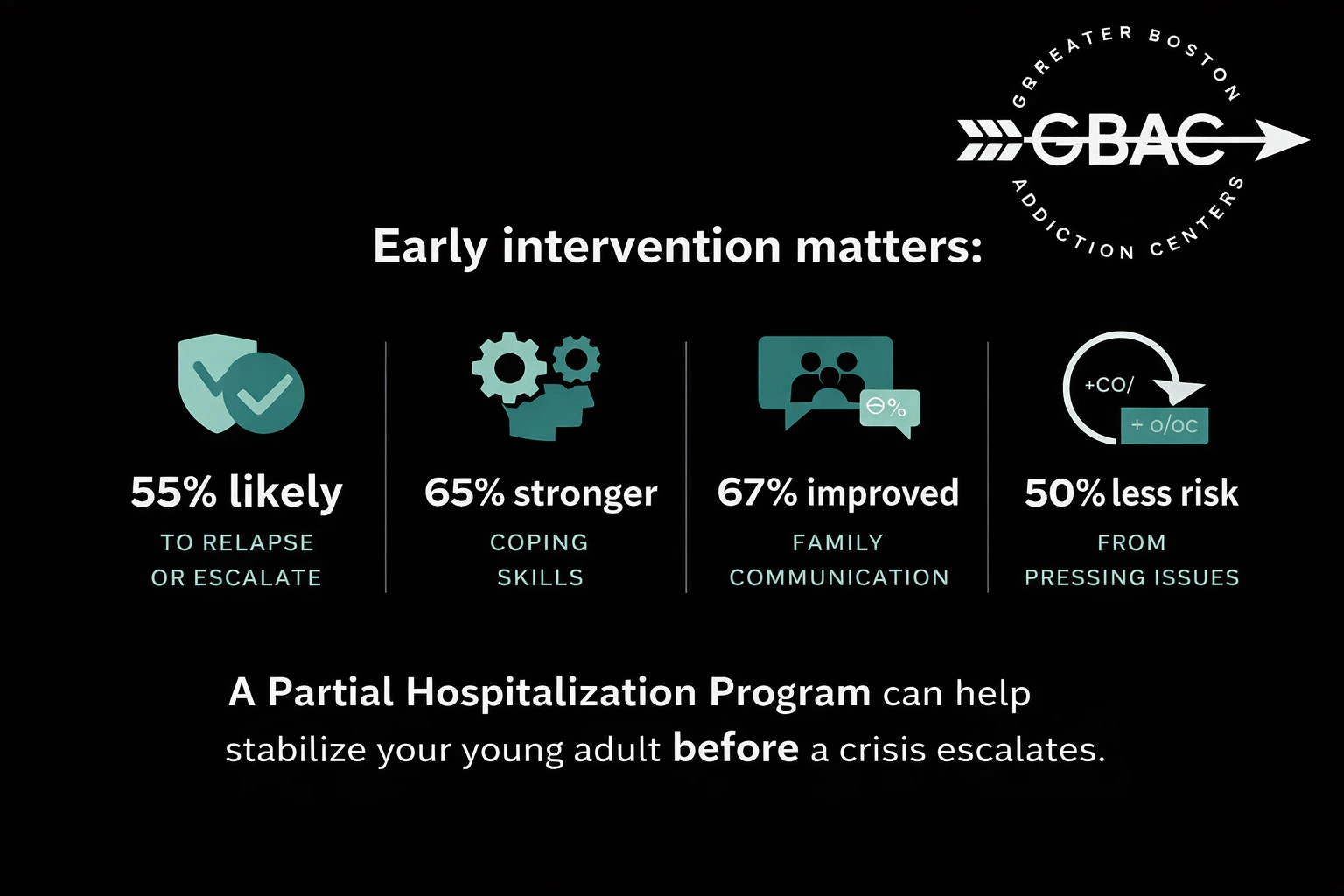
Getting help early — before significant harm happens — can:
- Reduce the risk of relapse or escalation
- Strengthen coping mechanisms and self‑awareness
- Improve communication within the family
- Support concurrent issues like anxiety, depression, or trauma
- Prevent avoidable crises that could require higher level care
If you’re looking for a partial hospitalization program in Dedham or considering PHP support for someone near Wellesley, Waltham, Newton, or West Roxbury, early intervention is not only possible — it’s proven to be effective.
How PHP Works for Young Adults
Here’s a snapshot of what a typical PHP schedule might look like:
Morning: Group therapy and check‑in
Midday: Skills training and psychoeducation
Afternoon: Individual therapy and reflection sessions
Late afternoon: Family or support meetings
Your child returns home each evening, which means they can maintain real‑world responsibilities like school attendance, part‑time work, or community involvement — but now they’re doing it with clinical support and structure.
PHP doesn’t isolate your child from their world; it gives them tools to engage with it more constructively.
Signs Your Child Could Benefit from PHP
You might be unsure whether it’s “bad enough” for PHP. Here are some early warning signs we often see:
- Sudden change in mood or behavior — quiet to angry, withdrawn to unpredictable
- Decline in school, work, or daily functioning
- Losing interest in previously enjoyed activities
- Substance use that feels out of control or risky
- Frequent conflict within the home
- Increased irritability, anxiety, or emotional overwhelm
These are not minor bumps in the road. They’re indications that your child may benefit from structured support before more harm occurs. You don’t need a dramatic event to justify care — you need recognition and a plan.
What You Can Expect from PHP
Parents often want to know: Is this professional care? Will my child be heard? Will it help?
Here’s how PHP offers structured and supportive care:
Clinical Oversight
Your child is monitored by licensed professionals daily — not just in therapy sessions, but in how they respond, process, and grow.
Evidence‑Based Interventions
Therapies like CBT (Cognitive Behavioral Therapy) and DBT (Dialectical Behavior Therapy) are used to give youth practical tools for mental and emotional regulation.
Family Involvement
Many programs incorporate family counseling so communication improves at home, not just in sessions.
Real‑Life Integration
Because your child returns home each night, they practice skills in everyday environments with support, rather than in an isolated setting.
PHP helps young adults build confidence and coping capacity before situations deteriorate further.
Real Families, Real Progress
Here’s a success story that resonates with many parents:
A mother from Waltham reached out because her 21‑year‑old was suddenly skipping classes, staying out late, and drinking excessively after work. She feared intervention would push her son away. Instead, PHP gave him structure and choice. He began attending daily groups and therapy, and started to rebuild trust at home.
Within weeks, he recognized patterns he couldn’t see before. He started sleeping more consistently and talking openly about stressors. The change wasn’t instant, but it was meaningful — and rooted in learning, not punishment.
Families across Dedham, Newton, and Wellesley have had similar experiences: care that meets the young adult where they are, without requiring a crisis to justify help.
FAQs About Partial Hospitalization Programs
Is PHP only for addiction?
No. PHP addresses behavioral health needs, co‑occurring disorders, and emotional regulation as well as substance use concerns.
Can my child still live at home?
Yes. PHP is designed so your child returns home, supporting both family involvement and community reintegration.
How long does PHP last?
Duration varies, but many young adults participate for several weeks, based on clinical assessment and progress.
Will school or work be affected?
PHP schedules can often be coordinated with school or jobs, and clinical teams can assist with communication and planning.
What if my child refuses to participate?
Resistance is common. Clinicians can help you approach the situation constructively without escalating conflict.
You Don’t Have to Wait for a Crisis
One of the kindest things you can do for your child is to intervene before everything collapses. Waiting for “rock bottom” does not make you a better parent — it just risks more pain, uncertainty, and avoidable fallout.
A partial hospitalization program is not a last resort. It is an early step, a space where healing begins with support, not punishment. It helps your young adult move from survival to growth, from fear to agency, and from chaos to clarity.
If you’re overwhelmed with fear for your child’s future and unsure what to do next, you can start with understanding how structured clinical support helps. You don’t have to solve this alone.
Call (877) 920‑6583 to learn more about our partial hospitalization program services in Massachusetts. Your child doesn’t need to hit rock bottom to deserve care — they deserve support today.
