

You thought things were getting better. Maybe they were—for a while. And now you’re here again, wondering what changed, what you missed, and what you’re supposed to do next.
As a clinician, I want you to hear this first: this moment doesn’t erase everything that came before it.
And it doesn’t mean you’ve failed.
If you’re trying to understand what comes next, you can explore options like alcohol addiction treatment while you keep reading—we’ll walk through this together.
This Isn’t Uncommon—Even If It Feels Personal
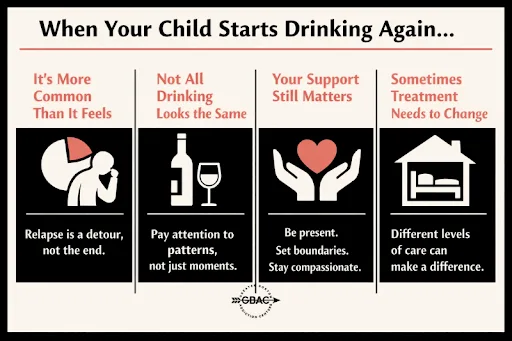
Relapse can feel deeply personal. Like a reflection of something you did or didn’t do.
But clinically, it’s often part of the process.
Recovery—especially for young adults—is rarely linear. A return to drinking doesn’t always mean they’ve given up. Sometimes it means something underneath hasn’t been fully addressed yet.
Think of it less like starting over… and more like missing a piece of the map.
What “Drinking Again” Can Actually Mean
Not all drinking looks the same. And not all of it means the same thing.
For some, it’s occasional. For others, it quietly builds back into something heavier—like finishing a bottle of wine a night and telling themselves it’s “not that bad.”
As a clinician, I pay attention to patterns, not just moments.
- Are they hiding it?
- Is it tied to stress, anxiety, or isolation?
- Are old behaviors resurfacing alongside the drinking?
These clues matter more than any single incident.
The Part No One Prepares Parents For
You can do everything “right”… and still watch your child struggle.
That’s the part that hurts the most.
Parents often carry silent questions:
- Did I miss something?
- Should I have pushed harder?
- Did I push too hard?
Here’s the truth: your love is not the problem.
In fact, it’s one of the few constants your child still has.
Support Doesn’t Mean Controlling the Outcome
This is where things get complicated.
You want to help—but you can’t force change. And trying to control their behavior often creates more distance, not less.
Support, in this stage, looks more like:
- Staying emotionally available without rescuing
- Setting boundaries that protect your well-being
- Encouraging help without ultimatums (when possible)
It’s a quiet kind of strength. Not passive—but not forceful either.
Sometimes the Treatment Needs to Change, Not the Person
If your child has been in treatment before, it’s natural to wonder why it didn’t “stick.”
But not all care is the same.
Some young adults need more structure. More time. More consistency.
That might look like:
- Multi-day weekly treatment instead of once-a-week sessions
- Or even round-the-clock support, like help in Residential settings, where the environment itself becomes part of the healing
Treatment isn’t one-size-fits-all. Sometimes it’s about finding the right level, not just trying harder.
You’re Allowed to Feel Both Hope and Exhaustion
There’s a quiet tension many parents carry:
You haven’t given up… but you’re tired.
Both things can be true at the same time.
Hope doesn’t have to look like optimism. Sometimes it looks like staying present. Asking one more question. Leaving the door open just a little longer.
That matters more than you think.
What I Want You to Hold Onto Right Now
Your child is still here. Their story isn’t finished.
And neither is yours.
This moment—painful as it is—can still be part of something that turns.
You don’t have to solve everything today. Just stay connected to what’s real, what’s possible, and what support actually looks like right now.
If you’re unsure what the next step should be, you don’t have to figure it out alone. Call (877)920-6583 or visit our alcohol addiction treatment services to learn more about your options.
