

You might already know something isn’t right. Maybe you’ve even looked into heroin addiction treatment services and then quickly closed the tab. That push-pull feeling? It’s more common than you think.
Let’s talk about what people often get wrong before they go—and why those beliefs can keep you stuck longer than you deserve.
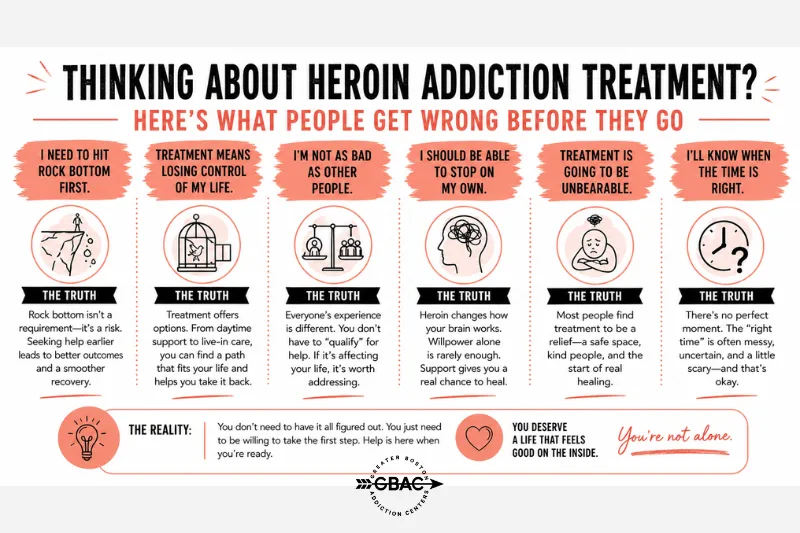
“I need to hit rock bottom first”
This idea keeps a lot of people waiting.
The truth is, “rock bottom” isn’t a requirement—it’s a risk. Waiting for things to get worse doesn’t make treatment more effective. It just makes the road back harder.
If you’re already questioning your use, that matters. Awareness is often the first real step—not collapse.
“Treatment means losing control of my life”
A lot of people picture treatment as something rigid or overwhelming.
But in reality, there are different levels of care. Some people start with structured daytime support. Others choose multi-day weekly treatment that fits around parts of their life. And for some, round-the-clock care provides the safety they need to reset.
It’s not about taking your life away. It’s about helping you get it back—piece by piece.
“I’m not as bad as other people”
Comparison is a quiet trap.
You might still be working. Showing up. Holding things together on the outside. But inside, it feels different—more chaotic, more exhausting.
Not everyone’s experience looks the same. And you don’t have to “qualify” for help by suffering more.
Sometimes the most important question isn’t how bad is it?
It’s how much is this costing me?
“I should be able to stop on my own”
This one comes with a lot of pressure.
Heroin changes the way your brain works. It’s not just about willpower—it’s about chemistry, patterns, and survival instincts that get rewired over time.
Trying to do it alone can feel like swimming against a current that never slows down.
Support doesn’t mean weakness. It means you’re choosing a different kind of strength.
The signs people notice—but don’t always name
Sometimes what brings people here isn’t a clear label. It’s moments that don’t quite add up.
You might recognize things like:
- Nodding off unexpectedly or at odd times
- Disappearing for hours without explanation
- Sudden mood shifts—calm one moment, distant the next
- Pulling away from people or responsibilities
- Changes in sleep, energy, or focus
These are often early signs of heroin use, even if no one has said it out loud yet.
And noticing them doesn’t mean you have all the answers. It just means something deserves attention.
“Treatment is going to be unbearable”
It’s normal to be scared of what treatment might feel like.
But most people are surprised by something: it’s not about punishment. It’s about relief.
Relief from the constant cycle. Relief from hiding. Relief from carrying it alone.
You don’t have to walk in ready to be perfect. You just have to walk in willing to be honest.
There isn’t a perfect moment to start
People wait for the “right time.”
After one more week. One more attempt. One more promise to themselves.
But the truth is, the right time often looks like this:
Uncertain. Nervous. Not fully sure it will work.
And still… curious enough to ask what help might look like.
If you’re even considering it, you’re already closer than you think.
If you’re exploring what support could look like, there are different paths—including live-in care and flexible treatment options in Residential that meet you where you are.
You don’t have to figure everything out today.
But you don’t have to stay stuck, either.
Call 877-920-6583 or visit our heroin addiction treatment page to learn more about our Heroin addiction treatment services in Massachusetts.
