

You already know.
That’s the part that hurts the most.
You don’t need another article telling you alcohol is bad for you. You’ve felt it. The mornings you wake up foggy. The quiet shame. The internal deal-making: “After this weekend.” “After the holidays.” “Starting Monday.”
If you’re even reading about Alcohol addiction treatment in Massachusetts, it likely means something inside you is done pretending this is just a rough patch.
Let’s talk honestly about the difference between trying to quit on your own and getting real support.
White-Knuckling Vs. Being Supported
Trying to quit alone usually looks like this:
You pour bottles down the sink.
Delete delivery apps.
Avoid certain restaurants.
Make new rules.
“No drinking during the week.”
“Only socially.”
“Just beer.”
And sometimes, for a while, it works.
But if alcohol has moved from habit to dependence, willpower starts to feel like trying to dam a river with sandbags.
White-knuckling is exhausting because you’re fighting cravings without backup. You’re negotiating alone. You’re relying entirely on mental strength while your brain chemistry is still wired for relief.
Structured support changes the fight.
You’re not alone in the room with your cravings anymore.
The Physical Risk Most People Downplay
Many first-time treatment seekers say, “I can handle withdrawal.”
What they often mean is, “I’m scared of what happens if I can’t.”
Alcohol withdrawal is not just uncomfortable—it can be medically risky for some individuals. Shaking, sweating, nausea, insomnia, severe anxiety. In certain cases, dangerous complications.
When you stop on your own, you’re guessing.
In a structured setting, your body is monitored. Stabilized. Supported. If symptoms escalate, there’s a response plan.
You don’t have to lie awake wondering if what you’re feeling is normal or dangerous.
That alone can reduce fear dramatically.
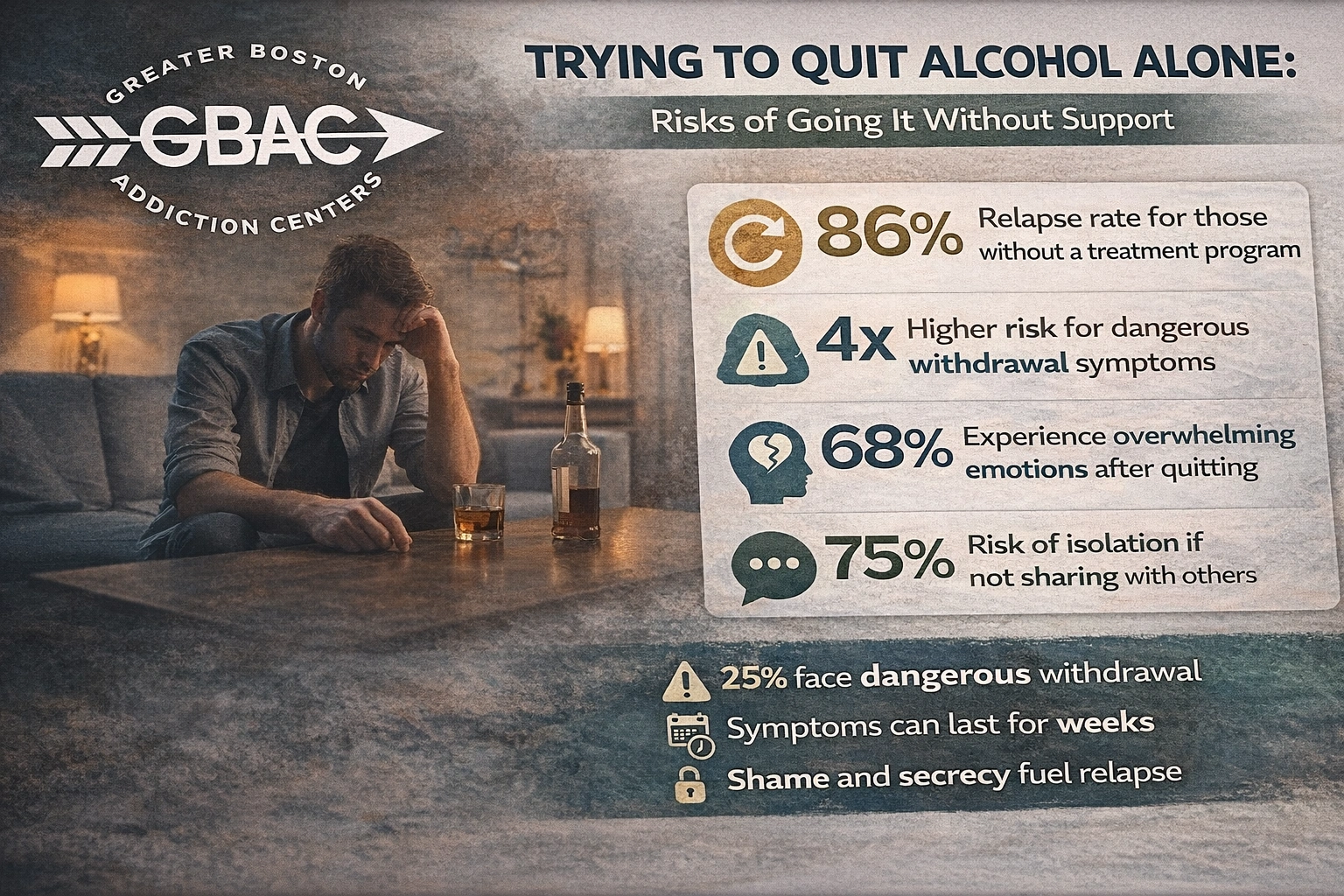
The Emotional Avalanche After You Stop
The physical part is only one layer.
Alcohol has likely been doing more than relaxing you. It’s been managing something deeper—stress, grief, anxiety, loneliness, performance pressure.
When mental health and substance use collide, removing alcohol can feel like removing your only coping mechanism.
Emotions don’t trickle back in. They flood.
Anger you didn’t process.
Grief you postponed.
Anxiety you medicated.
Trying to handle that alone can feel overwhelming.
Structured care doesn’t just help you stop drinking. It helps you build new emotional regulation tools so you’re not left defenseless.
The Isolation Trap
Quitting alone often means quitting quietly.
You don’t tell coworkers.
You don’t tell extended family.
You might not even tell close friends.
You carry it privately.
Isolation strengthens addiction. Secrecy protects it.
In treatment, isolation loosens.
You sit in rooms with people who understand the internal bargaining. The guilt. The fear of being exposed.
Connection does something powerful: it shrinks shame.
You realize you’re not uniquely broken. You’re human.
Structure Changes More Than You Think
People underestimate the power of daily structure.
When you try to quit alone, your environment stays the same. Same routines. Same triggers. Same stressors.
Treatment introduces shape to your days.
Time is accounted for.
Support is scheduled.
Expectations are clear.
For some individuals, live-in or round-the-clock support is necessary to interrupt deeply embedded patterns. Exploring treatment options in Residential can provide containment during the most vulnerable stages.
For others, structured daytime care or multi-day weekly treatment offers intensity without fully stepping away from responsibilities.
The key difference is this: you’re not improvising your recovery alone.
“What If I Should Be Strong Enough?”
This question carries quiet shame.
You may live in communities like Newton, Massachusetts, where success and composure are expected. Or in places like Needham, Massachusetts, where stability and self-sufficiency are part of the culture.
In environments like these, admitting you need help can feel like a crack in the image.
But addiction doesn’t care about zip codes or resumes.
Needing alcohol addiction treatment isn’t a character flaw. It’s a response to a brain pattern that has reinforced itself over time.
Strength is not measured by how long you suffer silently.
It’s measured by whether you act when something isn’t working.
Why Repeated Attempts Alone Matter
If this is your first attempt, trying on your own might seem reasonable.
But if you’ve tried before—if you’ve had sober weeks or months that unraveled under stress—that’s information.
Not evidence that you’re hopeless.
Evidence that alcohol has a stronger hold than you thought.
Treatment becomes appropriate when patterns repeat. When stress triggers relapse. When cravings overpower intention.
That doesn’t mean you failed.
It means your strategy needs reinforcement.
The Fear Of Losing Control In Treatment
Some people hesitate because they fear surrendering control.
“What if I hate it?”
“What if it’s too intense?”
“What if I’m judged?”
Treatment is not about stripping autonomy. It’s about restoring it.
You are still you. You still make choices. You still have a voice.
The difference is that you’re making decisions in a clearer mental state—not through the fog of dependency.
The Hard Truth
If you could permanently quit on your own, you likely would have by now.
That’s not criticism.
It’s clarity.
Addiction rewires motivation and reward circuits. It’s not about intelligence. It’s not about moral strength. It’s neurobiology reinforced by repetition.
Alcohol addiction treatment provides tools, medical oversight, and psychological support to interrupt that reinforcement loop.
You deserve support that matches the size of the problem.
FAQ
Can I Successfully Quit On My Own?
Some individuals do. But if you’ve experienced repeated relapse, severe withdrawal symptoms, or intense cravings, structured support increases safety and long-term success.
Is Treatment Only For Severe Cases?
No. Early intervention often leads to better outcomes. You don’t have to hit a catastrophic low before seeking help.
What If I’m Still Functioning At Work?
Functioning does not equal freedom. Many people maintain careers while privately struggling. If alcohol is controlling your mental space, that matters.
How Do I Know Which Level Of Care I Need?
An assessment can determine whether live-in support, structured daytime care, or multi-day weekly treatment is appropriate. The level depends on withdrawal risk, mental health, and pattern severity.
Will Treatment Fix Everything Immediately?
No. Recovery is a process. Treatment stabilizes, supports, and equips you—but growth continues afterward.
What If I’m Afraid Of Being Judged?
Treatment environments are built around confidentiality and compassion. Most people walking in feel the same fear you do.
If You’re Standing On The Edge Of Deciding
You don’t have to decide what forever looks like.
You only have to decide what today requires.
Continuing alone will feel hard.
Getting help will also feel hard.
The difference is that one path keeps you isolated in the fight—and the other places people beside you.
If your chest tightens reading this, that’s not weakness.
That’s awareness.
Call (877)920-6583 or visit our Alcohol addiction treatment services in Massachusetts to learn more.
