

I wasn’t new to treatment. I was tired of it.
Tired of group therapy that felt like performance art. Tired of therapists asking, “How does that make you feel?” while my nervous system silently screamed, “Exhausted. Terrified. Disconnected.”
I’d been to programs. Multiple ones. Long-term. Short-term. Some with community. Some clinical. I’d sat in rooms with laminated coping skills worksheets and left feeling more alone than when I walked in. I’d tried sitting still long enough to find some kind of inner wisdom—and mostly just found a brain that wouldn’t shut up.
So no, I didn’t walk into CBT with optimism. I walked in with eye-roll energy and the emotional range of a dry sponge.
But I went. Because I couldn’t stand feeling the way I felt. Because I wasn’t suicidal, but I also wasn’t particularly invested in being alive. Because something had to change—and I’d already ruled out everything else.
And, to my surprise, Cognitive-Behavioral Therapy didn’t try to make me feel better. It taught me how to think differently. And that changed everything.
CBT Didn’t Ask Me to “Believe in Myself”
My therapist didn’t light a candle. Didn’t tell me to find my inner child. Didn’t make me rehash every trauma I couldn’t fully name.
She said, “Let’s figure out what your thoughts are doing right before the anxiety hits.”
That was it. Not a spiritual awakening. Not some grand excavation of the soul. Just curiosity.
So we wrote stuff down. Not feelings—thoughts. She helped me track what I thought in the moments before I sabotaged myself, shut down, picked fights, ghosted, or spiraled.
Thoughts like:
- “They’re going to leave anyway.”
- “You’re already behind.”
- “Why bother?”
And instead of trying to emotionally fix me, we started asking: Are those thoughts true?
Sometimes the answer was no. Sometimes the answer was, “Even if they are, what else could also be true?”
I didn’t have to believe I was lovable. I just had to stop treating every thought like law.
I Stopped Performing—and Started Practicing
Before CBT, therapy always felt like trying to impress someone who might “diagnose me correctly” or “finally fix me.”
CBT was the opposite.
It wasn’t a performance. It was a practice. Like physical therapy for my brain. If my thoughts were a muscle group, they were tight, cramped, and overworked. CBT helped me stretch.
We did:
- Thought logs
- Behavior experiments
- Real-time reframes
- Pattern recognition
Some of it felt mechanical at first. But that was actually the point. I didn’t need more “just talk about it” sessions. I needed a new operating system—and this was the install process.
From Shutdown to Small Wins
I won’t pretend I had some dramatic “aha moment.” For me, CBT worked slowly. Quietly. Like a faucet being tightened one drip at a time.
Here’s how I knew it was working:
- I caught myself before canceling a plan just because I was anxious.
- I said, “That’s an old belief,” instead of, “I suck.”
- I paused during a spiral and made tea instead of numbing out.
- I felt proud after a session—not drained.
If you’re someone who feels like recovery didn’t “take,” I want you to know this: You’re not the exception. You might just need something that’s more practical than emotional. CBT was that for me.
Some of the most impactful moments happened outside session—like when I walked past a bench where I used to dissociate for hours and realized I hadn’t needed to sit there in weeks.
Or when I visited a friend in Newton and didn’t spend the whole time scanning the room for proof I didn’t belong. I just showed up. CBT didn’t make me “normal.” It made me present—which, honestly, is better.
Why This Time Felt Different
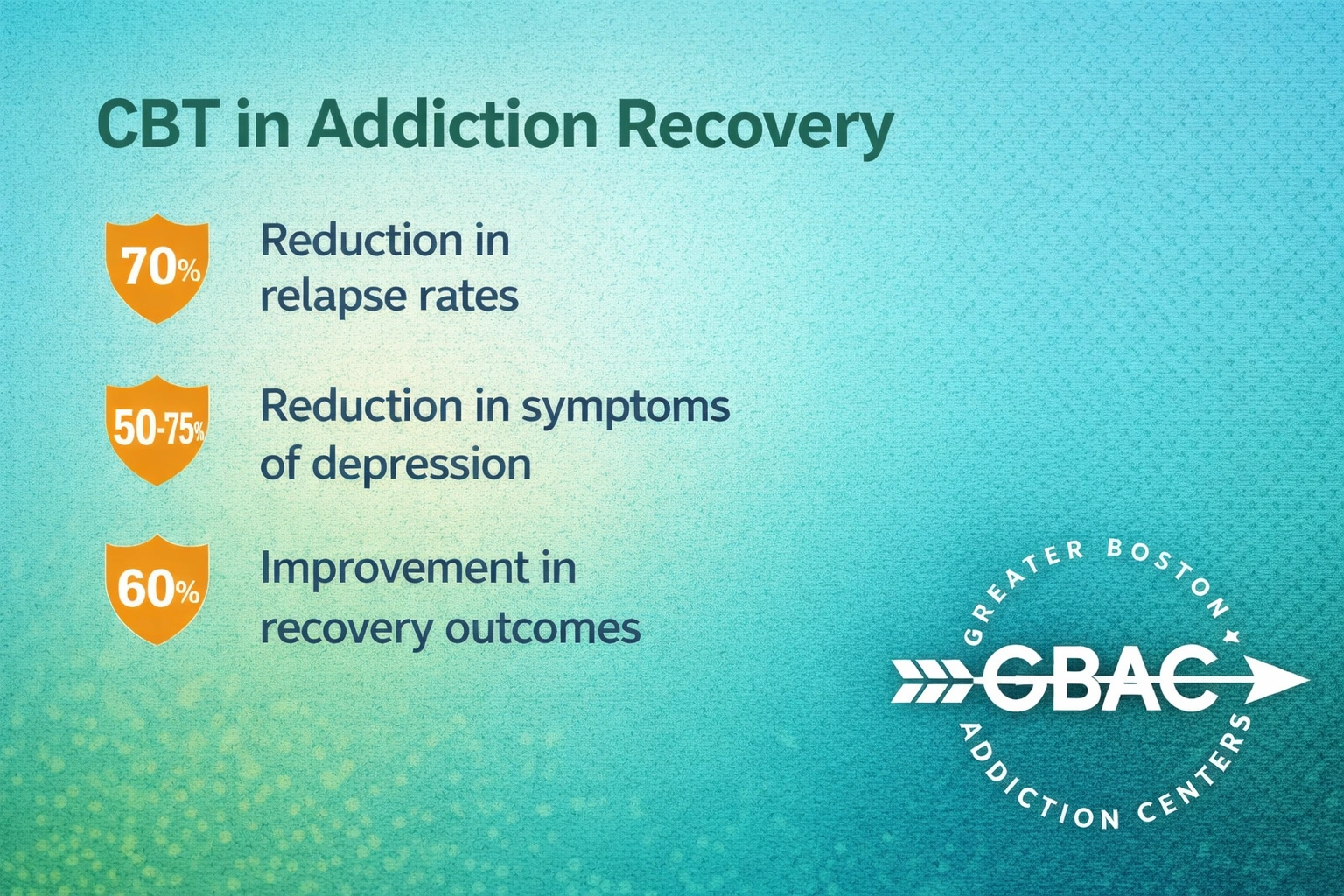
Let’s be real. Not every therapist is the same. Not every CBT experience is equal. But at Greater Boston Addiction Centers, the CBT process wasn’t just theoretical. It was alive. Adaptive. Rooted in my actual day-to-day triggers and self-sabotage patterns.
I didn’t feel like a case study. I felt like a person with habits, fears, and potential. The therapy didn’t try to “fix me.” It helped me interrupt the stuff that was keeping me stuck.
And it worked—again and again.
For the Skeptics: FAQs About CBT from Someone Who Gets It
Does CBT mean I’ll never talk about my trauma?
No. But it does mean you’ll only talk about it if and when it helps. CBT doesn’t start with your trauma story—it starts with your current patterns. Sometimes the past comes up naturally, but you don’t have to re-live anything to see real progress.
What if I already know my thoughts are messed up? Will CBT still help?
Yes. Knowing your thoughts are irrational doesn’t mean you know how to respond differently. CBT gives you tools to work with those thoughts, not just hate yourself for having them.
I’ve done therapy before and nothing changed. Why would CBT be different?
Because CBT is less about talking and more about doing. You’re not just reflecting—you’re experimenting. It’s action-oriented, and it builds momentum. You don’t need to believe in it. Just try the steps.
Is CBT cold or robotic?
Not at all. It’s structured, but it’s not sterile. A good CBT therapist uses the framework with you, not on you. It can be warm, real, and even funny at times. It’s just not passive. You’re part of it, and that’s empowering.
I shut down easily. What if CBT feels like too much?
You don’t have to go full speed. The best therapists tailor the pace to your window of tolerance. You can still do CBT in small, gentle steps. In fact, starting small is how most real shifts begin.
Final Thought: You’re Not Broken—You’re Unpracticed
I used to think I was just the kind of person therapy didn’t work for. That I was too damaged, too shut down, too “whatever.” But what I actually was… was unpracticed.
Nobody taught me how to question my thoughts.
Nobody showed me that reactions could be paused, not just obeyed.
Nobody told me that feelings weren’t facts.
CBT did all of that—and I didn’t have to be healed to start.
And now? Now I walk into coffee shops and don’t rehearse every word in my head. I send the text without waiting 45 minutes. I get up in the morning and don’t feel like a mistake in progress.
Once, after a hard session, I sat in a park in Needham, looked around, and thought, “This is what real peace might feel like.” It wasn’t loud. It wasn’t dramatic. But it was mine.
That’s what CBT gave me. Not perfection. Not erasure of pain. Just space to be in my life without drowning in it.
Call (877)920-6583 to learn more about our Cognitive-Behavioral Therapy in Boston, Massachusetts. You don’t have to feel ready. You just have to be willing to see what could happen if you try one more time—differently.
