

Some of the most put-together people I’ve treated were unraveling in silence.
They arrived in pressed suits.
Answered emails in the lobby.
Took work calls from the parking lot before walking in.
And they were using heroin.
If you’re reading this and quietly researching options for Heroin addiction treatment in Massachusetts, chances are you don’t fit the stereotype either. You’re productive. Responsible. Relied upon.
That’s exactly why this can stay hidden for so long.
I’m writing this as a clinician who has worked with executives, physicians, entrepreneurs, attorneys, and parents who maintained polished public lives while privately negotiating with a substance that was taking more than it gave.
Let’s talk honestly about what that looks like.
The High-Functioning Illusion
High-functioning heroin use rarely begins with chaos.
It begins with control.
You schedule it.
Contain it.
Rationalize it.
“I never use during work hours.”
“I still hit my deadlines.”
“My family hasn’t noticed.”
From the outside, you are succeeding. Promotions. Income. Community involvement. Maybe even leadership roles.
Internally, something is shifting.
Addiction doesn’t always destroy your résumé first. It erodes your peace.
The myth that keeps high performers stuck is simple:
“If it were really a problem, my life would be falling apart.”
But heroin doesn’t require public collapse to qualify as a crisis.
The Private Negotiations No One Sees
In my office, high-achieving clients speak differently than they do in boardrooms.
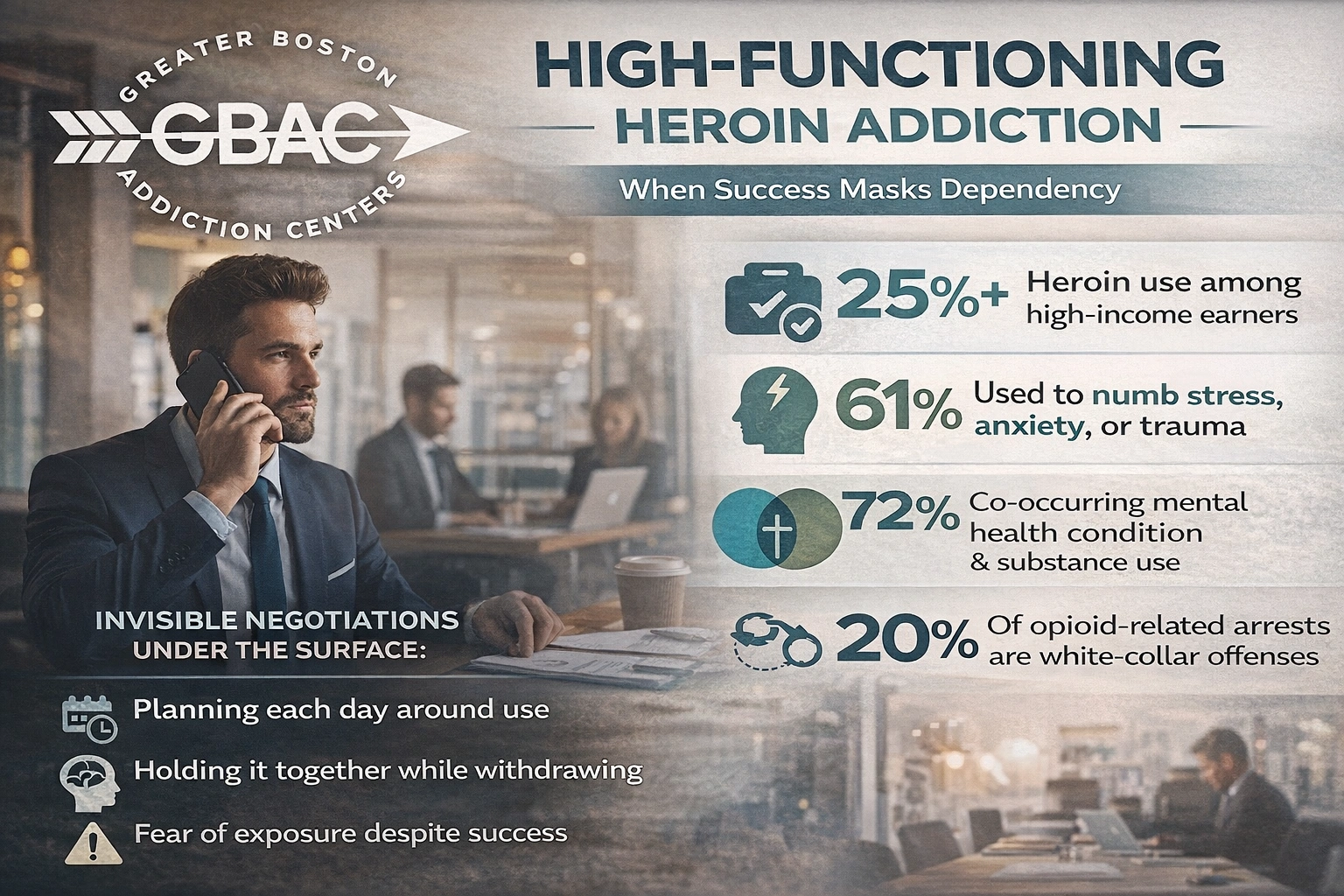
They talk about:
- Counting hours until the next use
- Irritability when plans interfere
- Planning travel around access
- Anxiety about withdrawal
- Fear of being exposed
There’s a constant mental math happening beneath your productivity.
You might still be closing deals or managing teams. But part of your brain is occupied with securing, timing, hiding.
That dual existence is exhausting.
Addiction at this level often feels less like chaos and more like a double life.
When Control Quietly Slips
The shift rarely announces itself dramatically.
It’s subtle at first.
You need a little more to feel the same relief.
Sleep starts to fracture.
Your patience shortens.
You feel emotionally flat without it.
You tell yourself you’ll scale back.
You don’t.
Heroin alters brain chemistry quickly. What began as relief becomes necessity. Not always in a dramatic, headline-making way—but in a steady tightening.
High-functioning individuals often endure this stage longer because they can still perform.
But performance is not the same as wellness.
When Mental Health And Substance Use Collide
Many of the professionals I work with didn’t start using heroin recklessly.
They started using strategically.
To soften anxiety that felt relentless.
To numb trauma that never got addressed.
To quiet racing thoughts after high-pressure days.
When mental health and substance use collide, heroin can feel like a solution.
It reduces noise.
It blunts panic.
It smooths edges.
For a while.
Then the anxiety intensifies without it.
The depression deepens.
The baseline shifts.
Now you’re not just managing stress—you’re managing dependence.
Why High Performers Delay Getting Help
There are predictable barriers:
Pride.
Reputation.
Control.
You may worry about confidentiality. About colleagues finding out. About losing authority.
In communities like Wellesley, Massachusetts, where image and achievement are part of the culture, asking for help can feel like an identity threat.
In areas such as West Roxbury, Massachusetts, where family roots and community ties run deep, the fear of being “found out” can feel just as heavy.
But addiction does not respect professional status or neighborhood reputation.
Heroin addiction treatment becomes necessary when internal stability begins to erode—even if your LinkedIn profile still looks impressive.
The Quiet Collapse Behind Closed Doors
Here’s what collapse often looks like for high-functioning individuals:
You’re emotionally unavailable at home.
Your partner says you seem distant.
Your children notice your irritability.
You wake up with anxiety before your feet hit the floor.
You still show up physically.
But you’re not fully present.
Addiction doesn’t always take your job first. Sometimes it takes your connection.
And that loss is harder to measure—but more painful.
What Treatment Means At This Level
There’s a misconception that seeking heroin addiction treatment means public disgrace.
In reality, it means interruption.
Interruption of the cycle.
Interruption of secrecy.
Interruption of neurological reinforcement.
Some clients require live-in treatment or round-the-clock support to safely stabilize, particularly if withdrawal risks are significant. Others begin with structured daytime care or multi-day weekly treatment while coordinating privacy and professional responsibilities.
For those needing more containment initially, exploring support in Residential can provide a medically supervised reset without public exposure.
Treatment is not about stripping identity.
It’s about restoring autonomy.
The Turning Point
The moment high-functioning clients decide to act is rarely dramatic.
It’s usually quiet.
A panic attack in a parking garage.
A near-miss while driving.
A spouse saying, “I don’t feel connected to you anymore.”
A realization that your entire day revolves around timing your next use.
That’s the crack in the armor.
If you’re reading this and recognizing yourself, that recognition matters.
You do not need a scandal to justify change.
You Cannot Outperform Neurobiology
High achievers often believe they can think their way out of dependency.
You’re intelligent. Disciplined. Strategic.
Those qualities are strengths in recovery—but they do not override brain chemistry.
Addiction is not a motivation problem. It’s a reinforcement loop in the brain. Repetition strengthens it. Secrecy protects it.
Breaking that loop requires structure, support, and honesty—not just willpower.
For The Loved One Watching
If you’re reading this as a spouse or family member, it can be disorienting.
They look successful. Stable. In control.
But something feels off.
Emotional withdrawal.
Increased secrecy.
Mood swings disguised as stress.
Trust your instincts.
High-functioning heroin use can coexist with promotions and public praise. That does not make it less serious.
FAQ
Can Someone Be Successful And Still Need Treatment?
Yes. Professional achievement does not eliminate substance dependency. Many high-functioning individuals maintain careers while privately struggling with heroin use.
How Do I Know If It’s Really Addiction?
If use feels compulsive, if you build your schedule around it, if stopping feels frightening or physically overwhelming, those are strong indicators of dependency.
What About Confidentiality?
Reputable treatment centers prioritize privacy. Many high-performing professionals seek care discreetly. You can ask direct questions about confidentiality before committing.
Is Residential Care Always Required?
Not always. The appropriate level of care depends on severity, withdrawal risk, and co-occurring mental health concerns. An assessment can determine what’s safest.
What If I’m Afraid Of Withdrawal?
That fear is common and valid. Medical supervision can significantly reduce risk and discomfort during stabilization.
Will Treatment Ruin My Career?
Untreated addiction poses a far greater long-term risk to your career and reputation than seeking help does.
A Direct Word To You
If you are high-functioning and using heroin in secret, I want to be clear:
You are not weak.
You are overextended.
You are likely exhausted from holding two realities at once.
The private collapse behind public success is heavy. It convinces you that you’re the exception—that you should be able to manage this alone.
You don’t have to wait for visible ruin to justify getting help.
Heroin addiction treatment is not a last resort for people who have “lost everything.” It’s an option for people who want to keep what matters before it’s too late.
You built your career through discipline and strategy.
Recovery requires those same qualities—applied honestly.
Call (877)920-6583 or visit our Heroin addiction treatment in Massachusetts to learn more about.
