

The night before treatment can feel heavier than anything that came before it.
You might sit on the edge of your bed staring at your phone. You might pack and unpack the same bag three times. You might tell yourself you can still back out.
Fear gets loud in quiet rooms.
At Greater Boston Addiction Centers, we’ve walked beside hundreds of people in that exact moment. And if you’re considering Heroin addiction treatment, we want you to know something simple and true:
The first day is almost never as scary as the story your mind tells you.
The Fear Before Treatment Is Usually About Losing Yourself
When someone is newly diagnosed or finally admits they need help, the fear isn’t just about detox or logistics.
It’s deeper than that.
It’s about identity.
- What if I’m labeled forever?
- What if medication changes who I am?
- What if I can’t handle it?
- What if I fail again?
Especially if you’re scared to take medication, there can be a quiet panic underneath it all: What if this takes something away from me?
That fear deserves respect. You’re not dramatic. You’re not weak.
You’re standing at the edge of change. And change always feels destabilizing before it feels relieving.
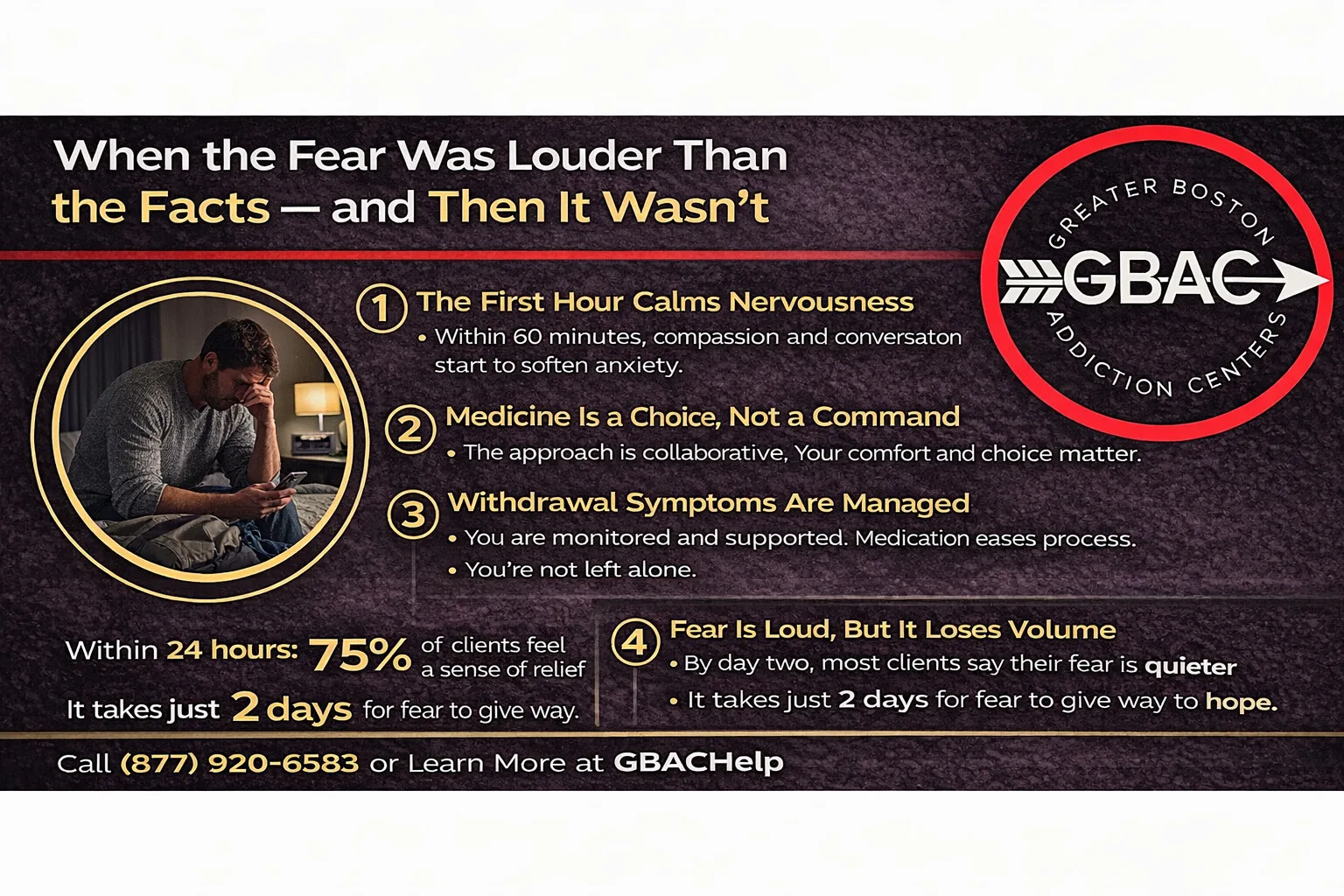
The First Hour Is Usually the Turning Point
Most people arrive braced for something cold.
They expect paperwork without eye contact. Rules without explanation. A feeling of being processed instead of understood.
Instead, what often happens is quieter.
You’re greeted. You’re asked how you’re feeling. You’re given space to speak without interruption. Our clinical team doesn’t rush your story. We listen for what’s underneath the words.
We don’t see “an addict.”
We see a person who has been carrying too much for too long.
That shift alone—being seen instead of judged—can lower your nervous system within minutes.
Medication Is a Conversation, Not a Command
For many people, the scariest part isn’t the building. It’s the medication.
You may worry about:
- Feeling numb
- Losing creativity
- Becoming dependent on something else
- Not recognizing yourself
Those concerns are common. They’re also valid to voice.
Medication, when used, is approached collaboratively. You are part of the discussion. You can ask about side effects. You can ask about alternatives. You can move forward slowly.
The goal is not to dull you.
The goal is to stabilize you.
Think of it less like “changing who you are” and more like turning down static on a radio. When the noise softens, your real voice gets clearer—not quieter.
And if medication isn’t appropriate for you, we don’t force it. Treatment is individualized. Your autonomy matters here.
Structure Feels Safer Than You Imagined
Before treatment, structure can sound restrictive.
After day one, it often feels like relief.
There’s something grounding about knowing:
- When meals happen
- When group begins
- When you’ll meet with a clinician
- When you can rest
When your life has revolved around avoiding withdrawal, chasing relief, or managing chaos, structure isn’t punishment.
It’s stability.
For some individuals, beginning with more immersive support makes the transition even smoother. We offer compassionate care in Residential settings where round-the-clock support helps your body and mind settle safely.
Structure doesn’t take freedom away.
It creates a foundation so freedom can return.
Withdrawal Is Managed — You’re Not Left Alone
Another fear that builds before admission is physical discomfort.
“What if it’s unbearable?”
“What if I can’t get through it?”
You are not expected to suffer silently.
Medical professionals monitor symptoms. Support is available. Adjustments are made. You’re checked on regularly. You’re not left in a room to “tough it out.”
Most people find that once support is in place, their anxiety about withdrawal was worse than the experience itself.
The anticipation was louder than the reality.
You Realize You’re Not Uniquely Broken
Shame isolates.
It whispers that you’re different. Worse. Beyond help.
Then you sit in your first group.
Someone across the room says something that sounds like it came directly from your own mind. The same promises. The same guilt. The same exhaustion.
It’s disorienting—in a good way.
You are not uniquely broken.
Addiction thrives in secrecy. Recovery begins in shared understanding.
That moment alone makes treatment feel less like a punishment and more like a place you belong.
The Staff Isn’t Waiting for You to Mess Up
Some people come in expecting scrutiny.
They assume staff members are watching for noncompliance. Waiting to catch mistakes.
Instead, what they experience is consistency.
We don’t expect perfection. We expect honesty.
We know ambivalence exists. We know fear doesn’t vanish overnight. We know relapse history can make you skeptical.
Our role isn’t to police you.
It’s to support you.
The Second Night Feels Different Than the First
The first night can still feel strange.
But by the second night, many clients notice something subtle:
Their breathing is deeper.
Their thoughts are less frantic.
Their shoulders are lower.
You start learning names. Faces feel familiar. The unknown begins to shrink.
The building doesn’t feel intimidating anymore. It feels structured. Predictable. Human.
And for the first time in a long time, you might fall asleep without planning how to get through tomorrow.
Fear Doesn’t Have to Be Gone for You to Begin
Here’s something important:
You don’t need to feel confident to enter treatment.
You don’t need certainty.
You don’t need perfect motivation.
You don’t need to promise forever.
You only need willingness for one day.
The first day often proves something quietly powerful:
This isn’t what I imagined. It’s safer than I thought.
And that realization opens the door to the next step.
If you’re considering heroin addiction treatment and fear is the loudest voice in the room right now, that doesn’t mean you shouldn’t go.
It means you care.
It means you’re human.
It means this matters.
And we are here to meet you exactly where you are.
Frequently Asked Questions
Is the first day of treatment always overwhelming?
It can feel intense emotionally, but most people describe it as more relieving than overwhelming. The unknown is usually scarier than the actual experience. Once you meet the team and understand the structure, anxiety tends to decrease.
What if I’m scared to take medication?
That fear is common. Medication is discussed with you—not imposed on you. You’ll have the opportunity to ask questions, understand your options, and participate in decisions. Your voice matters in your care.
Will I feel judged when I arrive?
No. Our team approaches every client with respect and compassion. We understand addiction as a health condition—not a moral failure. Judgment doesn’t help people heal, so it’s not part of our culture.
What happens if I change my mind after I get there?
Ambivalence is normal. Many people feel unsure even after arrival. We encourage open conversations about those feelings. You’re not expected to feel completely certain on day one.
How long does it take for treatment to feel less scary?
For many people, it happens within the first 24–48 hours. Once routines begin and you experience real support, fear typically loses intensity.
What if I’ve tried before and it didn’t work?
Previous attempts don’t mean you can’t succeed. Treatment isn’t one-size-fits-all. Sometimes a different environment, structure, or level of support makes the difference.
If you’re ready to move from fear into possibility, we’re here.
Call (877)920-6583 or visit our program page to learn more about our Heroin addiction treatment services in Boston.
