
You got sober. You did the damn work. Maybe you even help other people now. But some days, if you’re honest, it feels like you’re walking around in someone else’s life. Like recovery gave you structure—but not depth. Peace—but not passion. You’re grateful… but also a little lost.
If that hits, you’re not failing. You’re evolving.
Cognitive behavioral therapy (CBT) isn’t just for getting sober. At Greater Boston Addiction Centers, it’s a powerful tool for long-term alumni to reconnect with themselves, challenge outdated beliefs, and figure out what comes next.
Because recovery isn’t a personality—and sobriety isn’t the end of your story.
You’re Not “Done” Just Because You’re Sober
No one talks enough about the weird in-between that happens after your first big milestones. When the crisis is over and stability kicks in—but something feels…off. Flat. Boring, even.
You’re not drinking, not using. You might be working, parenting, showing up. But underneath it all, there’s a voice saying: Is this all there is?
If you feel like a ghost in your own life, CBT helps you get curious about that—not judgmental. You’ve done the survival phase. This is about learning how to live again.
CBT Isn’t About “Fixing” You—It’s About Updating the Operating System
You don’t need to be in a crisis to benefit from therapy. Especially not CBT.
Cognitive behavioral therapy helps you notice the thought patterns that quietly shape your decisions, your moods, and your relationships. Not the big dramatic thoughts—more like the low-grade static of belief systems that never got challenged:
- “I should be happy with what I have.”
- “If I feel off, I must be doing something wrong.”
- “Other people are struggling more—I don’t have the right to complain.”
These kinds of thoughts don’t scream. They whisper. But they can dull your sense of self until you’re just going through the motions. CBT gives you the tools to question that mental autopilot—and to rewrite the script.
You’re Allowed to Change—Even If Things Are “Fine”
Let’s be real: sometimes long-term recovery feels like being trapped in the version of you who got clean. You built a life that works—but maybe it doesn’t fit anymore. And that’s okay.
You’re not betraying your recovery by evolving. You’re honoring it.
CBT helps you explore what identity means when you’re not constantly managing crisis. When you don’t need to be the strong one, the helper, or the success story all the time. You get to redefine yourself—not from scratch, but from a place of agency.
Feeling Disconnected Doesn’t Mean You’re Broken
“I didn’t relapse, but I still felt like I disappeared. Like I stopped being a person and just became someone in recovery. CBT helped me get my voice back.”
– Alumni Client, 2023
If you’ve been white-knuckling through emotional flatness, or numbing out with productivity or perfectionism, you’re not alone. In fact, it’s common.
You did the hard part already—survived, healed, built. Now you get to get curious about who you are, not just what you’ve overcome. CBT gives you space to safely unpack those layers, without shame or pressure.
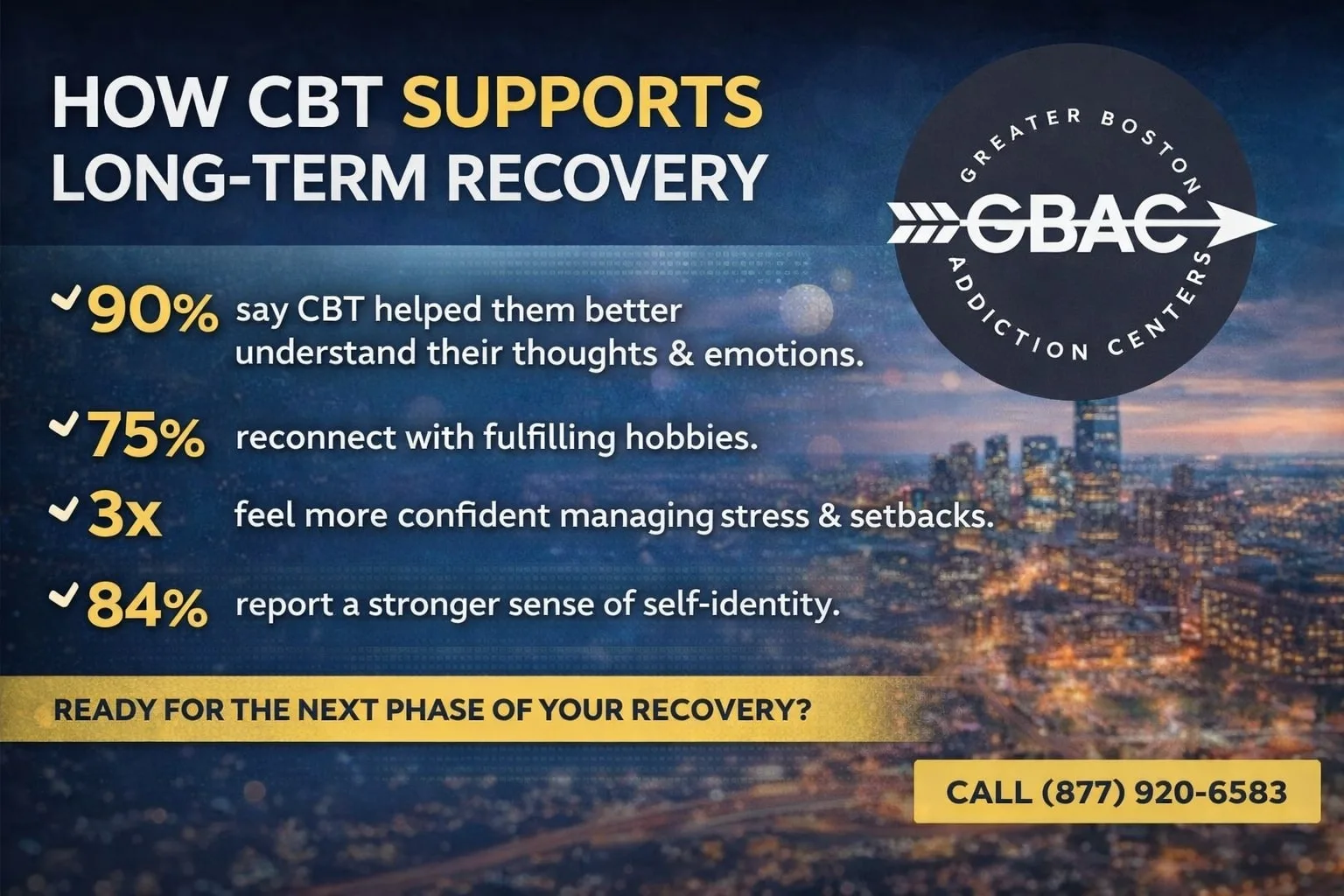
How CBT Supports Emotional Growth in Long-Term Recovery
Here’s what CBT can actually do for you in this phase of life:
- Name the storylines running your thoughts. Are they yours—or inherited from trauma, early recovery, or old survival strategies?
- Challenge emotional deadness. CBT helps you reconnect to authentic emotion—not just “good vibes only” but the full, messy spectrum.
- Build habits around meaning, not just management. Once stability is in place, you can start building toward what lights you up—not just what keeps you afloat.
- Update your self-image. You’re not just someone who used to struggle. You’re a human being with preferences, creativity, complexity, and desire. CBT helps you meet that version of yourself.
Boston Alumni Are Finding a New Phase of Recovery Through CBT
The pace of life in Boston can be relentless. Career, family, relationships, even your own high standards—it’s easy to stay busy and look functional while feeling emotionally numb. Greater Boston Addiction Centers offers CBT that honors the complexity of your recovery—not just the milestones, but the in-between moments too.
Explore CBT services in Boston, MA that aren’t just about relapse prevention. They’re about identity expansion, emotional reconnection, and giving yourself permission to want more.
CBT Is the Tool for the “Now What?” Season
You’ve earned your seat at the table. Now what?
If you’ve been thinking that something’s missing—even if you can’t name what—CBT is a place to start asking the deeper questions. Not to tear your life apart, but to help you feel present in it again.
FAQ: CBT for Long-Term Recovery
What is CBT, really?
CBT (Cognitive Behavioral Therapy) is a structured, evidence-based form of talk therapy that focuses on identifying and challenging unhelpful thought patterns. It’s less about analyzing the past and more about noticing what thoughts are shaping your present—and learning how to shift them.
I’ve been sober for years. Is CBT still relevant to me?
Absolutely. CBT isn’t just for early recovery or crisis management. Many long-term alumni use CBT to work through emotional numbness, spiritual disconnection, identity confusion, or even plateaued personal growth.
Is CBT like 12-step work?
There’s overlap—both encourage self-awareness and action. But CBT gives you specific psychological tools to explore your thoughts and behaviors with precision. It’s not a replacement for mutual aid—it’s an additional support layer.
Will CBT feel like I’m starting over?
Not at all. In fact, it starts right where you are. CBT is about building on your current recovery—not undoing it. Think of it like updating your emotional software to reflect the person you’ve become.
How do I get started with CBT in Boston?
Greater Boston Addiction Centers offers CBT as part of our comprehensive therapy and alumni support services. Whether you’re looking to deepen your emotional work, reconnect with yourself, or just feel something again, we’re here for it.
Ready to Reconnect With Yourself?
Call (877) 920-6583 or visit our CBT services page to explore how cognitive behavioral therapy can support your next phase of recovery. You’re not broken. If you’re near Boston, Dedham, Waltham, or West Roxbury, Massachusetts, GBAC offers programs with that same approach. You’re just ready for more.
