

I can’t tell you how many people have looked at me and said this quietly:
“What if I get sober and I’m not me anymore?”
Not dramatic. Not resistant. Just scared.
If you’re creative, intense, sensitive, or socially magnetic, substances may have felt like part of your rhythm. A way to soften anxiety. A way to access emotion. A way to connect without overthinking every word.
And the thought of walking into something like Heroin addiction treatment can feel less like hope—and more like erasure.
Let’s talk about what nobody really says about anxiety and substance use.
The Drug Didn’t Create Your Personality — It Helped You Cope
Many people who struggle with heroin use also live with anxiety.
Not always panic attacks. Sometimes it looks like:
- Replaying conversations at 2am
- Feeling too aware of yourself in a room
- A constant hum of tension in your chest
- Perfectionism that feels like pressure, not pride
Heroin can feel like relief. Like the volume drops. Like your body unclenches for the first time all day.
That relief can become intertwined with identity.
“I’m more relaxed.”
“I’m more creative.”
“I’m more myself.”
But here’s the distinction I gently offer my clients:
Relief is not identity.
The substance didn’t invent your depth, your humor, your artistic edge, or your emotional intensity. It managed the anxiety that was interfering with those traits.
When mental health and substance use collide, the drug becomes a regulator. A fast one. A powerful one. But still just a tool your brain grabbed onto.
And tools can be replaced.
The Fear of Becoming “Flat”
This is one of the most vulnerable fears I hear:
“What if I get boring?”
There’s often shame underneath that question. As if wanting to stay interesting means you don’t care about getting better.
But it’s human.
Early recovery can involve a recalibration period. Your brain has to relearn how to experience pleasure, creativity, connection, and calm without a chemical override.
During that adjustment, things can feel… muted.
Music might hit differently. Social interactions might feel awkward. Emotions might swing.
That doesn’t mean sobriety is flattening you.
It means your nervous system is healing.
Think of it like coming out of a room with strobe lights. At first, natural light feels strange. Not dramatic enough. Not intense enough.
But your eyes adjust.
And what you start to notice isn’t less color. It’s more detail.
Anxiety Gets Louder Before It Gets Quieter
This is the part people don’t always prepare you for.
When heroin leaves the picture, anxiety can surge.
Your body has relied on something powerful to quiet it. Remove that, and your system can feel exposed.
You might experience:
- Restlessness
- Racing thoughts
- Irritability
- Emotional waves that feel bigger than you expected
That doesn’t mean you can’t do recovery.
It means your anxiety needs treatment too.
For some, that begins with structured daytime care. For others, it means starting in a contained, supportive environment with round-the-clock stabilization—like getting help in Residential where both anxiety and substance use can be addressed together.
Not as separate problems. But as intertwined ones.
When we treat anxiety directly—through therapy, skill-building, sometimes medication, nervous system work—the fear of losing yourself often softens.
Because what you were really afraid of losing… was relief.
And relief can be rebuilt in healthier ways.
You’re Not Interesting Because You Suffer
I want to say something gently, especially if you’re creative or emotionally intense:
You are not compelling because you’re in pain.
Culture romanticizes tortured artists and chaotic personalities. It subtly tells us that depth requires dysfunction.
But clinically—and humanly—that’s not what I see.
What I see is this:
When anxiety decreases, creativity becomes more sustainable.
When substance use decreases, relationships become more stable.
When your nervous system feels safe, your personality expands instead of contracts.
You don’t lose your edge.
You lose the constant emergency state.
And that emergency state might have felt like intensity—but it was actually strain.
Recovery Is Not a Personality Replacement Program
There’s a myth that treatment turns everyone into the same person.
Same language. Same hobbies. Same tone.
That’s not the goal. And it’s not how real healing works.
Effective care helps you:
- Understand your anxiety instead of running from it
- Build distress tolerance without numbing
- Separate your coping strategy from your identity
- Develop emotional range without chemical assistance
Heroin addiction treatment, when done thoughtfully, isn’t about flattening who you are.
It’s about stabilizing your brain and body so you can access who you are more consistently.
Recovery is not a personality transplant.
It’s a nervous system repair process.
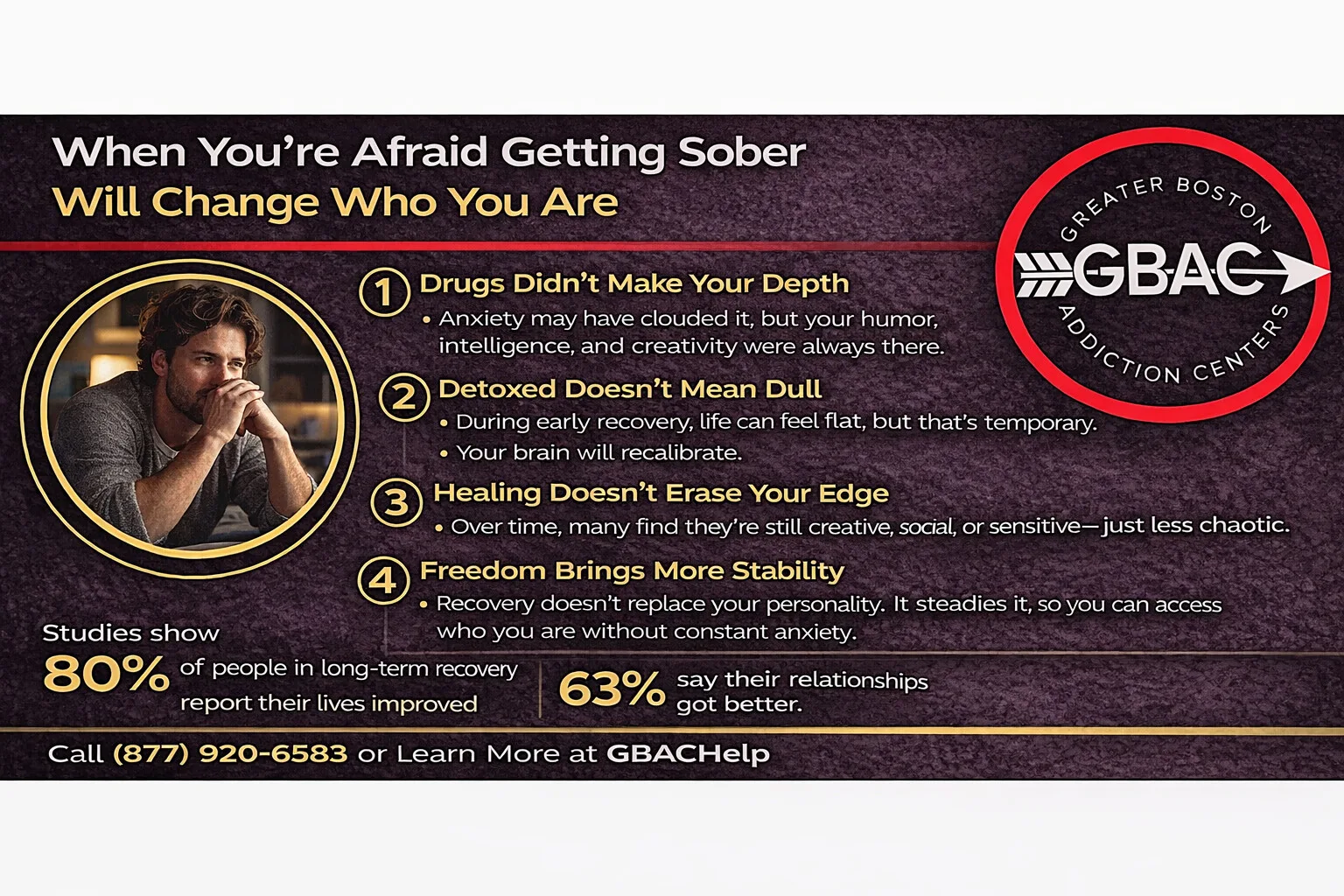
What Actually Changes — And What Doesn’t
Let’s be honest about what does shift in recovery:
You may:
- Leave certain social circles
- Discover that some relationships were built around use
- Feel awkward in new environments at first
- Reevaluate parts of your identity that were tied to substances
That can feel destabilizing.
But here’s what doesn’t disappear:
- Your humor
- Your creativity
- Your ability to connect
- Your sensitivity
- Your intelligence
In fact, many people find those traits deepen—because they’re no longer filtered through anxiety and chemical dependence.
The version of you that emerges isn’t smaller.
It’s steadier.
When Anxiety and Substance Use Feed Each Other
There’s a cycle that often develops:
Anxiety → Use → Temporary Relief → Rebound Anxiety → More Use
Over time, the brain becomes less able to regulate naturally.
So the fear becomes:
“If I remove the drug, the anxiety will swallow me.”
But in reality, continued use often intensifies baseline anxiety over time.
Part of recovery is gently retraining your system to regulate without crisis.
That might involve therapy, group work, medication support, somatic tools, or structured treatment levels that meet you where you are.
The goal isn’t to strip you down.
It’s to build you back up.
You Don’t Have to Choose Between Depth and Stability
One of the biggest misunderstandings is that you must choose:
Be stable and boring.
Or intense and self-destructive.
That’s a false binary.
You can be emotionally rich and regulated.
Creative and grounded.
Social and sober.
It takes time. And support. And patience with the adjustment period.
But I’ve watched people rediscover music, art, humor, and intimacy in ways that feel less chaotic and more sustainable.
Recovery doesn’t erase you.
It removes what was distorting you.
FAQs: The Questions People Are Afraid to Ask
Will I lose my creativity if I stop using heroin?
Creativity often feels heightened when substances reduce inhibition or anxiety. In early recovery, there can be a temporary adjustment period. But long-term, most people report clearer thinking, more consistent output, and deeper emotional access. Creativity thrives in stability—not just intensity.
What if my anxiety becomes unbearable without heroin?
It’s common for anxiety to spike when stopping. That’s why support matters. Treatment addresses both substance use and underlying anxiety. You don’t have to “white-knuckle” it. There are structured, compassionate ways to stabilize your nervous system safely.
I’ve always been the “fun one.” What if I change socially?
Social dynamics may shift. But being “fun” doesn’t require substances. Confidence and presence can feel shaky at first—but they rebuild. Over time, many people feel more authentic in social settings because they’re not managing secrecy or internal distress.
Is it normal to feel ambivalent about getting help?
Yes. Especially if substances feel tied to identity or relief. Ambivalence doesn’t mean you’re not serious. It means part of you is protecting something that once helped you survive.
What if I’ve tried before and felt flat or disconnected?
Early recovery can feel emotionally muted for some. That doesn’t mean that’s your permanent state. Brain chemistry needs time to rebalance. If a previous attempt felt unsupported or too abrupt, a different level of care or more integrated mental health support can make a significant difference.
How do I know if I need structured care?
If anxiety and heroin use are feeding each other, if stopping feels impossible alone, or if your life feels increasingly built around managing use, structured support can provide stabilization and safety. You don’t have to wait for everything to fall apart to ask for help.
A Gentle Invitation
If you’re scared that sobriety will take away who you are, I want you to hear this clearly:
You are not a personality built out of heroin.
You are a person who learned how to cope.
Heroin addiction treatment is not about erasing your intensity, creativity, or identity. It’s about helping you feel steady enough to live without constant internal pressure.
If you’re curious—even cautiously curious—you can explore what that might look like through our Heroin addiction treatment services in Massachusetts.
Call (877)920-6583 or visit our program page to learn more about our Heroin addiction treatment services in Boston.
