

I remember thinking I was different this time. Stronger. Smarter. Fixed.
I even told myself I didn’t need as much support anymore—until I proved myself wrong.
If you’re here, you probably know that feeling too. And if you’re trying to make sense of it, you’re not alone.
The Confidence That Quietly Turns Into Risk
Around 90 days, something shifts.
You’re sleeping better. Thinking clearer. Life feels… manageable.
That’s where it got me.
I stopped checking in as much. Skipped meetings. Told myself I didn’t need structure anymore. I wasn’t craving alcohol the same way, so I assumed I was safe.
But the truth? I didn’t lose the problem—I just got more comfortable standing next to it.
The Lie That Sounds Like Growth
It didn’t come back as a loud craving.
It sounded like this instead:
- “I’ve learned enough now.”
- “I can handle just one.”
- “Other people need treatment. I’m past that.”
That’s the part no one really warns you about.
Relapse doesn’t always feel like falling—it can feel like progress.
I even started looking up safe ways to stop drinking, like I was just “adjusting,” not slipping. Like I could control it this time.
But control wasn’t the issue. It never was.
The Moment It Clicks (And It Hurts)
For me, it wasn’t dramatic.
It was a quiet realization:
I was hiding again.
Not from everyone else—but from myself.
Minimizing. Justifying. Rewriting the story.
That moment hits hard because you know better.
And somehow, that makes it feel worse.
You Didn’t Erase Your Progress
Here’s what I wish someone told me right then:
Relapse doesn’t cancel what you built.
You didn’t imagine those 90 days.
You didn’t fake the growth, the clarity, the effort.
You just stepped away from the things that were helping you stay there.
That’s different than starting over.
Trying to “Manage It Alone” Isn’t Strength
I thought going solo meant I was stronger.
It actually meant I was drifting.
There’s this idea that once you’ve been through treatment, you should be able to maintain it on your own. But recovery doesn’t work like a graduation—it works like maintenance.
Sometimes that means stepping back into support before things spiral further.
For some people, that looks like reconnecting with structured care or even exploring alcohol addiction treatment again—not because you failed, but because you’re paying attention.
What Helped Me Turn It Around (Again)
Not perfectly. Not instantly. But honestly.
- I told someone the truth—even though I didn’t want to
- I stopped trying to “outthink” my drinking
- I gave myself permission to need help again
And yeah… it was humbling.
But it also worked.
Sometimes the strongest move isn’t pushing through alone—it’s turning back before things get worse.
If You’re Sitting in That “I Thought I Was Past This” Feeling
I get it. That mix of frustration, confusion, maybe even embarrassment.
But this doesn’t mean you’re broken.
It means you’re still in it—and that matters.
There are still options. Still support. Still a way forward that doesn’t involve pretending you’re fine.
If you’re thinking about what comes next, it might help to look at different levels of care, including more immersive options like live-in support or exploring treatment options in Residential.
You don’t have to figure it all out today. Just don’t ignore what you’re noticing.
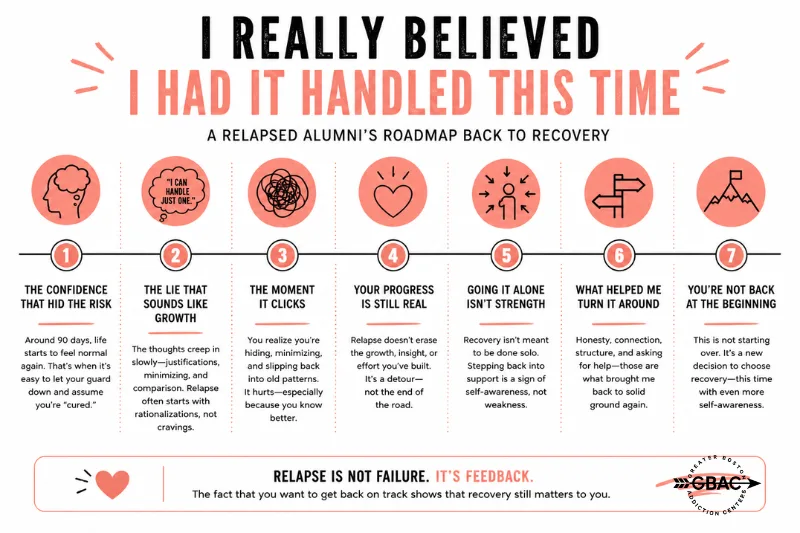
You’re Not Back at the Beginning
You’re at a point where something important is becoming clear again.
That counts.
Call (877)920-6583 or visit our alcohol addiction treatment services to learn more about our Alcohol addiction treatment services.
