

When our 20-year-old relapsed, it was like someone yanked the floor out from under us.
We had made it through detox. We’d done the early-recovery chaos. He had been doing “okay” by all external measures. He was going to meetings. Staying clean. Back at work. Even laughing again.
And then, just like that, it all unraveled. A missed call. A string of lies. Then the gut punch: “I slipped.”
We were devastated—and terrified. The fear of losing him came flooding back. But what we didn’t expect was how much EMDR therapy would shift not only his recovery, but our understanding of what relapse really meant.
The Pain Behind the Panic
As parents, it’s easy to interpret relapse as defiance, apathy, or regression. It can feel like betrayal—especially after all the effort, money, and hope you’ve invested.
We wanted to say, “Why would you throw this away?” We wanted to scream, “Don’t you see what this is doing to us?”
But EMDR taught us to ask a better question: What pain is still unhealed beneath this behavior?
Because relapse often isn’t about wanting to get high. It’s about wanting to stop feeling something that feels unbearable—and not knowing any other way to do that.
EMDR Isn’t Just for Trauma Survivors—It’s for People Who Can’t Move Past Something
At first, EMDR sounded intense and specialized. We assumed it was only for people with extreme PTSD—veterans or abuse survivors.
But what we learned is this: EMDR is for unprocessed pain. Period.
It’s for the memory your brain still reacts to like it’s happening now. The moment that gets stuck and resurfaces in panic, shame, or total emotional shutdown.
For our son, that unprocessed pain was subtle—things even he hadn’t fully identified. But with EMDR, he didn’t need to explain it all. He just had to show up, and let his brain do what it couldn’t do when it was in survival mode.
During sessions, the therapist guided him through a process involving eye movements or tapping that helped “unstick” those memories—without re-traumatizing him. He didn’t have to rehash every detail. He just had to let it pass through, this time with support.
You can learn more about EMDR at Greater Boston Addiction Centers—especially how it’s used to help people who relapse not out of rebellion, but because they’re still carrying something they can’t put into words.
We Started Responding With Curiosity, Not Crisis Mode
Before EMDR, every bump in the road sent us into full-blown panic. We watched him like a hawk. We begged him to be honest. We swung between micromanaging and emotional withdrawal.
But once we saw what EMDR was revealing—how certain memories still held power over him—we stopped asking “What’s wrong with you?” and started wondering “What’s unfinished in you?”
That shift—honestly—saved our relationship with him.
We moved from reaction to regulation. From accusation to empathy. From treating relapse like the end of the world to seeing it as a signal: something deeper needs attention.
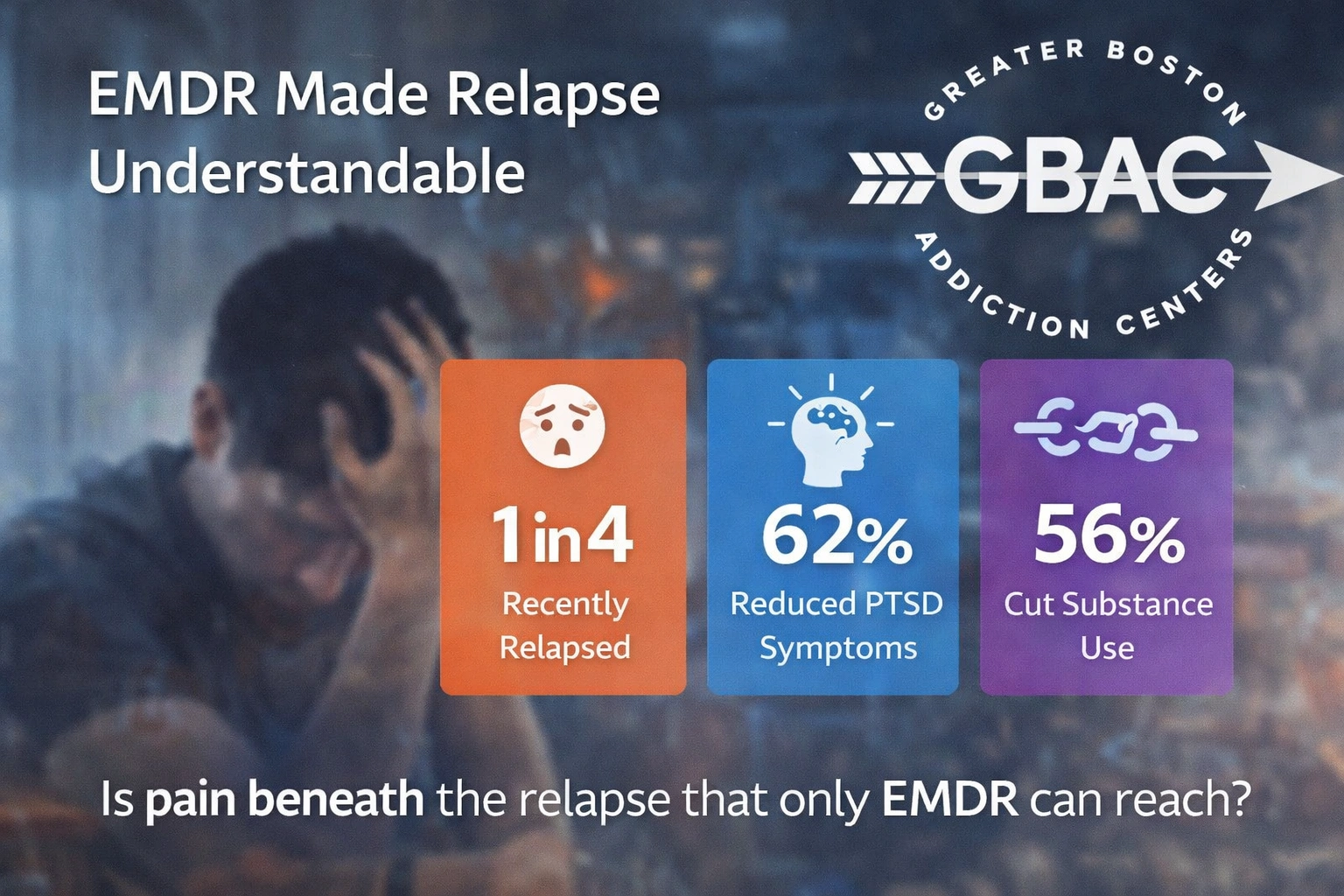
EMDR Made Healing Feel Possible Again—for All of Us
Our son began using again during a stressful week at work—but that wasn’t the full story. EMDR helped him recognize how that stress triggered something older: the belief that he always fails, that he’s inherently broken.
Once he processed that through EMDR, something loosened.
He didn’t suddenly become “fixed.” But he stopped spiraling. He started saying things like, “I felt the urge coming on, but I knew what it was connected to.” That kind of insight changed everything.
And it wasn’t just him. We, as parents, needed our own kind of EMDR too. To help us deal with years of walking on eggshells, of absorbing fear in our bodies, of feeling like we were failing too.
Sometimes family members get stuck in their own emotional loops—loops that EMDR can gently unwind.
When the Past Doesn’t Get Processed, It Shows Up in the Present
Our son never talked about the bullying in middle school. Or the way he froze when he couldn’t protect a friend. Or the shame he felt when we tried to help and he wasn’t ready.
But those things didn’t disappear just because he got sober.
That’s the hard truth we had to learn: sobriety doesn’t erase trauma. It just removes the numbing. And when all that pain comes roaring back, it’s no wonder people relapse. It’s not weakness. It’s physiology.
EMDR gave his nervous system a way to complete the processing that never happened. And that’s what helped make space for actual healing.
If you’re in Waltham, Massachusetts, and your loved one keeps cycling through relapse without explanation, it might be time to ask: is there pain beneath this pattern that therapy alone hasn’t reached?
We Learned to Step Back Without Walking Away
As parents, we often walk a tightrope between helping and hovering.
After EMDR began, we found more peace in letting go of control—not because we stopped caring, but because we started trusting the process. We didn’t have to be the therapists. We didn’t have to interpret every mood shift.
We just had to love him through it. With boundaries. With presence. And with a willingness to keep learning alongside him.
That’s when we started healing too.
EMDR Isn’t a Magic Fix—But It’s a Doorway
Our son still goes to meetings. He still has support outside of EMDR. He still messes up.
But what’s different now is this: he knows the why behind his behaviors. He knows where the emotional fire is coming from. And he knows how to sit with it—sometimes painfully, sometimes clumsily—but without running.
For families near Wellesley, Massachusetts, where recovery resources may feel overwhelming or unfamiliar, EMDR can offer a simple, powerful doorway into healing—whether that’s during outpatient work or after stabilization in support in Residential.
FAQ: EMDR and Family Recovery
What exactly does EMDR treat?
EMDR helps reprocess traumatic or distressing experiences that are “stuck” in the nervous system. This includes trauma, emotional neglect, shame, bullying, grief, and more.
Can EMDR help after relapse?
Yes. EMDR is often most effective after stabilization, when someone is ready to explore the roots of emotional pain that contribute to substance use.
Can family members do EMDR too?
Absolutely. Parents often carry unprocessed fear, guilt, or trauma related to their child’s addiction. EMDR can help reduce anxiety, regulate emotional reactions, and foster better boundaries.
Does it replace traditional therapy?
No—it complements it. EMDR is a powerful tool within a broader treatment plan. It works best when paired with therapy, group support, and a safe, structured environment.
What if my child doesn’t want to talk about the past?
That’s okay. EMDR doesn’t require full disclosure or deep conversation. The process allows healing without rehashing every painful detail.
From Panic to Perspective
Relapse shook us. EMDR steadied us.
It helped our son move through his pain instead of hiding from it. And it helped us stop fearing the past—and start understanding how it shaped the present.
If you’re watching your child relapse and you feel powerless to stop it, you’re not failing. You’re not alone. And there may be a kind of healing ahead that none of you have tried yet.
It might not look like a breakthrough. It might look like safety, and softness, and space. And that’s where healing often begins.
Want to explore trauma therapy that sees the person—not just the behavior?
Call (877) 920-6583 to learn more about our Dialectical Behavior Therapy in Massachusetts.
