

Some people get sober after hitting rock bottom. Others just start asking different questions.
Questions like:
- Why do I keep ending up here?
- Why do I feel okay… until I suddenly don’t?
- What if I’m not “an addict,” but I still don’t feel free?
If that’s you—searching, unsure, quietly burned out by patterns that don’t make sense on paper but feel all too familiar—there’s something worth exploring: EMDR.
It’s not a fix-all. It’s not a label. And it’s not just for trauma survivors in the clinical sense.
EMDR is for people whose past is still whispering (or yelling) into their present. For those who’ve talked about their struggles, reflected, journaled, processed—and still feel like something inside them hasn’t quite caught up.
1. Your Brain’s Job Is to Keep You Safe—Even If It Gets It Wrong Sometimes
Let’s say something hard happened years ago. Maybe it was a major trauma. Maybe it was a long stretch of emotional neglect. Maybe it was a moment you can’t even name, but you know it changed something in you.
Your brain did what it was supposed to do: it formed protective patterns.
Don’t get close.
Numb the fear.
Stay in control.
Shut it down.
Drink a little more when it gets loud.
Those aren’t character flaws. They’re safety adaptations.
EMDR (Eye Movement Desensitization and Reprocessing) isn’t here to criticize those adaptations. It’s here to update them.
Because what protected you then might be limiting you now.
2. EMDR Doesn’t Ask for a Diagnosis—Just a Willingness to Be Honest
You don’t need to call yourself an “alcoholic.”
You don’t need to decide if your cannabis use is “a problem.”
You don’t need to explain why certain things still mess you up more than they should.
You just need to be honest that something doesn’t feel right—and open to the idea that your brain might be holding on to something it’s ready to release.
EMDR meets people in that space. It’s not about labeling you. It’s about listening to what your nervous system might still be carrying and giving it a safe place to let go.
3. What Actually Happens in EMDR?
It’s easier than it sounds.
In an EMDR session:
- You bring up a memory, feeling, or belief that feels stuck (like “I’m not safe” or “I always mess things up”).
- While holding that thought, you engage in bilateral stimulation—usually by following your therapist’s finger, tapping rhythmically on your knees, or listening to alternating tones.
- This process helps your brain reprocess the memory—not with logic, but with its built-in trauma-resolution system (similar to what happens during REM sleep).
Over time, those emotionally charged experiences lose their grip. You don’t forget them. You just stop living in them.
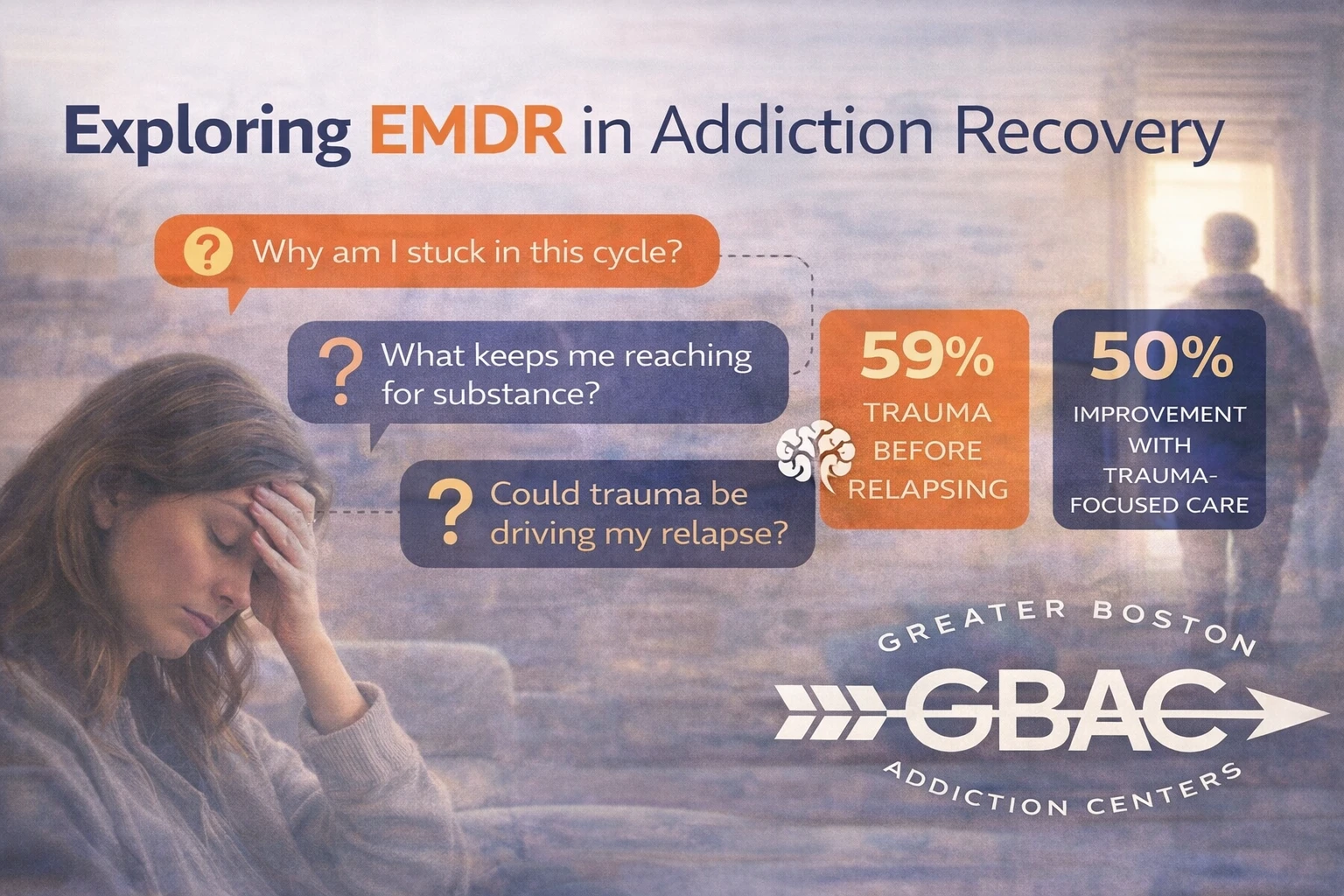
4. EMDR Helps You Unhook from the Loop
For a lot of people exploring sobriety, the issue isn’t just the substance. It’s the loop that leads there.
It looks like this:
- Feel a certain kind of stress, shame, or discomfort
- Hear the old narrative: I can’t deal with this
- Cope with whatever numbing tool is closest
- Regret it, restart, repeat
That cycle gets exhausting.
EMDR helps interrupt the loop—not by giving you better affirmations or accountability, but by working under the loop. It helps your brain stop reacting as if that old pain is still present. Because once that changes, your options open up.
You can pause instead of panic.
You can feel discomfort without fleeing.
You can choose differently—not because you should, but because you can.
5. EMDR Is a Fit for the “High-Functioning but Not Okay” Crowd
Some of the people who benefit most from EMDR are the ones who are holding it together. On the outside, they’re fine. Productive. Reliable. Maybe even thriving.
But inside? They’re managing a background hum of anxiety, guilt, emotional disconnection, or inexplicable overwhelm. They can’t always explain it, but they feel like their internal world is running on old software.
EMDR helps them update that internal coding.
We see this every day in our programs in Newton, Needham, and the greater Boston area: clients who weren’t in full-blown crisis, but who still wanted something deeper. Something that helps make the quiet pain… actually quiet.
6. You Don’t Have to Tell the Whole Story to Heal from It
One of the most common fears people have about EMDR is that they’ll have to dig up every detail. You don’t.
You get to set the pace. You get to choose what you name. And sometimes, you don’t have to say much at all.
That’s the beauty of EMDR—it works on the emotional and sensory memory systems in your brain, not just the verbal ones.
If you’ve ever felt like “talking about it” hasn’t worked—or that you don’t even know what “it” is exactly—EMDR might be the first thing that actually feels like movement instead of rehashing.
7. You’re Allowed to Start Healing Without Waiting for a Meltdown
If you’re even thinking about change—about drinking less, reconnecting with yourself, letting go of old pain—that’s valid.
You don’t have to wait until your life falls apart.
You don’t have to call it rock bottom.
And you don’t have to keep doing this dance where things get almost better—until they don’t.
At Greater Boston Addiction Centers, we help people every day who are in that in-between space. Curious. Questioning. Still functioning, but wanting something more than just “getting through the day.”
Whether you’re local to Brookline, Boston, or a nearby town, you don’t need to know exactly what you’re healing from. You just need to know you’re ready to stop doing it alone.
FAQs About EMDR for the Sober Curious
Do I have to be sober already?
No. You can be curious, cutting back, or even still using. EMDR is often part of early recovery—not something you have to earn first.
What if I don’t have a big trauma story?
EMDR works for all kinds of experiences—not just “Big T” trauma. Rejection, emotional neglect, shame, or bullying can all leave marks worth healing.
Is EMDR emotional?
Sometimes. But you’re always in control. EMDR is designed to process emotion in small, manageable pieces. You’re never forced into overwhelm.
How fast does it work?
Some people feel shifts in just a few sessions. Others do EMDR alongside longer-term therapy. It’s not instant, but it’s often faster and deeper than talk therapy alone.
Is EMDR only for PTSD?
Not at all. It’s used for anxiety, depression, addiction, grief, and general emotional stuckness—especially when old patterns keep repeating.
You’re Not Too “Okay” to Get Help
There’s a myth that you have to be broken to reach out. That if you’re still functioning, still employed, still getting by—you’re not “sick enough” for support.
Forget that myth.
You’re allowed to want peace. Stability. Clarity. You’re allowed to want to stop reliving the past, even if you’re not sure which part of it is still following you.
Call (877) 920-6583 or visit EMDR therapy in Massachusetts to learn more about our trauma-informed services in West Roxbury, and the Boston area.
Curiosity is enough. You’re enough.
Let’s talk about what healing could look like on your terms.
