

You’re the go-to person.
The one who handles things.
The one who remembers the birthdays.
The one who shows up, holds it together, and gets it done.
From the outside, no one sees a problem. You’re working. You’re maintaining relationships. You even make people laugh. There’s no crisis to point to—nothing dramatic, nothing anyone would call “rock bottom.”
And yet, under the surface, you’re slipping.
It’s not that you want to drink or use. It’s that not doing it feels… unbearable. Because it’s the only time your brain goes quiet. The only time your shoulders drop. The only time you feel like you get a break from the pressure.
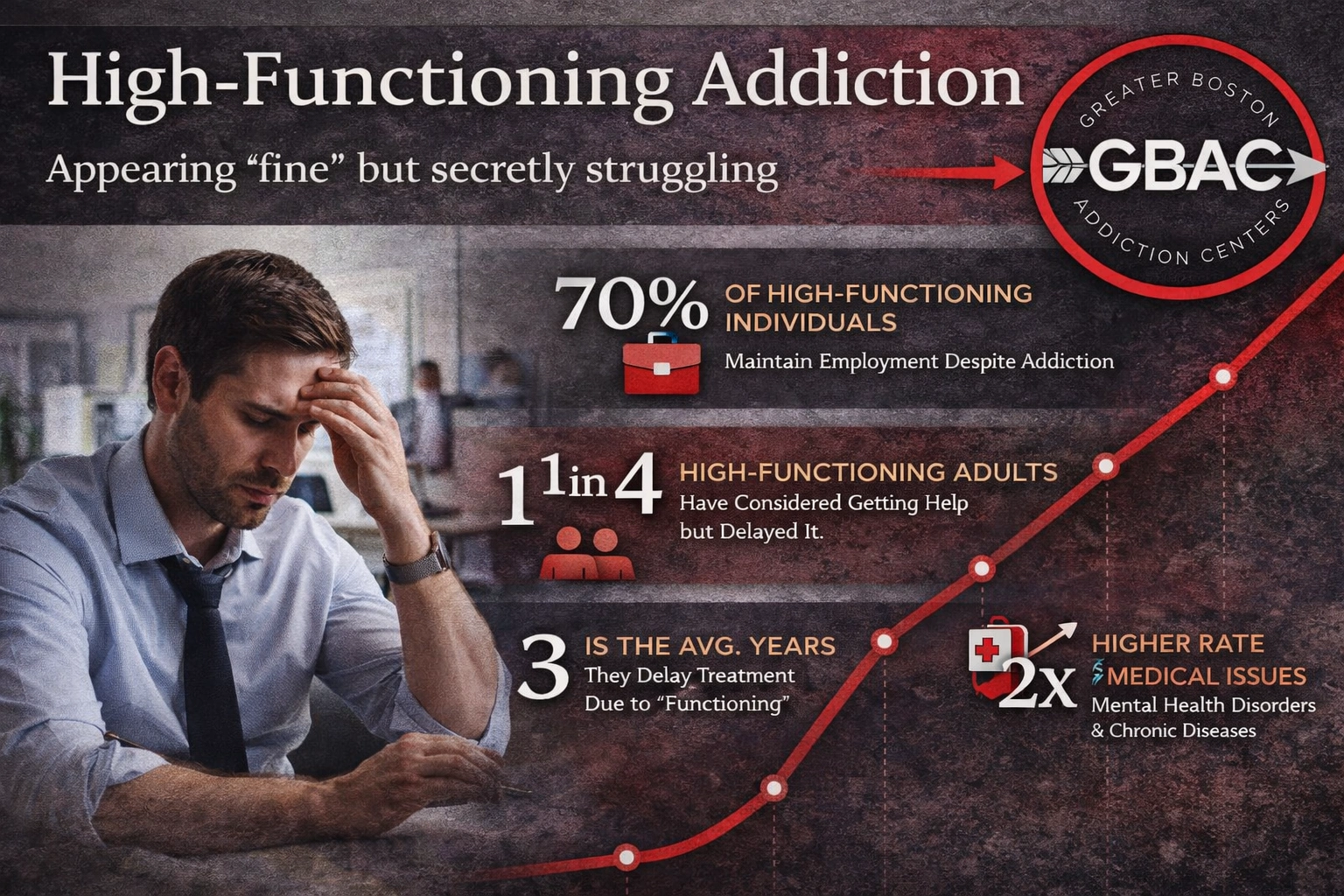
This is the hidden world of high-functioning addiction—and you’re not alone in it.
At Greater Boston Addiction Centers, we see you. And we built our intensive outpatient program to give people like you a space to be real, to rest, and to recover—without having to lose everything first.
When Capability Hides the Crisis
One of the hardest parts about being high-functioning is that no one knows you’re struggling.
And that’s by design. You’ve made sure of it.
You still show up. You’re productive. You make it to meetings. You keep the kids fed. Your outer life is intact.
So when your drinking increases, or when the pills become non-negotiable, or when the comedown anxiety turns into panic at 3 a.m.—you tell yourself:
“It’s not that bad. I’m still handling it.”
But functioning isn’t the same as being okay.
Numbing Isn’t Healing (But It’s Trying to Be)
Whatever you’re using—alcohol, stimulants, prescriptions—it’s likely serving a function. It quiets something. Softens something. Lets you keep going.
That doesn’t make you weak. It makes you adaptive.
But over time, that coping starts to cost more than it gives.
- You lose time.
- You forget conversations.
- You overreact. Or underreact.
- You lie. Or hide. Or cancel.
And the more you rely on it, the more you feel like you can’t stop.
That’s where IOP comes in—not to strip your life away, but to help you reconnect with it.
What Is an Intensive Outpatient Program (Really)?
You might picture rehab and think: “I can’t disappear for 30 days.”
Or: “I don’t want everyone to know.”
Or: “I don’t need all that.”
That’s why intensive outpatient programs exist.
IOP gives you a flexible structure: multiple sessions a week (often in the evenings), combining group therapy, individual counseling, and education—all without requiring you to leave your job or home.
You can keep living your life while starting to rebuild it.
At our intensive outpatient program in Waltham, we tailor treatment to people who are holding it together on the outside, but quietly unraveling inside.
This includes:
- Professionals in high-pressure roles
- Parents managing chaos
- Caregivers with no time for themselves
- Students who feel they “should be fine”
You don’t have to explain your whole life to us. We already know how heavy it is.
You Deserve Help Before You Collapse
There’s a cultural lie that says you need to hit “rock bottom” before you get help.
We reject that.
You don’t need to lose your job, destroy your marriage, or get hospitalized to qualify for support.
You just need to notice that something’s not right—and be willing to name it.
That quiet voice inside you saying, “I can’t keep doing this”? That’s enough.
You’re allowed to respond before the crash.
You’re Not the First “Put-Together” Person We’ve Helped
A common fear is that you’ll walk into treatment and not belong. You imagine a room full of people who’ve lost everything, and you—still working, still “fine”—won’t fit.
But here’s what actually happens:
You show up, unsure. And you hear someone say something that sounds just like you:
“I was still showing up to work every day. But inside, I was falling apart.”
You realize that “functioning” and “okay” aren’t the same.
And suddenly, you’re not so alone.
Whether you’re in Boston or looking for an intensive outpatient program in Dorchester, we have space for you.
What Happens When You Finally Exhale
One of the most powerful moments in IOP isn’t learning a new skill or hitting a milestone.
It’s this:
You sit in a room where you don’t have to impress anyone.
You speak without performing.
You admit something raw—and no one flinches.
And your body, which has been bracing for years, finally lets go. Just a little.
That’s what healing begins to feel like.
Not fireworks. Not perfection.
Just… space.
To be tired. To be unsure. To be human.
Frequently Asked Questions (FAQs)
What exactly is an intensive outpatient program?
An IOP provides structured support—group therapy, individual counseling, and education—without requiring overnight stays. It’s ideal for people who need help managing substance use while still living at home and maintaining work or school.
How many hours a week is IOP?
Our program typically runs 3–5 days a week, around 3 hours per day. This allows for depth of care while keeping your schedule intact.
Will I have to take time off work?
Not necessarily. Many of our IOP sessions are scheduled in the evening to accommodate work or family responsibilities.
Do I have to be “addicted” to qualify for IOP?
No. If you’re struggling with substance use—whether it’s daily drinking, periodic overuse, or growing dependence—you may benefit. You don’t need a diagnosis to start.
Will my employer find out?
No, unless you choose to disclose it. Our services are confidential and protected by HIPAA. We can also help you explore leave options if needed.
Is IOP only for people who’ve already been to rehab?
Not at all. Many people begin their recovery in IOP. It’s a great starting point for those who are still high-functioning but know they need support.
You Can Still Be Strong—But Not Alone
We’re not here to take over your life.
We’re here to give you a safe space to stop managing it all alone.
You’ve been functioning. That’s admirable. But what if you could function and feel peace?
What if you could have your career and your clarity?
What if you didn’t have to white-knuckle through every day, waiting to earn rest?
You don’t have to wait for a crisis to want more from your life.
Ready to put the mask down?
Call (877) 920-6583 to learn more about our intensive outpatient program services in Boston, MA.
You’re not too put-together for help. You’re just ready for something real.
