

You already know you need help. That part is clear. What’s harder is figuring out what kind of help makes sense.
Residential treatment can feel overwhelming. Weekly outpatient therapy can feel like not enough. A partial hospitalization program sits right in the middle—offering strong, structured support without requiring you to live on-site.
If you’re in early recovery and scared of making the wrong choice, you’re not alone. Many of the people who walk through our doors feel the same way. They’re ready—but they’re unsure. And that uncertainty deserves clarity, not pressure.
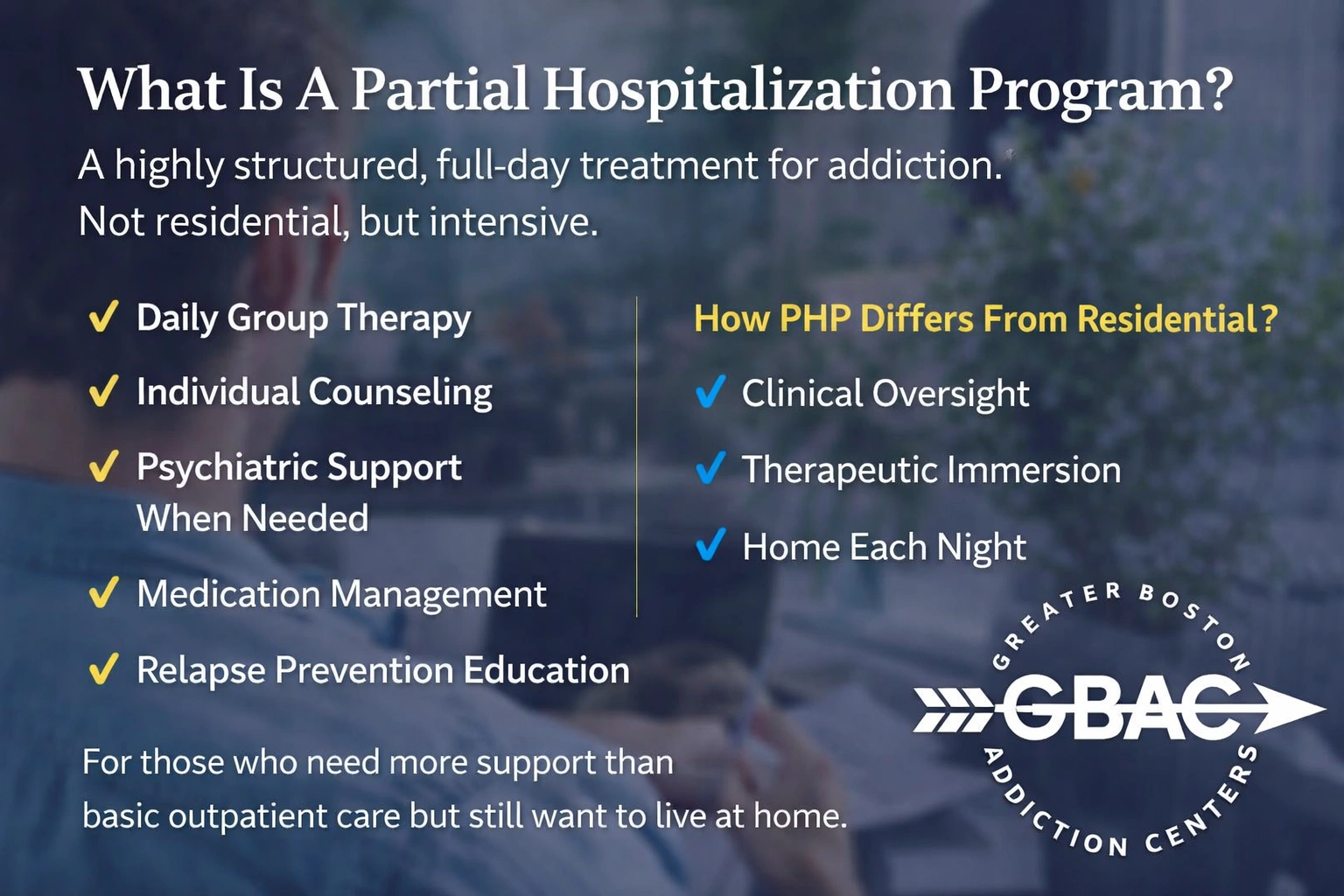
What Is A Partial Hospitalization Program?
A partial hospitalization program (often called PHP) is a highly structured, full-day treatment option for addiction recovery. You attend programming during the day—typically five to six days a week for several hours—but return home in the evenings.
It’s intensive. But it’s not isolating.
You receive:
- Daily group therapy
- Individual counseling
- Psychiatric support when needed
- Medication management (if appropriate)
- Relapse prevention education
- Emotional regulation and coping skills training
Think of it like scaffolding around a building under repair. You’re still living your life—but you’re supported from multiple angles while you rebuild.
For many individuals in early sobriety, that daily contact creates stability when everything else still feels shaky.
How A Partial Hospitalization Program Differs From Residential Treatment
Residential treatment requires living at the facility 24/7. It removes you from your home environment entirely. For some people, that level of containment is necessary—especially if the home environment is unsafe or filled with triggers.
But not everyone needs that.
A partial hospitalization program provides:
- Structured clinical days
- Ongoing medical oversight
- Therapeutic immersion
- Evening independence
You sleep in your own bed. You begin practicing recovery in real time.
Some clients begin in residential care and then step down into PHP as a transitional level of care. Others start directly in PHP if they are medically stable and have a supportive home environment.
There is no “stronger” or “weaker” option here. There is only the right level of care for where you are.
Why Outpatient Care Alone Sometimes Isn’t Enough
Traditional outpatient programs often involve therapy a few times per week for a few hours.
For someone newly sober, that can feel like being handed a life jacket in the middle of a storm.
Early recovery is emotionally intense. Your brain chemistry is recalibrating. Old coping mechanisms are gone. Triggers feel louder. Sleep may be disrupted. Anxiety can spike without warning.
A partial hospitalization program offers daily therapeutic engagement. That consistency matters.
Instead of waiting days between sessions when something hard happens, you’re back in a clinical environment the next morning. You process it. You stabilize. You learn from it.
That repetition builds resilience.
Who Is A Good Fit For A Partial Hospitalization Program?
You might benefit from PHP if:
- You’ve completed detox and need structured next steps
- You don’t require 24-hour supervision
- You feel motivated but vulnerable
- You’ve tried outpatient care before and relapsed
- Your home environment is relatively stable
- You want intensive support without fully stepping away from your life
Many of our clients come from surrounding communities like Dedham, Massachusetts and are looking for a program that allows them to receive comprehensive care while staying connected to family responsibilities.
Others travel from areas such as Newton, Massachusetts, seeking a structured daytime program that still allows them to return home each evening.
No matter where you’re coming from, the question isn’t whether you “qualify.” It’s whether this level of support meets your current needs.
What A Typical Day In A Partial Hospitalization Program Looks Like
Knowing what to expect can lower anxiety.
A typical PHP day often includes:
Morning Check-In:
You meet with peers and clinicians to assess mood, triggers, cravings, and goals for the day.
Process Group Therapy:
Facilitated discussions around emotional regulation, accountability, trauma, relationships, and recovery challenges.
Psychoeducation Sessions:
Learning about addiction science, relapse prevention strategies, nervous system regulation, and coping skills.
Individual Therapy:
One-on-one sessions to work on deeper issues driving substance use.
Psychiatric Appointments (if needed):
Medication management and mental health stabilization.
Skill-Building Workshops:
Communication tools, boundary setting, stress management, and relapse prevention planning.
It’s structured—but not rigid. Supportive—but not suffocating.
There’s space to breathe, to process, and to grow.
The Emotional Reality Of Early Recovery
Let’s be honest.
Early sobriety can feel like standing in bright light after years in the dark. Everything feels exposed.
You may think:
- What if I can’t do this?
- What if I fail again?
- What if treatment works… and I don’t recognize myself anymore?
A partial hospitalization program doesn’t demand perfection. It creates safety.
You’re allowed to be unsure. You’re allowed to be scared. What matters is that you show up.
And when you show up consistently, something begins to shift.
Sleep stabilizes.
Appetite returns.
Conversations feel clearer.
Shame starts to loosen its grip.
It’s not instant. But it’s real.
Success Stories: What We See Every Day
We’ve watched people enter PHP withdrawn and leave grounded.
One client came to us after multiple outpatient attempts. He said outpatient felt “too loose.” He’d attend sessions, leave, and fall back into old patterns within hours.
In PHP, the daily structure changed that rhythm. He built morning routines. He processed urges in real time. He began identifying emotional triggers he’d never addressed.
Three months later, he stepped down into outpatient care with confidence instead of fear.
Another client, a parent, worried that residential treatment would mean disappearing from her children’s lives. PHP allowed her to receive intensive care during the day and return home each evening.
She described it as “learning how to live sober in real life, not in a bubble.”
That’s the gap PHP fills.
Not isolation. Not overwhelm. But supported reintegration.
The Clinical Benefits Of A Partial Hospitalization Program
From a clinical standpoint, PHP offers several measurable advantages:
- Increased therapeutic hours compared to outpatient
- Faster emotional stabilization
- Higher engagement in relapse prevention strategies
- More consistent peer accountability
- Stronger transition planning
Research consistently shows that continuity of care improves long-term recovery outcomes. PHP often serves as that stabilizing bridge.
It strengthens the foundation before you step into more independence.
What Happens After A Partial Hospitalization Program?
PHP is not the end goal. It’s a phase of recovery.
As stability increases, many clients step down into:
- Intensive Outpatient Programs (IOP)
- Standard outpatient therapy
- Alumni support groups
- Ongoing psychiatric care
The goal isn’t to keep you in treatment forever. It’s to help you build enough internal and external support that you don’t need this level of intensity anymore.
Recovery should expand your life—not shrink it.
Frequently Asked Questions
How Long Does A Partial Hospitalization Program Last?
Length varies based on individual needs. Many clients participate for several weeks to a few months. Progress is evaluated regularly, and transitions happen when clinically appropriate—not on a rigid timeline.
Is PHP Covered By Insurance?
Many insurance plans provide coverage for partial hospitalization programs. Our admissions team helps verify benefits and explain options clearly so you’re not left guessing about financial logistics.
Can I Work Or Attend School During PHP?
Because PHP is a full-day program, most clients pause work or school temporarily. However, the flexibility of returning home each evening can make it easier to maintain certain responsibilities compared to residential care.
What If I’m Also Struggling With Anxiety Or Depression?
Co-occurring mental health conditions are common in addiction recovery. PHP often includes psychiatric evaluation and integrated mental health support, ensuring both substance use and underlying emotional conditions are treated together.
What If I’ve Tried Treatment Before And It Didn’t Work?
That doesn’t mean you failed. It may mean the level of care wasn’t the right fit. Many individuals who struggled in outpatient settings find greater stability in a partial hospitalization program because of the daily structure and accountability.
Is PHP Only For Severe Addiction?
No. PHP is appropriate for individuals who need more support than outpatient care but do not require 24-hour supervision. Severity is less important than stability and safety.
You Don’t Have To Guess Your Way Through This
Choosing treatment isn’t about proving how strong you are. It’s about choosing the right environment for healing.
A partial hospitalization program fills the space between isolation and independence. It gives you structure without removing your autonomy. It offers support without stripping away your daily life.
If you’re scared, that’s normal. If you’re unsure, that’s human.
What matters is that you’re considering change.
Call (877)920-6583 to learn more about our partial hospitalization program in Boston, Massachusetts.
