
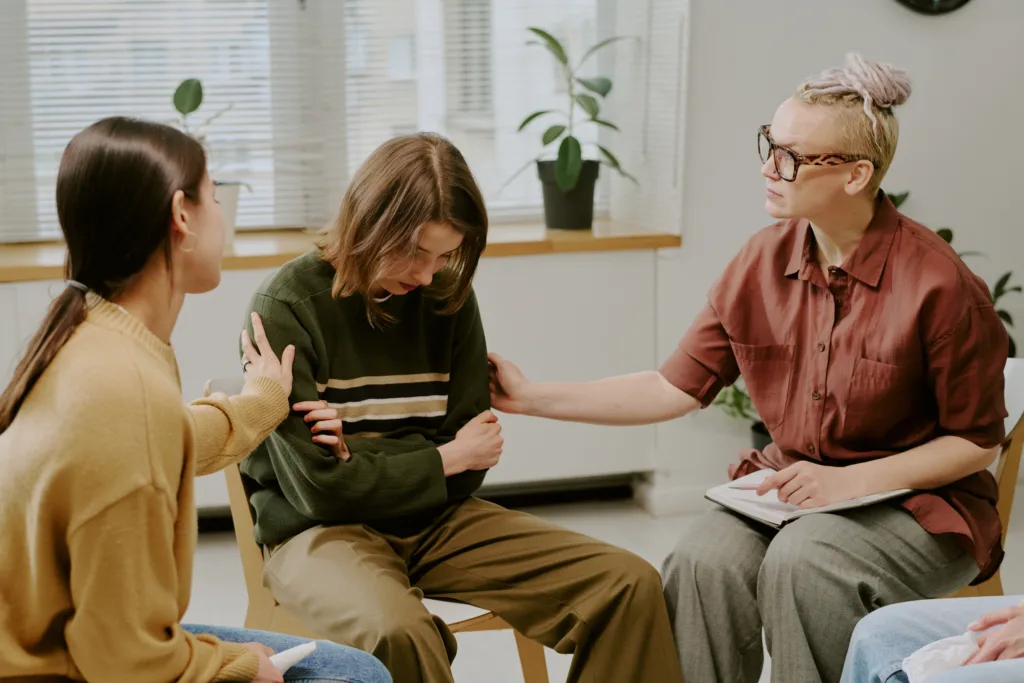
I didn’t spiral right away.
It was quieter than that. One decision, then another… and suddenly I was somewhere I swore I’d never go back to.
If you’re here, you probably know that feeling.
And if your brain is telling you you ruined everything—I need you to hear this from someone who’s been there:
You didn’t.
The Moment I Realized I Needed Help Again
Relapse doesn’t always come with chaos. Sometimes it comes with denial that sounds reasonable.
“I’ll get it back under control tomorrow.”
“It’s just one bad week.”
“No one needs to know.”
But deep down, I knew something had shifted. Not just the behavior—the thinking.
That old mental noise came back. The bargaining. The hiding. The quiet disconnect from everything that had been working.
That’s when I started looking again at structured daytime care.
Not because I wanted to start over—but because I didn’t want to lose everything I had built.
Shame Will Tell You to Stay Away
This part hit hardest.
Walking back felt like admitting failure. Like I’d be “that person” who couldn’t make it stick.
I almost didn’t go.
But here’s what actually happened:
No one looked at me like I failed.
No one talked down to me.
No one asked, “Why would you do that?”
Instead, it was more like:
“Yeah… this happens. Let’s figure out what changed.”
That shift matters. A lot.
It Didn’t Feel Like Starting Over
This surprised me.
I expected to feel like day one again. Like I had erased 90 days completely.
But that’s not how it works.
I still had awareness.
I still had tools.
I still knew what honesty felt like—even if I hadn’t been living in it for a bit.
Coming back into a partial hospitalization program didn’t reset me to zero.
It reconnected me to what I already knew—but couldn’t access on my own anymore.
What I Actually Needed Was Structure Again
Here’s the truth I didn’t want to admit:
I hadn’t relapsed overnight. I had drifted.
Less routine.
More isolation.
Skipping the things that used to keep me grounded.
That’s why being in a place with consistent, daily support helped more than I expected.
Not forever. Not in a dramatic, life-stopping way.
Just enough structure to stabilize things again.
Kind of like resetting your footing before you try to walk forward.
I Wasn’t the Only One Who Came Back
This is something people don’t talk about enough.
There were others there who had time—real time—and still came back after slipping.
And no one treated them like they didn’t belong.
If anything, they were some of the most honest people in the room.
Because they knew what it felt like to lose momentum… and choose to rebuild anyway.
If You’re Debating Whether to Reach Out Again
I get it.
Part of you wants to fix it quietly.
Part of you doesn’t want to face anyone.
Part of you is tired.
But there’s another part of you too—the one that clicked on this.
Listen to that part.
You don’t have to collapse everything to come back.
You don’t have to wait until it’s “bad enough.”
Sometimes getting support again is just… course correction.
And if you need something more steady for a bit, even support in Residential is there without judgment.
This Didn’t End My Recovery
It changed it.
It made it more honest. Less performative. More real.
Because now I know something I didn’t before:
Recovery isn’t proven by never slipping.
It’s proven by what you do next.
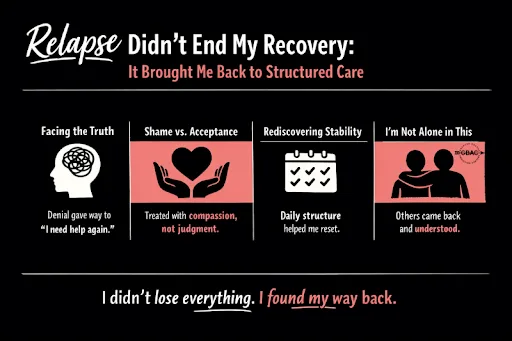
You’re not the only one who’s had to come back. Not even close.
And if you’re thinking about it, that means something in you is still fighting.
Call (877)920-6583 or visit our partial hospitalization program services to learn more about our partial hospitalization program services.
