You might not be afraid of quitting.
You might be afraid of disappearing.
If part of you wonders whether getting help will flatten your personality, dull your creativity, or take away the thing that makes you you—that fear deserves to be taken seriously.
And it’s something I hear more often than you’d think.
The Version of You That Only Shows Up When You Use
In clinical work, I’ve sat with people who feel most alive after they take something. More open. More expressive. More connected.
So the question underneath it all becomes:
If I stop… do I lose that version of me?
It makes sense.
Because right now, your brain has learned that relief, energy, and even identity come from using. Especially with opioids, where physical dependence can blur the line between who you are and what your body needs just to feel okay.
That’s not a personality flaw. It’s a nervous system doing its best to cope.
Feeling Sick Without It Isn’t Just Physical
A lot of people come in saying something like:
“I keep getting sick if I don’t take it. I just want that to stop.”
What they’re describing is withdrawal—but it’s more than flu-like symptoms.
It’s anxiety that spikes out of nowhere.
Restlessness that makes it hard to sit still in your own skin.
A sense that something is off, even if you can’t explain it.
Understanding the oxycodone withdrawal timeline can help make sense of this experience—but more importantly, it helps people realize: this isn’t permanent.
Your body is adjusting. Not breaking.
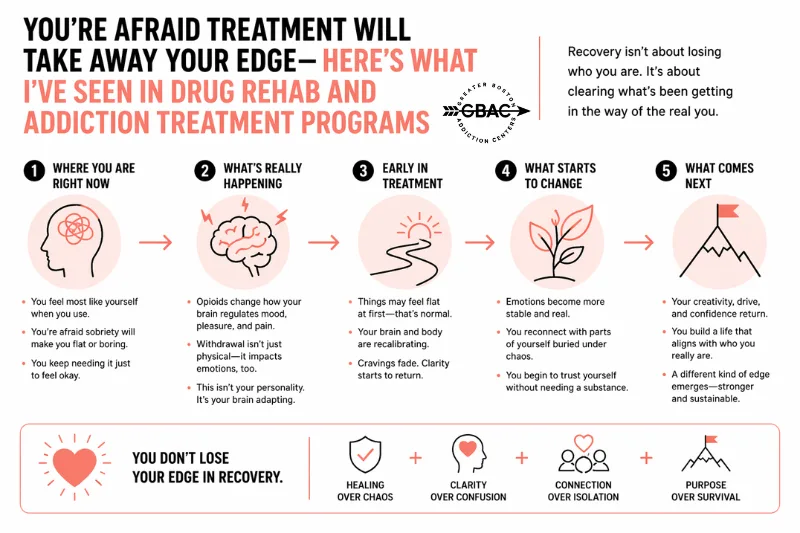
The Fear That You’ll Become “Flat”
This is the quiet fear people don’t always say out loud:
“What if I get boring?”
“What if I can’t feel things the same way?”
“What if I lose my edge?”
Here’s what I’ve actually seen:
At first, yes—things can feel muted. That’s part of your brain recalibrating after being pushed in one direction for a long time.
But that “flat” feeling isn’t your final state.
It’s a transition.
And with the right support, something more stable—and often more authentic—starts to come back online.
What Treatment Actually Protects (That You Might Not Expect)
Good treatment isn’t about taking things away.
It’s about giving your brain and body enough stability to function without chaos.
In medication-supported care, for example, the goal isn’t to numb you. It’s to reduce the intensity of withdrawal and cravings so you can think clearly again.
That clarity is where identity starts to rebuild.
Not forced. Not fake. Just… steady.
For some people, that happens best in structured settings like live-in care or multi-day weekly treatment, where there’s space to reset without constant triggers. Others start exploring options like treatment in Residential to give themselves a full break from the cycle.
You’re Not Losing Yourself—You’re Meeting Yourself Without Interference
There’s a difference between intensity and authenticity.
Substances can amplify emotions—but they can also distort them.
They can make connection feel easier—but harder to sustain.
They can create confidence—but not always consistency.
What many people discover in recovery is this:
The parts of you you’re afraid to lose?
They don’t disappear.
They just stop being dependent on something outside of you to exist.
A Different Kind of Edge
One patient once told me:
“I thought I’d lose my personality. But it turns out, I just lost the chaos around it.”
That stuck with me.
Because what came back for them wasn’t dull or boring. It was focused. Creative. Real.
A different kind of edge.
One that didn’t come with a crash afterward.
You Don’t Have to Figure This Out Alone
If you’re stuck in that cycle—needing something just to feel okay, and worrying about what happens if you stop—you’re not the only one who’s felt that way.
And there are ways to move through it without losing yourself in the process.
Call (877)920-6583 or visit medication assisted treatment program services to learn more about our drug rehab and addiction treatment programs, medication assisted treatment program services in .
You’re not choosing between being yourself and getting help.
You’re choosing how much of yourself you want back.
