

You’re still showing up.
Work gets done. People rely on you. No one’s asking questions.
But there’s a moment—maybe late at night, maybe in the car—where something shifts. And the thought slips in:
What if this is getting out of control?
If you’ve quietly searched something like heroin addiction treatment options and immediately closed the tab… this is for you.
You Don’t Look Like What You Thought This Would Look Like
You’re not missing work.
You’re not losing everything.
You’re not who people picture when they hear “heroin.”
That’s part of what makes this so easy to hide—and so hard to face.
High-functioning doesn’t mean safe. It just means the consequences haven’t caught up yet.
And deep down, you probably know that.
The Exhaustion Isn’t Just Physical
You might tell yourself it’s stress. Or burnout. Or just life being a lot right now.
But there’s a specific kind of tired that comes with this.
It’s the mental math.
The timing.
The constant background noise of keeping it together.
It’s not that you’re falling apart. It’s that you’re holding everything together too tightly.
That pressure builds. Quietly. Consistently.
You’re Already Thinking About Change—Even If You Haven’t Said It Out Loud
People don’t casually Google treatment.
They don’t stumble into searches about structured daytime care or ways to get help without disappearing from their lives.
That search means something.
Not rock bottom.
Not failure.
Just awareness.
And awareness is where things start to shift.
The Fear Isn’t Just About Stopping
Let’s be honest—this isn’t just about heroin.
It’s about your job.
Your reputation.
Your routine.
Your identity.
You’ve built a life that works—at least on the surface. And the idea of stepping away from that, even temporarily, feels risky.
That’s why many people in your position look for options like outpatient opioid rehab Massachusetts programs—because they need help that doesn’t require everything to fall apart first.
There are ways to get support while still maintaining parts of your daily life. And there are also options like live-in care if things feel less manageable than you expected, including access to help in Residential.
You don’t have to decide everything today. But you do deserve to know your options.
You’re Not “Overreacting” for Thinking About This
There’s a voice that says:
It’s not that bad.
Other people have it worse.
I can handle this.
That voice is loud in high-functioning people.
But here’s the reality I’ve seen, over and over again as a clinician:
The people who consider getting help early are often the ones who protect the most—their careers, their relationships, their sense of self.
Waiting doesn’t make this easier. It just makes it louder.
You Don’t Have to Collapse Before You Reach Out
There’s a myth that treatment is only for people who’ve lost everything.
It’s not.
It’s for people who are still holding everything together… and are tired of doing it alone.
You don’t need a dramatic moment.
You don’t need permission.
You don’t need to explain it to anyone else yet.
You just need to be honest—with yourself—about what’s happening.
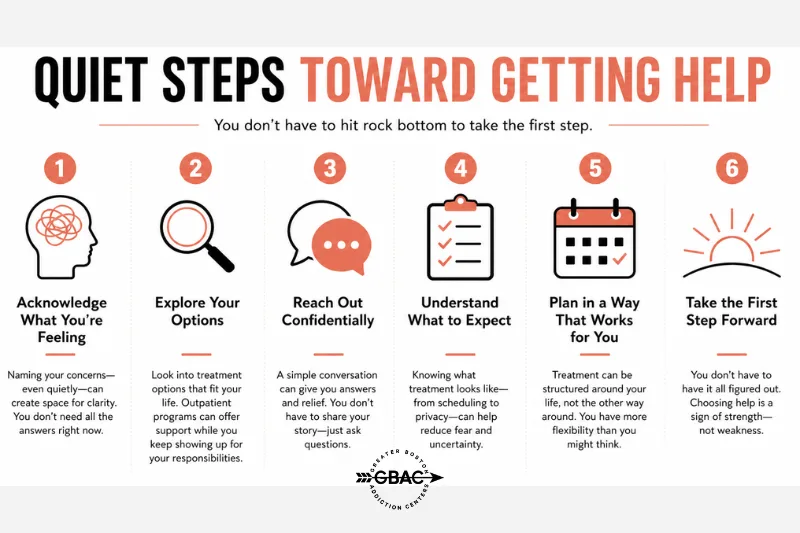
A Quiet Next Step Can Still Be a Powerful One
You don’t have to announce anything.
You don’t have to commit to a full plan today.
But you can take one step that no one else sees.
Call. Ask questions. Learn what your options actually look like.
Because the truth is—this doesn’t stay quiet forever.
But getting help? That can be done on your terms.
Call 877-920-6583 or visit our heroin addiction treatment services to learn more about our Heroin addiction treatment services.
